

More news on this day
Thousands of air travelers across China have been stranded this week as a wave of delays and cancellations at major hubs from Beijing to Guangzhou disrupts one of the world’s busiest aviation markets.
Get the latest news straight to your inbox!
Severe Weather and System Strain Converge
Published coverage and live flight-tracking data indicate that a fresh round of storms and poor visibility has collided with already stretched airport operations, triggering large-scale disruption at key Chinese gateways. On April 1, 2026, reporting from industry-focused outlets pointed to nearly 8,500 delayed or canceled flights nationwide, with the bulk concentrated at Guangzhou, Shenzhen, Shanghai and Beijing.
Travel and aviation reports describe Guangzhou Baiyun, Shenzhen Bao’an, Shanghai Hongqiao and Shanghai Pudong among the worst hit, with hundreds of flights delayed at each airport and dozens canceled outright. Additional knock-on disruption has been reported in Chengdu, Chongqing, Wuhan and other inland hubs, underlining how quickly weather events in China’s coastal and southern regions can ripple across the country’s dense air network.
Observers note that China’s rapid rebound in air travel has left limited slack in the system. With passenger volumes already running at or above pre-pandemic levels on many domestic routes, even routine thunderstorms or low cloud ceilings can cascade into extensive queues for takeoff and landing, tighter air traffic management windows and aircraft and crews trapped out of position.
Operational analysts point out that China’s airspace structure, including significant zones reserved for non-civil use, can magnify the effect of storms and low visibility. When weather forces rerouting or holding patterns around major hubs, there are fewer alternative corridors available, and congestion builds quickly both on airport ramps and in surrounding airspace.
Major Hubs Log Hundreds of Delays in a Day
Data summarized by travel industry outlets this week show that Guangzhou Baiyun International Airport has recorded some of the heaviest disruption, with close to 1,000 delays and more than 100 cancellations in a single day during the latest wave of storms. Shenzhen Bao’an International Airport has reported a similar pattern, with hundreds of delayed departures and arrivals compounding an already busy schedule of domestic and regional services.
Shanghai’s twin airports, Hongqiao and Pudong, have also experienced extensive delays. Reports indicate that more than 650 flights at the two airports were delayed or canceled during one peak disruption day, affecting both short-haul domestic routes and long-haul international services. Congestion at Shanghai’s hubs has a particularly wide impact, because many connecting itineraries between northern and southern China, as well as regional links into East and Southeast Asia, pass through the city.
Beijing’s Capital and Daxing airports, while slightly less affected than southern hubs in some recent weather episodes, have still logged hundreds of delayed flights and several dozen cancellations in aggregate. As key bases for Air China and other large carriers, irregular operations at these airports can quickly spill into secondary cities when aircraft and crews fail to return to their scheduled rotations on time.
Compounding the strain, smaller but strategically important airports such as Hangzhou, Nanjing, Chongqing, Kunming and Wuhan have reported steady streams of delays. Although each airport may post fewer cancellations than the largest hubs, collectively they contribute to a nationwide pattern of missed connections, overnight stranding and last-minute rebooking pressure on airlines and ground handling teams.
Passengers Face Long Queues and Limited Options
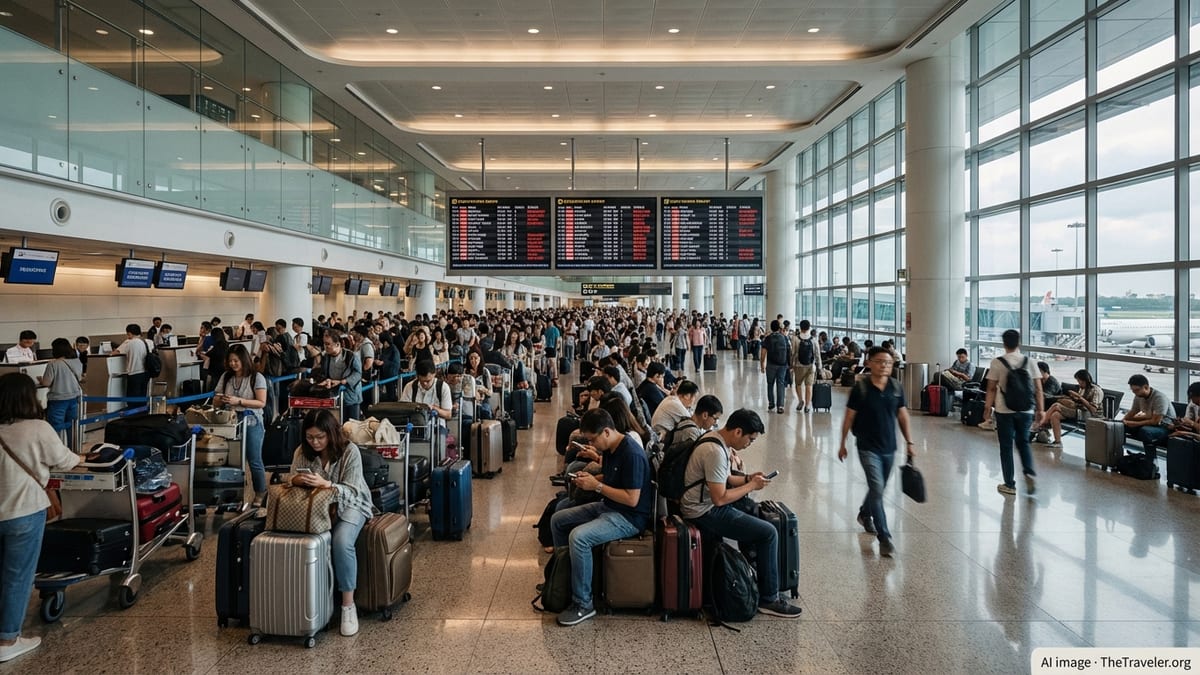
Anecdotal accounts circulating on Chinese social media platforms, along with descriptions in domestic and international media, depict crowded terminals where travelers queue for hours at check-in counters and customer service desks seeking new itineraries. In several major airports, departure boards have shown rows of flights marked late or with estimated times repeatedly pushed back, while gate changes add another layer of confusion for passengers unfamiliar with large terminal layouts.
Publicly available information on consumer experiences suggests that the heaviest burden falls on travelers with tight connections or limited flexibility in their plans. Families returning from holiday, migrant workers heading back to job sites after the Spring Festival period and small-business travelers working across multiple cities are among those most affected when itineraries unravel in real time.
Reports indicate that hotel capacity near major airports in Guangzhou, Shanghai and Shenzhen has been strained during the worst evenings of disruption, pushing some passengers to seek accommodation well into city centers or to sleep in terminal waiting areas. Travel insurance and credit card protection can help cover out-of-pocket costs, but coverage details vary widely by policy, leaving many travelers reliant on airline goodwill or personal funds.
Travel advisories and industry commentary emphasize the importance of real-time monitoring of flight status through official airline apps and airport information systems. In China’s fast-moving aviation environment, gate and timing changes may be updated digitally first, long before printed signage or public announcements catch up, making mobile access especially valuable for minimizing missed opportunities to rebook.
Broader Context: A Surging but Vulnerable Aviation Market
The current wave of disruptions comes against the backdrop of sustained growth in China’s civil aviation sector. Recent statistics from the country’s aviation authorities, cited in domestic media, show that passenger trips during the 2026 Spring Festival travel rush surpassed 94 million, setting fresh records and underscoring the scale of demand now flowing through the network.
China’s major carriers and airport operators have been racing to add capacity, new routes and upgraded facilities to keep pace. Construction has accelerated on new infrastructure in the Pearl River Delta and other key regions, while existing hubs in Beijing, Shanghai, Guangzhou and Chengdu continue to invest in additional gates, taxiways and terminal expansions designed to smooth future peak traffic.
At the same time, analysts and policy-focused publications highlight that more traffic also means heightened exposure to disruption. Weather events, air traffic control restrictions, technical issues and geopolitical factors can all trigger sudden bottlenecks. When flights are tightly scheduled and load factors are high, recoveries become more complex, and passengers feel the impact more acutely.
Aviation specialists point to international experience showing that large, rapidly growing markets must continually refine coordination among airlines, airports and regulators to manage surges and shocks. The latest turbulence across China’s hubs is being watched as a case study in how a maturing aviation giant balances growth ambitions with the need for resilience in the face of increasingly frequent operational stress tests.
What Travelers Can Do Right Now
Travel guidance compiled by consumer and aviation outlets suggests that passengers scheduled to pass through China’s busiest airports in the coming days should build extra time into their journeys and be prepared for schedule changes, particularly on routes connecting through Guangzhou, Shenzhen, Shanghai and Beijing. Same-day tight connections are currently considered risky on itineraries that require terminal changes or re-clearing security.
Experts recommend that travelers check flight status multiple times in the 24 hours before departure, confirm that the airline has up-to-date contact details and monitor mobile notifications closely. In many recent disruption cases, rebooking options, digital meal vouchers or hotel arrangements have first appeared inside airline apps or text messages rather than at physical counters.
Passengers are also encouraged to review the terms of their tickets, including fare class flexibility and any change-fee waivers that carriers may introduce during extended periods of operational difficulty. While China does not apply the same compensation framework as regions such as the European Union, publicly available information shows that airlines operating in the country often offer date changes or alternative routings at reduced or no additional cost during severe disruptions.
For travelers already stranded, consumer advocates suggest documenting expenses, keeping boarding passes and delay notifications, and seeking written confirmation of any changes made to itineraries. These records can be useful when pursuing refunds, travel insurance claims or future goodwill gestures once the immediate chaos at China’s major hubs begins to ease.