

More news on this day
Flight delays are rippling across the United States in early April 2026, as a volatile mix of spring weather, record holiday demand and capacity constraints batters operations at six of the country’s busiest hubs.
Get the latest news straight to your inbox!
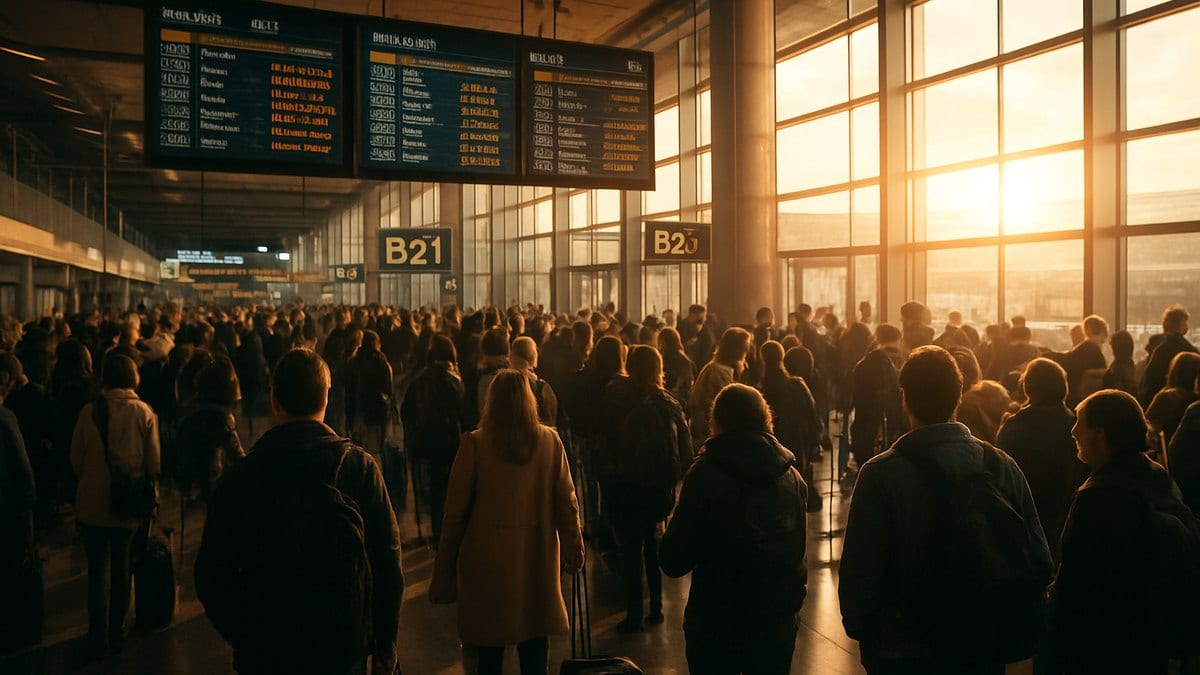
Six Hubs at the Center of a Strained Network
Publicly available flight-tracking tallies for the first week of April point to heavy disruption at Atlanta, Chicago O’Hare, Dallas Fort Worth, New York’s LaGuardia, Los Angeles International and Denver, with each airport recording several hundred delays on peak days. Coverage from aviation data services and travel news outlets indicates that these hubs routinely sat near the top of national delay rankings as Easter travel and spring break traffic overlapped.
Reports on the Easter weekend travel period show Chicago O’Hare emerging as one of the hardest-hit hubs, logging more than 260 delays and dozens of cancellations on a single April day as unstable weather lingered over the upper Midwest. At the same time, Atlanta and Dallas Fort Worth contended with thunderstorms and congestion that slowed departures across busy southeastern and central corridors, while New York’s LaGuardia and Los Angeles International struggled with a combination of volume, low clouds and airspace constraints.
Denver, which had already weathered significant snow-related disruption in March, saw additional knock-on delays as unsettled early April conditions moved across the Rockies and Plains. When any one of these hubs faltered, downstream airports felt the effects, since the six together anchor some of the most heavily traveled domestic and transcontinental routes in the U.S. system.
Data aggregated by consumer-rights and travel advisory platforms suggest that on several early April days, total U.S. delays climbed into the low thousands, with a large share traceable to operations at, or flowing through, these six airports. For travelers, the result was long lines, rolling departure pushes and missed connections, even when skies appeared relatively clear at their departure point.
Weather Volatility Collides With Holiday Demand
Meteorological summaries for late March and early April describe a series of fast-moving frontal systems sweeping across the central and eastern United States, generating thunderstorms, low ceilings and pockets of heavy rain just as Easter and spring break travel peaked. Forecast discussions from early April highlight below-normal temperatures and unsettled conditions over parts of the Midwest and Northeast, matching the pattern of delays seen at Chicago, New York and Denver.
In Florida and the Southeast, lingering storm energy and saturated ground from earlier severe weather episodes led to repeated traffic-management programs around key waypoints, which in turn constrained arrival and departure rates for flights headed to and from Atlanta and Dallas Fort Worth. Travel industry coverage of network performance in this period notes that even short-lived ground stops at one southeastern hub were enough to push delays well past the 45-minute mark for later waves of flights.
On the West Coast, marine layers around Los Angeles triggered instrument-approach operations and reduced spacing between aircraft, a familiar but still disruptive pattern during shoulder seasons. Aviation briefings from April 8 reference proposed ground delay programs at San Francisco and continuing flow restrictions into California airspace, creating further pressure on transcontinental services linking Los Angeles with New York, Chicago and Atlanta.
With passenger volumes on U.S. carriers projected modestly above last year’s record levels for the March to April period, according to trade group estimates cited in recent travel coverage, the timing of these weather systems left the network with little slack. Flights were heavily booked, leaving airlines with limited room to re-accommodate passengers when storms or low visibility forced cancellations at a major hub.
Structural Bottlenecks: Staffing and Runway Capacity
Beyond the weather, federal workforce statistics and industry analysis point to underlying structural issues that magnified early April’s disruption. A recent review of air traffic control staffing levels indicates the Federal Aviation Administration is operating with roughly 10,800 fully certified controllers against an internal target near 13,800, a shortfall of almost 3,000 personnel. That gap is particularly acute at busy terminal radar facilities handling New York and Southern California airspace.
Records from the national Air Traffic Control System Command Center, summarized in specialized aviation publications, show that ground delay programs were in place for New York-area facilities on a significant share of days in March, with average holds often running from 45 minutes to more than two hours. When similar constraints appeared again around Easter and into early April, LaGuardia and its connecting hubs at Chicago, Atlanta and Dallas Fort Worth felt the cumulative strain.
Runway and airfield projects are also limiting flexibility. In San Francisco, for example, publicly available operational notices show reduced arrival rates tied to runway work and enhanced safety procedures, slowing the flow of transcontinental traffic and tightening the margins for schedule recovery at West Coast gateways. Los Angeles has faced its own capacity pressures as carriers add more widebody and high-frequency narrowbody flights into already saturated banks.
Academic work analyzing delay causation across more than a decade of Bureau of Transportation Statistics data suggests that, at large hubs, delays often stem from a complex blend of weather, airspace management, late-arriving aircraft and security screening impacts rather than a single factor. The early April pattern across the six major hubs appears to fit that multi-causal profile, with each constraint amplifying the others when demand peaks.
How Delays Spread Across the National Grid
Operational data and modeling studies show that delays at major hubs tend to propagate quickly along route networks. Aircraft scheduled for tight turnarounds at Atlanta, Chicago or Dallas Fort Worth can depart late after arriving from a storm-affected area, immediately pushing subsequent flights behind schedule. As this process repeats throughout the day, small initial disruptions evolve into widespread late-evening delays thousands of miles from the original weather event.
Consumer-rights platforms tracking United States disruptions in early April describe days when one carrier alone reported more than 800 delays and several dozen cancellations, with the bulk concentrated at its largest hubs. Separate reporting highlights another major airline recording close to 1,000 delays at airports including Chicago, Los Angeles and New York during the height of the April 3 disruption window, underlining how quickly problems at a handful of facilities can cascade across the system.
Network-focused datasets developed by researchers emphasize the role of shared aircraft and crew assignments in this cascade. When a single aircraft is scheduled to operate multiple segments between the six affected hubs in one day, a delay on the first leg can ripple through every subsequent sector. With early April loads running high, reassigning aircraft or crews was more difficult, prolonging the recovery period after each bout of severe weather.
These dynamics help explain why passengers in smaller cities far from storm zones reported significant delays and missed connections during the same period. Flights from regional airports often rely on inbound aircraft from Atlanta, Chicago, Dallas, Denver, Los Angeles or LaGuardia, leaving local schedules vulnerable to bottlenecks and flow restrictions hours earlier in the day.
What Travelers Can Expect for the Remainder of April
Seasonal outlooks issued in early April anticipate a mixed pattern for the rest of the month, with additional chilly snaps and scattered storm systems likely across parts of the northern and eastern United States, alongside generally warming conditions elsewhere. That suggests the potential for renewed weather-related slowdowns at hubs such as Chicago, New York and Denver, even as Easter and spring break volumes gradually ease.
Travel advisories from tour operators and airline-focused publications are encouraging passengers to build more buffer time into itineraries, particularly when connecting through the six most-affected hubs. Common recommendations include choosing earlier departures, allowing longer layovers, and favoring nonstop flights when possible to reduce exposure to delay-prone connection points.
Analysts note that while airlines are working to balance schedules and gradually add resilience, structural constraints such as air traffic control staffing will take years to resolve fully. Until then, episodes like the early April 2026 disruption are likely to recur during peak travel periods, especially when fast-changing weather patterns intersect with already crowded skies over Atlanta, Chicago, Dallas, New York, Los Angeles and Denver.
For now, publicly available performance data and recent coverage suggest that travelers passing through these hubs in the coming weeks should remain prepared for periodic delays, closely monitor flight status tools and consider contingency plans in case a single storm cell or airspace restriction once again ripples across the national aviation grid.