

More news on this day
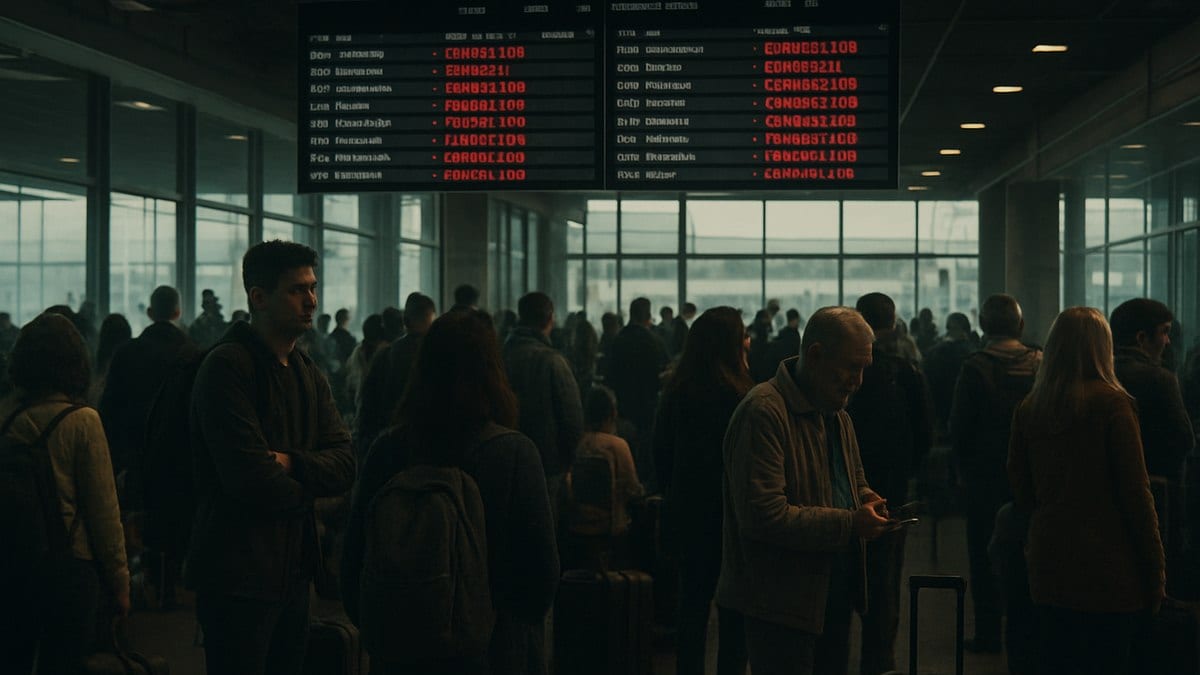
Flight delays are inflicting an estimated annual burden of around $34 billion on the global aviation system, as disruption-related costs for airlines, passengers and national economies rise alongside record demand for air travel.
Get the latest news straight to your inbox!
A Growing Global Price Tag for Disruption
Recent industry and academic analyses indicate that delays and related disruptions now represent one of the largest hidden costs in commercial aviation. In the United States alone, publicly available studies have placed the annual economic impact of flight disruptions in the range of 30 billion to 34 billion dollars in recent years, once lost productivity, missed connections, crew and fuel costs, and knock-on effects across the wider economy are taken into account. Comparable modeling for Europe has pointed to multi‑billion‑euro annual losses tied specifically to air traffic management and airport congestion.
Global estimates vary by methodology, but several reports suggest that when similar dynamics are extrapolated worldwide, delay costs for airlines and passengers are comfortably in the tens of billions of dollars each year. Some research that aggregates primary delay, reactionary knock‑on disruption and schedule padding concludes that total global delay costs, including outside the passenger market, are well above 100 billion dollars annually. Within that broader figure, roughly 34 billion dollars can be attributed to the commercial passenger system’s recurring pattern of late departures, missed slots and cascading cancellations.
These figures capture a structural problem that has persisted even as the industry has emerged from the pandemic downturn. Traffic growth, chronic bottlenecks at key hubs, labor shortages across airports and air traffic control, and increasingly volatile weather patterns have combined to keep delay indicators elevated relative to pre‑2019 benchmarks. The rebound in travel demand has delivered record revenues for airlines, but it has also magnified the cost of every minute that aircraft, crews and passengers are left waiting.
Analysts note that the burden is not evenly distributed. Markets with dense hub‑and‑spoke networks and constrained airport capacity, such as the United States and parts of Europe, bear a disproportionate share of global delay costs, while point‑to‑point carriers in less congested regions tend to be more resilient. Yet even in those markets, a single major disruption, such as a systems outage or airspace closure, can generate hundreds of millions of dollars in losses within days.
Who Pays: Airlines, Passengers and the Wider Economy
Behind the headline global figure, the economic burden of delays is split between airlines, travelers and the broader economy. Airlines incur direct operational expenses when flights run late: additional fuel burned during holding patterns and extended taxi times, crew overtime and repositioning, aircraft rescheduling, maintenance reslotting and ground handling overtime. Airlines also absorb accommodation and rebooking costs when passengers misconnect or when services are canceled and must be consolidated.
For passengers, recent analyses of U.S. and European data show that lost time and disrupted plans account for a significant share of the total cost. Researchers have used value‑of‑time models to estimate how much a delayed hour is worth to travelers and then applied those values across the hundreds of millions of delay‑affected journeys recorded annually. The resulting figures routinely run into the tens of billions of dollars, suggesting that passengers collectively may shoulder as much or more of the true economic impact as the carriers themselves through missed work, forfeited reservations and foregone economic activity.
There is also a wider macroeconomic dimension. When flights run late at scale, business meetings are postponed, cargo connections are missed, tourism receipts are lost and airport retail spending patterns shift. Some studies have found that spending in terminal stores and restaurants drops as delays keep passengers stranded at gates rather than circulating in commercial areas, while destination economies lose high‑value visitors whose itineraries are shortened or canceled altogether. Over a full year, these indirect effects add billions more to the global tally.
Regulatory frameworks influence how these costs are shared. In the European Union, passenger rights rules require airlines to provide care and, in many cases, fixed compensation for long delays and cancellations that are considered within the carrier’s control. Industry data from recent years suggest that compliance with such schemes already costs European airlines several billion euros annually. In other jurisdictions, including the United States, compensation policies are more limited, which shifts a greater proportion of the financial burden toward passengers and third‑party travel providers.
Root Causes: Capacity, Weather and System Complexity
Published operational data and independent assessments point to a familiar set of root causes behind the growing economic toll of delays. Capacity constraints at busy hubs and in saturated airspace corridors remain a central issue. Air traffic control systems in several regions are operating near practical limits at peak times, leaving little margin to absorb surges in demand, weather deviations or staffing shortfalls without knock‑on impacts across entire networks.
Weather continues to be a significant and, in many markets, worsening driver of disruption. Heat waves, severe storms, wildfire smoke and other climate‑linked phenomena have led to more frequent ground stops, diversions and reroutings, increasing fuel burn and pushing schedules off track. Because primary weather delays often trigger reactionary delays as aircraft and crew rotations fall behind, the economic effect multiplies beyond the original event.
Staffing imbalances in critical roles add another layer of vulnerability. Airlines, airports and navigation service providers in North America and Europe have reported persistent shortages of pilots, ground handlers, technicians and controllers since the pandemic. Training pipelines and certification processes make it difficult to adjust staffing rapidly as demand recovers, leaving operators with thinner buffers to cope with spikes in traffic or localized disruptions.
Finally, the sheer complexity and interdependence of modern airline networks magnify the impact of any disturbance. Hub‑and‑spoke systems concentrate passengers and aircraft at a small number of major nodes, creating efficiency in normal operations but also creating conditions in which a single outage or bottleneck can ripple through hundreds of downstream flights. As digital systems become more central to scheduling, crew management and passenger servicing, technology failures can quickly translate into large‑scale economic losses.
Environmental and Consumer-Protection Dimensions
The financial burden of delays sits alongside growing concern about environmental impacts. Analyses of 2022 and 2023 disruption patterns in major markets have suggested that delay‑related holding, rerouting and ground‑idling are responsible for a measurable share of the sector’s carbon emissions. Extra fuel burned while aircraft wait for departure slots or circle congested airports adds to carriers’ costs and undermines efforts to meet long‑term decarbonization commitments.
At the same time, consumer advocates argue that recurring delays erode public confidence in air travel and weaken the perceived value of ticket purchases. Complaints filed with regulators in North America and Europe commonly cite lack of timely information, difficulty securing rebooking or refunds, and inconsistent accommodation support after major disruptions. These experiences translate into reputational risks for airlines and airports, reinforcing the economic case for reducing delays beyond the immediate operational savings.
Policymakers have responded with a mix of regulatory pressure and infrastructure planning. Passenger rights regimes, minimum service standards and transparency requirements for on‑time performance are becoming more common, placing a clearer onus on carriers and airports to manage disruption. At the same time, governments and industry groups are promoting upgrades to air traffic management, airport capacity expansions, and adoption of digital tools that can improve forecasting, slot allocation and disruption recovery.
Environmental policy is also intersecting with the delay debate. As emissions pricing and sustainability reporting frameworks expand, airlines face stronger incentives to cut avoidable fuel burn associated with congestion and holding patterns. This has pushed carriers to experiment with more dynamic flight planning, continuous descent and climb operations, and closer coordination with air navigation providers to reduce airborne waiting times.
Investment, Technology and the Outlook for Travelers
Industry forecasts suggest that, absent significant investment, the economic cost of delays could continue to rise as passenger volumes grow through the 2030s. Some global outlooks produced in late 2025 estimate that labor, fuel and infrastructure constraints will remain pronounced for several years, keeping pressure on punctuality in both mature and emerging markets. In that context, reducing the roughly 34 billion‑dollar annual delay burden has become a strategic priority for airlines, airports and regulators.
Technology providers and operators are promoting a new generation of disruption‑management platforms that use real‑time data feeds, predictive analytics and automation to reassign aircraft, crews and passengers more efficiently when schedules begin to slip. Early adopters report improved recovery times after storms or system outages, along with more targeted spending on hotels and rebooking. However, experts caution that software alone cannot compensate for chronic under‑investment in physical capacity and staffing.
For travelers, the practical implications are likely to be felt most in how disruption is handled rather than in the complete elimination of delays. Airlines in several major markets are expanding proactive notification systems, same‑day rebooking options and digital self‑service tools that allow passengers to adjust itineraries rapidly when irregular operations occur. Some carriers and airports are also experimenting with closer integration of rail links and alternative transport to provide additional resilience on high‑frequency corridors.
Even with these initiatives, the underlying economic calculus remains stark. Each delayed departure represents more than an inconvenience: it is a quantifiable hit to airline profitability, passenger welfare and national output. As global air traffic continues to climb, the extent to which the industry can bring that 34 billion‑dollar annual burden under control will shape both the traveler experience and aviation’s broader economic contribution in the decade ahead.