

More news on this day
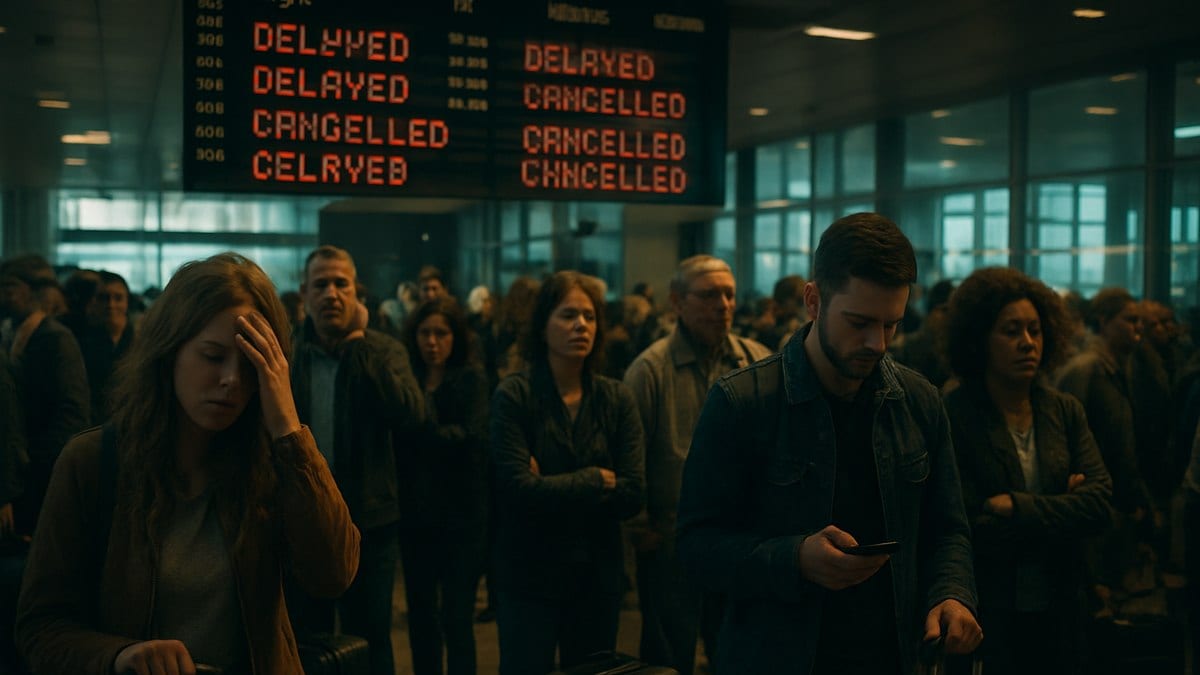
Flight disruptions that once appeared as isolated holiday glitches are increasingly exposing a deeper, multi‑billion dollar structural crisis in global aviation, with recent analyses putting the economic hit from delays and cancellations in the United States alone at up to 34 billion dollars annually.
Get the latest news straight to your inbox!
A Growing Economic Drag Behind Every Delay
Recent industry and government-supported research on the cost of flight disruption in the United States suggests that delayed and cancelled flights generated an economic impact of 30 to 34 billion dollars in a single year, even before accounting for knock-on effects in other regions. This tally includes direct airline operating expenses, compensation and rebooking costs, as well as the value of passengers’ lost time and broader spillover impacts on hotels, rental cars, and local businesses.
These figures align with wider findings shared by aviation data firms, which describe a post-pandemic environment where disruption has become a persistent feature of air travel rather than an occasional shock. Analysts note that while passenger volumes have largely recovered and in some markets exceeded 2019 levels, the capacity of fleets, crews, airspace and airport infrastructure has not kept pace, creating a fragile system where small incidents cascade quickly into large-scale gridlock.
For travelers, this structural fragility translates into rising odds of missed connections, overnight airport stays and lost baggage. For airlines and airports, it represents a steady erosion of margins, with operational buffers consumed by contingency staffing, spare aircraft positioning and growing compensation claims. The 34 billion dollar estimate underscores how disruption is no longer a side effect of aviation, but a central economic and operational challenge.
Environmental impacts add another layer to the tally. Studies submitted to US regulators and summarized in industry reporting indicate that flight disruptions generate millions of tons of additional carbon emissions each year, as aircraft are rerouted, held in extended ground or air queues, or repositioned empty to recover schedules. That reality complicates carriers’ climate commitments and raises questions about how a system under chronic stress can deliver on long-term decarbonization goals.
Supply Chain Bottlenecks and Aging Fleets
At the heart of the crisis is a supply chain still struggling to recover from pandemic-era shutdowns and subsequent geopolitical shocks. A joint analysis by the International Air Transport Association and consultancy partners estimates that supply chain problems alone will impose more than 11 billion dollars in extra costs on airlines in 2025, largely because aircraft and engines are not being delivered or repaired fast enough to meet demand.
Publicly available financial outlooks from IATA describe record backlogs for new aircraft, with the global commercial order book stretching well beyond 17,000 units. Aircraft manufacturers and engine makers are contending with shortages in skilled labor, specialized materials and critical components, extending maintenance turnaround times and forcing airlines to keep older jets in service longer than planned. Industry briefings show that the delayed fuel-efficiency gains from these newer models account for a substantial share of the forecast 11 billion dollar hit, as carriers burn more fuel and pay higher carbon costs operating aging fleets.
For airport planners and network schedulers, the ripple effects are clear. When a single grounded aircraft can unravel rotations across several hubs, the lack of spare capacity in fleets becomes a primary driver of cancellations. Airlines that try to build resilience by leasing additional aircraft or holding more spare parts face sharply higher costs, from elevated leasing rates to inventory tied up in warehouses rather than earning revenue in the sky.
These bottlenecks are structural, not cyclical. Industry forecasts point to several years of constrained aircraft and engine supply, suggesting that disruption risk is effectively “baked in” to flight schedules. Unless production, maintenance capacity and certification pipelines expand more quickly, the 34 billion dollar disruption bill seen today may prove a baseline rather than a peak.
Labor Shortages, Regulation and the Human Factor
Beyond machinery and parts, the people who keep aviation running are in short supply. Surveys and economic outlooks from IATA and other industry bodies highlight a global shortage of pilots, air traffic controllers, and licensed technicians. Training bottlenecks mean it can take 18 to 24 months or more to add new skilled workers, leaving airlines and service providers competing for a limited pool of talent.
As carriers rebuild schedules, this labor squeeze manifests in thinner margins for error. A wave of sick calls, a localized weather event or an unexpected technical failure can rapidly exhaust available crew reserves, triggering rolling cancellations. In some jurisdictions, the introduction of stricter crew duty-time rules and fatigue protections in recent years has further constrained scheduling flexibility. Analysts tracking high-profile disruption events, such as the mass cancellations at a major US low-cost carrier in late 2022, note that legacy crew-planning systems and underinvestment in staffing and technology have magnified these regulatory shifts.
Strikes and industrial action have also become a recurring feature in the past two years, with pilots, cabin crew and ground handlers pushing for wage increases to match inflation and address workload concerns. Financial outlooks for 2024 and 2025 highlight “intense salary pressure” and one-off labor dispute costs as notable headwinds, even as airlines return to profitability. Each strike not only halts flights for days at a time but also exposes how lean staffing models and rigid rostering tools can turn a labor negotiation into a network-wide crisis.
For passengers, the human factor is most visible at airport chokepoints. Security queues, border control lines and baggage handling operations remain vulnerable to staffing gaps, particularly during peak travel seasons. Industry reporting shows that even as airlines fine-tune their schedules, mismatches between airport staffing levels and traffic peaks can prompt last-minute flight caps or schedule reductions, reinforcing the perception that the system cannot reliably cope with demand.
Geopolitical Shocks and a Fragile Global Network
Compounding these structural weaknesses are a series of geopolitical shocks that have reconfigured global airspace. The ongoing conflict involving Iran and its regional neighbors, for example, has led to the closure or restriction of key corridors linking Europe, Asia and parts of Africa. Public analyses of the conflict’s economic impact note that several major Middle Eastern hubs handling a significant share of global traffic have faced temporary closure or capacity limits.
Airlines have responded by rerouting flights along longer, more circuitous paths that avoid affected airspace. These diversions add hours to flight times in some cases, increase fuel burn, and strain crew duty limits, raising the risk of additional unscheduled stops, missed connections and cancellations. Even carriers not flying directly over the conflict zones are indirectly affected by congestion in alternative corridors and the knock-on impact on aircraft and crew rotations.
Recent global IT outages have further underscored the vulnerability of aviation to external shocks. In July 2024, a software update issue at a major cybersecurity provider triggered worldwide technology failures that disrupted airline check-in, crew scheduling and airport operations. Coverage of the event documented thousands of cancellations and delays, with some airlines taking days to fully restore normal operations, highlighting legacy dependencies on centralized, non-redundant systems.
These episodes illustrate that the 34 billion dollar disruption burden is not a simple byproduct of bad weather or seasonal peaks. Instead, they reveal an interconnected network where security, cyber resilience and geopolitical stability now rank alongside fuel prices and demand trends as key determinants of aviation reliability and cost.
Underinvestment in Infrastructure and the Passenger Experience
Behind the operational flashpoints lies a longer-running concern: chronic underinvestment in aviation infrastructure. An assessment by airport industry groups of the US network alone identified a double-digit billion dollar annual shortfall in funding for terminals, runways and supporting systems. Projections suggest that if this gap persists over the next decade, the cumulative impact on airlines, regional economies and travelers will run into the hundreds of billions of dollars.
In Europe, network performance reports from regional air traffic management bodies point to persistent capacity constraints in crowded airspace and at major hubs. Controllers and infrastructure operators are grappling with rising traffic levels and the need to integrate new types of airspace users, from business jets to drones, without the full benefit of modernized systems. The result is a pattern of en route delays and slot restrictions that feeds directly into the disruption statistics.
For passengers, these systemic issues materialize in the form of longer queues, cramped terminals and increasingly frequent schedule reshuffles. Industry commentary notes that many airports are relying on temporary fixes such as pop-up security lanes, expanded use of remote stands and ad hoc terminal reallocations rather than fully funded, long-horizon expansion projects. While digital tools and automation have improved elements of the journey, they have not fully offset the pressure created by physical capacity limits.
As global aviation edges toward the symbolic one trillion dollar revenue mark, the contrast between headline financial growth and the unresolved 34 billion dollar disruption bill is becoming harder to ignore. Analysts argue that without coordinated investment in fleets, people, infrastructure and resilience, the industry risks normalizing a level of unreliability that undermines public confidence and constrains future growth, even as travelers continue to fill planes.