

More news on this day
Thousands of air travelers across the United States are facing disrupted plans as Charlotte Douglas International Airport reports dozens of cancellations and hundreds of delays involving major carriers American Airlines, Delta Air Lines, Southwest Airlines, and Spirit Airlines, snarling connections to major cities including New York, Los Angeles, Chicago, and Miami.
Get the latest news straight to your inbox!
Operational Snarls Hit Major Carriers at a Key Hub
Publicly available tracking data for Sunday indicates that Charlotte Douglas International Airport has recorded 53 flight cancellations and around 290 delays, affecting a mix of departures and arrivals. The disruptions are concentrated among large domestic carriers, with American Airlines, Delta Air Lines, Southwest Airlines, and Spirit Airlines all showing elevated irregular operations on their Charlotte schedules.
Charlotte functions as a critical connecting hub in the U.S. air network, particularly for American Airlines, which operates a substantial share of the airport’s daily flights. When operations at Charlotte slow, misalignments quickly cascade across the system, leaving passengers stranded far from the Carolinas as aircraft and crew fail to reach their next legs on time.
Tracking services and airline status pages show that the combined tally of cancellations and late departures at Charlotte is significantly higher than on an average spring Sunday. While the raw number of 53 cancellations is modest compared with past nationwide meltdowns, the concentration at a single hub amplifies the impact on travelers attempting to move between major coastal and Midwest cities.
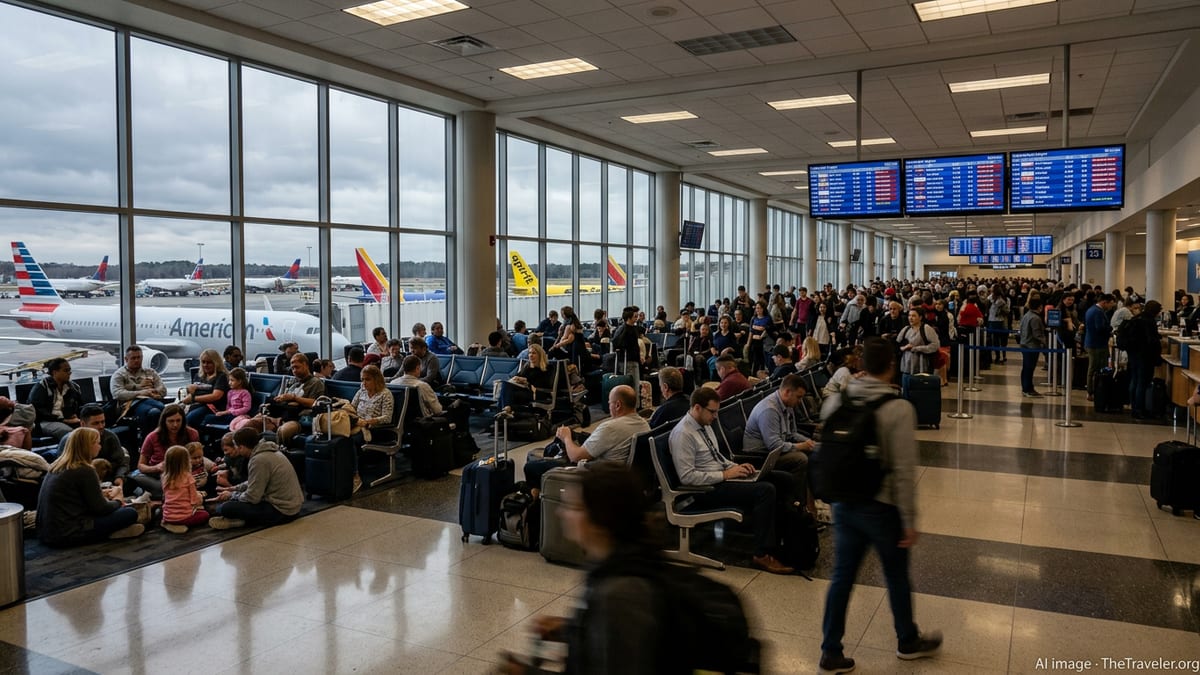
For affected passengers, the numerical totals translate into long lines at rebooking counters, crowded gate areas, and uncertainty over when alternate flights will become available. The disruptions come amid a broader period of strain for U.S. airlines, which have faced a series of weather events, system issues, and crew shortages over recent months.
Ripple Effects on New York, Los Angeles, Chicago, and Miami
Published flight schedules and recent performance data underscore how delays at Charlotte can quickly spread to other major metropolitan areas. Charlotte is a key connector to New York–area airports, as well as to Chicago, Los Angeles, and Miami. When a bank of flights at the hub falls behind schedule, onward departures to those cities often depart late or are canceled outright if aircraft and crews are out of position.
Routes linking Charlotte with New York and Chicago are particularly sensitive, as they serve large numbers of connecting passengers heading onward to additional domestic and international destinations. A cancellation between Charlotte and New York, for example, can strand travelers connecting to Europe or to smaller regional airports across the Northeast and Mid-Atlantic, while disruptions on Charlotte–Chicago services can block access to the Upper Midwest and West.
Los Angeles and Miami, meanwhile, function as major gateways to the West Coast and Latin America. Disruptions on Charlotte–Los Angeles flights can lead to missed connections up and down the Pacific Coast, while interruptions to Charlotte–Miami services can complicate trips to the Caribbean and South America. Recent disruption analyses have highlighted how even small percentages of canceled flights at large hubs can result in millions of passenger delay hours over the course of a year.
On Sunday, the combination of delays and cancellations at Charlotte is contributing to rolling knock-on effects, with some later flights from New York, Chicago, Los Angeles, and Miami also departing behind schedule as airlines work aircraft and crews back into their planned rotations.
Weather, Congestion, and System Strain Behind the Disruption
Recent weeks have seen multiple severe winter storms and bouts of turbulent weather sweep across parts of the United States, forcing airlines to thin schedules, reroute aircraft, and extend crew duty days. Coverage of recent winter systems shows that carriers have canceled thousands of flights nationally in order to maintain safety margins and manage the limits of their fleets and staff.
While specific causes for each individual cancellation at Charlotte on Sunday vary, publicly available information points to a familiar mix of contributing factors: residual schedule disruptions from previous storms, tight aircraft utilization, and congested airspace along the busy East Coast corridor. When earlier flights are delayed by weather or traffic management programs, the aircraft scheduled to operate later Charlotte departures can arrive hours behind schedule, leaving airlines little flexibility.
Industry data compiled in recent disruption reports has identified Charlotte Douglas, along with airports in New York, Chicago, Los Angeles, and Miami, as among the nation’s most delay-prone hubs. High traffic volumes, complex runway configurations, and frequent weather challenges make it difficult for carriers to recover quickly once operations slip, especially on peak travel days.
As a result, Sundays and Mondays often see a backlog of disrupted itineraries as airlines attempt to reposition planes and crews to where they are needed most. The current wave of cancellations and delays at Charlotte fits into that broader pattern of network stress, where a series of compounding factors leads to visible effects for passengers at gates around the country.
Impact on Travelers: Missed Connections and Overnight Stays
For travelers, the immediate consequences of the Charlotte disruptions are being felt not only in North Carolina but also in busy terminals from New York to Los Angeles. Passengers whose itineraries rely on a Charlotte connection are experiencing missed onward flights, involuntary overnight stays, and reroutings that add hours to already long travel days.
Social media posts and traveler forums on Sunday describe scenes of crowded concourses and long customer service queues, with some passengers reporting multiple rolling delays before receiving final cancellation notices. In many cases, rebooking options are limited, particularly on high-demand routes into and out of New York, Chicago, Los Angeles, and Miami, where remaining seats can fill quickly during irregular operations.
Standard airline policies typically provide rebooking on the next available flight and, in certain circumstances, meal or accommodation vouchers, but the exact level of support varies depending on the cause of the disruption and the carrier involved. Passengers affected by the Charlotte issues are being encouraged by consumer advocates to monitor their flight status closely, use airline apps to rebook when possible, and retain documentation of expenses incurred while stranded.
For some travelers, particularly those with tight onward connections or cruise departures from Miami or Los Angeles, the compounding delays can translate into missed vacations or important events. The experience echoes earlier high-profile meltdowns at U.S. carriers in recent years, when large numbers of passengers were left sleeping in terminals as airlines struggled to stabilize schedules.
Charlotte’s Growing Role and What Comes Next
Charlotte Douglas International has grown significantly over the past decade, emerging as one of the busiest airports in the United States by passenger numbers. Published traffic statistics list it among the top connecting hubs in the country, with heavy volumes on routes linking it to New York, Chicago, Miami, and other major cities. That growth has brought economic benefits to the region but has also heightened the stakes when operations falter.
Recent government and industry reports on U.S. flight performance indicate that large hub airports are bearing the brunt of nationwide congestion, with Charlotte ranked among facilities where delays contribute disproportionately to total passenger wait times. As airlines continue to rebuild networks and adjust to shifting travel patterns, the balance between maximizing aircraft utilization and preserving operational resilience remains a central challenge.
In the short term, the priority for carriers at Charlotte is restoring regular operations, moving stranded passengers to their destinations, and clearing the backlog of mispositioned aircraft and crews. Travelers with flights touching Charlotte, New York, Chicago, Los Angeles, or Miami over the next 24 to 48 hours may continue to see schedule adjustments as airlines reshape their networks in response to Sunday’s disruption.
Looking ahead, the latest wave of cancellations and delays at Charlotte is likely to feed into ongoing discussions about infrastructure investment, air traffic modernization, and consumer protections. For now, however, the immediate story remains the same one unfolding at departure gates and baggage carousels across the country: thousands of passengers waiting for their next confirmed boarding pass, and for the U.S. air system to catch up.