

More news on this day
Operations at São Paulo-Guarulhos International Airport were severely disrupted on March 7, with seven cancellations and 142 delays affecting flights operated by LATAM Brasil, Emirates, Azul and other carriers, rippling across Brazil, Argentina, Uruguay, Qatar and additional international destinations.
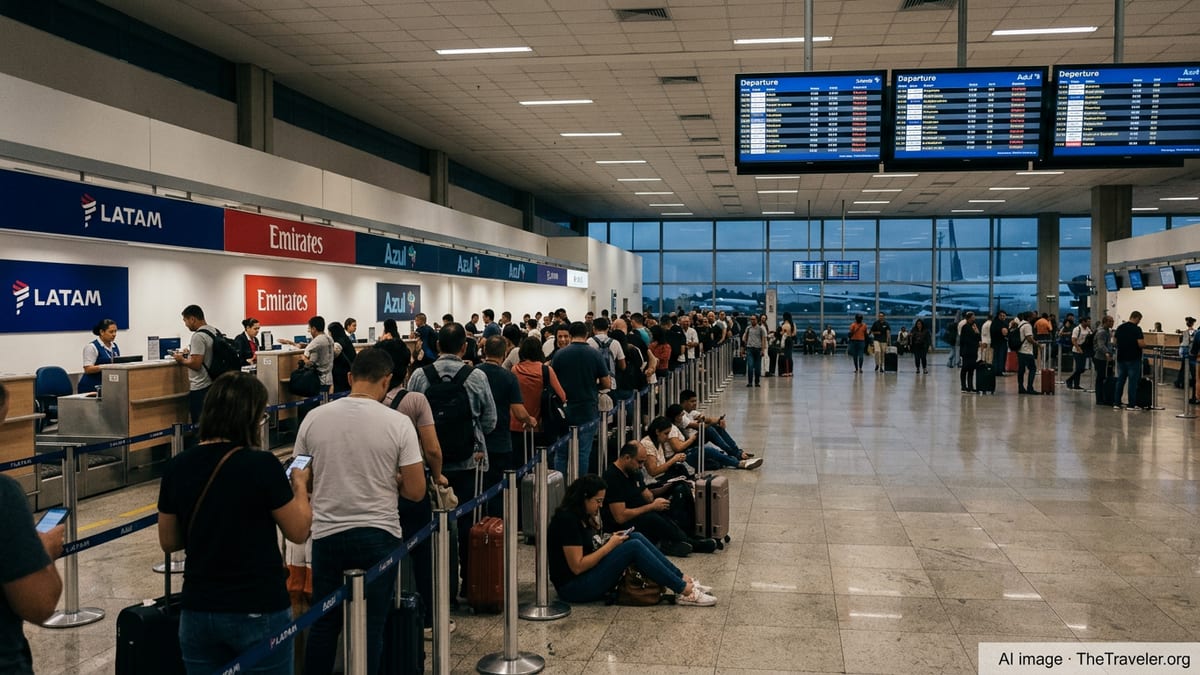
Widespread Disruptions Hit Brazil’s Busiest International Hub
São Paulo-Guarulhos, Brazil’s primary international gateway and one of Latin America’s busiest hubs, saw its Saturday schedules heavily impacted as airlines struggled to recover from a week of instability on long haul and regional routes. Airport monitoring platforms showed a sharp spike in delayed departures and arrivals through the morning and afternoon window, with knock on effects across domestic and international networks.
The seven cancellations and 142 delayed flights represent a significant share of Guarulhos traffic for a single day, particularly as the southern hemisphere summer holiday period draws to a close. Passengers reported long lines at check in counters and security, as well as crowded boarding areas as departure times were repeatedly revised.
While weather over São Paulo remained generally flyable, a combination of aircraft and crew positioning challenges, lingering effects of previous days’ disruptions on Middle East routes, and congestion in regional airspace contributed to the operational strain. Airport authorities and airlines advised travelers to verify flight status before heading to the terminal and to prepare for extended waiting times.
The irregular operations underscored how quickly schedule reliability can deteriorate at a major hub where domestic connections, South American regional services and long haul flights to Europe, North America and the Gulf are tightly interlinked. Delays on a handful of key trunk routes can cascade across dozens of subsequent rotations.
LATAM Brasil, Emirates and Azul Among Most Affected Carriers
LATAM Brasil, the largest operator at Guarulhos, bore much of the impact as late arriving aircraft forced adjustments to an already dense schedule of domestic and regional departures. Services to Brasília, Recife, Porto Alegre and other major Brazilian cities experienced rolling delays, complicating connections for passengers bound onward to neighboring countries such as Argentina and Uruguay.
Long haul operations were also under pressure. Emirates, which is progressively restoring its full schedule between Dubai and São Paulo after a period of curtailed operations linked to instability in the Middle East, faced knock on delays on the pivotal Brazil United Arab Emirates corridor. Passengers connecting in Dubai to Doha and other Gulf destinations reported tight or missed onward connections as departure times from Guarulhos shifted later into the day.
Azul, a key player in Brazil’s domestic and regional market, saw its dense network of point to point flights out of São Paulo affected as well. Even modest departure delays of 30 to 60 minutes on early bank flights were enough to push aircraft and crews off their planned rotations, leading to additional delays on later services within Brazil and to leisure destinations in Uruguay and Argentina.
Other international carriers serving Guarulhos, including airlines linking São Paulo with major hubs in Europe and the Americas, were forced to adjust ground times and in some cases swap aircraft in order to keep intercontinental operations broadly on track. However, the disruption to local feed from within Brazil made it challenging for airlines to ensure all connecting passengers were able to reach their long haul departures on time.
Travelers Face Long Queues, Missed Connections and Last Minute Rebookings
For passengers passing through Guarulhos, the operational turbulence translated into hours of uncertainty. Many arrived at the airport to find departure boards studded with new estimated times, and were directed to check in desks or airline service counters for rebooking assistance when misconnected from inbound flights.
Travelers heading from secondary Brazilian cities to São Paulo for same day connections to Buenos Aires, Montevideo, Doha and other long haul destinations were particularly vulnerable. Even small delays on domestic legs were enough to jeopardize minimum connection times in Guarulhos’ busy terminals, especially during peak morning and evening banks when security lines and immigration queues are longest.
Airlines responded by offering date changes without penalty on some affected itineraries, prioritizing families, elderly travelers and those with essential travel needs. However, with seat availability tight at the tail end of the summer season, many passengers faced the prospect of overnight stays in São Paulo or forced changes to their ultimate destinations.
Social media posts from the terminals showed crowded gate areas, passengers sleeping on benches and ad hoc information briefings by ground staff. While most flights ultimately departed, the constant retiming created stress for travelers uncertain about whether they would make onward connections in hubs such as Doha and Dubai or arrive on schedule for events in neighboring South American capitals.
Operational Recovery Efforts and Guidance for Upcoming Travel
By late evening, airlines and airport authorities were working to stabilize operations, reposition aircraft and reset crew rosters to support a gradual return to normal timetables. With only a small number of outright cancellations, carriers were focused on absorbing accumulated delays and protecting long haul departures, even if that meant turning some domestic flights around more quickly than usual.
Operational planners indicated that the effects of Saturday’s disruptions could still be felt into Sunday, particularly on early morning departures where aircraft and crew availability remained tight. Travelers with tickets from Guarulhos over the next 24 to 48 hours were urged to monitor real time flight status and to arrive at the airport earlier than usual, especially if they needed to check baggage or complete international formalities.
Analysts noted that the situation at Guarulhos highlights the fragility of highly optimized airline schedules, especially at mega hubs that serve as both domestic connectors and intercontinental gateways. When external shocks such as regional instability, crew duty time limits or minor weather issues coincide, the margin for recovery can be thin, leading to exactly the kind of ripple effects seen across Brazil, Argentina, Uruguay and Gulf destinations.
Industry observers expect airlines operating at Guarulhos to review schedule buffers, ground times and contingency plans in the coming weeks, particularly on routes linking São Paulo with major hubs in the Middle East. For passengers, the episode will serve as a reminder of the value of longer connection windows, flexible tickets and comprehensive travel insurance when planning itineraries through one of South America’s most important aviation hubs.