

More news on this day
Hundreds of air travelers across northern and southwestern China have been stranded after a fresh wave of disruptions involving at least 26 grounded flights and nearly 300 delayed or rescheduled services operated by China Express, China Eastern and Chengdu Airlines, with routes touching Inner Mongolia, Xinjiang, Yunnan, Shaanxi and Hunan and key hubs including Hohhot, Kunming, Harbin and Xi’an.
Wide Ripple Effects Across Inner Mongolia, Xinjiang, Yunnan, Shaanxi and Hunan
The latest disruption has underscored how quickly flight problems in China can spill across vast regions and affect multiple carriers at once. From the grasslands of Inner Mongolia and the deserts of Xinjiang to the tourist-heavy landscapes of Yunnan and the densely populated corridors of Shaanxi and Hunan, passengers have reported queues, rolling delays and sudden gate changes as airlines struggled to consolidate and reroute services.
In Inner Mongolia, Hohhot Baita International Airport has seen waves of passengers waiting for updated departure boards as China Express and China Eastern adjusted regional connections serving smaller cities. Similar scenes have been reported at Kunming Changshui International Airport in Yunnan, a major gateway for domestic tourism and international links to Southeast Asia, where Chengdu Airlines and China Eastern have both adjusted operations in recent disruption cycles.
Farther north, Harbin Taiping International Airport in Heilongjiang has been affected by knock-on schedule changes even when it has not been at the epicenter of cancellations, because many routes pass through or connect to flights serving the heavily impacted western regions, including Xinjiang. In Shaanxi, Xi’an Xianyang International Airport, one of China’s busiest inland hubs, has also experienced waves of schedule changes as airlines rebalance aircraft and crew availability across the network.
Hunan, while not always directly listed among the airports with the highest number of cancellations, has been caught in the resulting web of disrupted connections. Changsha Huanghua International Airport, a growing regional hub, has experienced delays and equipment swaps on services operated or fed by China Express, China Eastern and their partners, particularly on routes linking central China to the northwest and southwest.
How Many Flights Are Affected and What “Grounded” Really Means
According to operational data shared through airport and industry updates, at least 26 flights are currently classified as grounded, with a further 294 services reported as disrupted in the latest wave of irregular operations. While those figures sound straightforward, the terminology can be confusing to travelers seeing only a brief line on a departure board or mobile app.
A grounded flight typically refers to a service that has been taken out of operation altogether, often due to aircraft availability, crew constraints, maintenance issues or broader disruptions elsewhere in the network. For travelers, this usually translates to an outright cancellation, requiring rebooking onto another flight or alternative transport. A disrupted service, by contrast, may still operate but can involve extended delays, equipment changes, partial route adjustments or, in some cases, diversion to a different airport before passengers are moved onward.
China Express, China Eastern and Chengdu Airlines have all used a combination of these measures as they navigate tight turnarounds, weather variability and fluctuating demand. In practice, this has meant that some flights listed as suspended or deferred may reappear on schedules later in the day or week, while others are quietly removed as carriers consolidate passengers onto fewer departures along busy corridors.
For travelers, the most immediate impact is uncertainty. A flight officially described as deferred or adjusted may still involve missed connections and overnight stays, while a grounded aircraft can suddenly cascade into delays on later legs if replacement equipment cannot be sourced in time.
Key Airports Under Strain: Hohhot, Kunming, Harbin and Xi’an
Hohhot, Kunming, Harbin and Xi’an occupy strategic positions in China’s domestic air network, which explains why disruptions on China Express, China Eastern and Chengdu Airlines have generated disproportionate ripple effects. Each airport serves not only its home province but also acts as a bridge between multiple regions.
Hohhot, capital of Inner Mongolia, functions as a crucial stepping stone between Beijing, the vast northern interior and routes further west. When short-haul regional flights are grounded there, connections to and from Xinjiang and other western destinations can be thrown off balance, especially for passengers traveling onward by rail or road.
Kunming’s Changshui airport is one of China’s busiest hubs and a key gateway to Yunnan’s popular destinations such as Dali, Lijiang and Xishuangbanna. Any wave of deferred or cancelled flights involving China Eastern or Chengdu Airlines in Kunming tends to hit leisure travelers hard, particularly during weekends and peak holiday periods when hotel bookings and onward tours are tightly scheduled.
Harbin and Xi’an play critical roles as regional anchors in the northeast and northwest. Harbin provides a hub for connections across Heilongjiang and neighboring provinces, meaning delays there can strand travelers heading to smaller cities with limited daily services. Xi’an, a major inland hub and tourist destination in its own right, connects central and western China with the coastal metropolitan belt. When multiple carriers adjust schedules in Xi’an, it affects not just point-to-point travelers but also those relying on one-stop connections across the country.
Why These Disruptions Are Happening
While each grounded or delayed flight has its own operational cause, several broader factors lie behind the recent pattern of disruptions involving China Express, China Eastern and Chengdu Airlines. Seasonal weather across China remains a persistent challenge, particularly in regions such as Inner Mongolia, Xinjiang and Heilongjiang where heavy snow, high winds and low visibility are common during large parts of the year.
In the southwest, airports like Kunming and those serving Yunnan’s mountainous areas are vulnerable to sudden storms and low cloud, while the growing volume of traffic in hubs like Xi’an can compound delays when weather, airspace congestion or temporary runway restrictions occur. Airlines typically respond with rolling schedule adjustments, sometimes grounding individual aircraft or routes for several rotations while they stabilize operations.
At the same time, China’s domestic air market has been ramping up capacity in response to strong demand from business travelers and tourists, especially as more routes are restored or expanded. This has left carriers with tighter margins for disruption. When a single aircraft is taken out of service for maintenance or safety checks, or when crews reach duty-time limits, a line of departures can quickly shift into the “deferred” or “suspended” category.
Industry analysts note that secondary and regional carriers such as China Express, working alongside large network airlines like China Eastern and niche operators like Chengdu Airlines, are particularly exposed because they often operate thinner routes with fewer daily frequencies. Cancelling one sector to protect another can be the most efficient solution for the airline, but the impact on passengers in smaller cities can be significant.
What Stranded Passengers Are Experiencing on the Ground
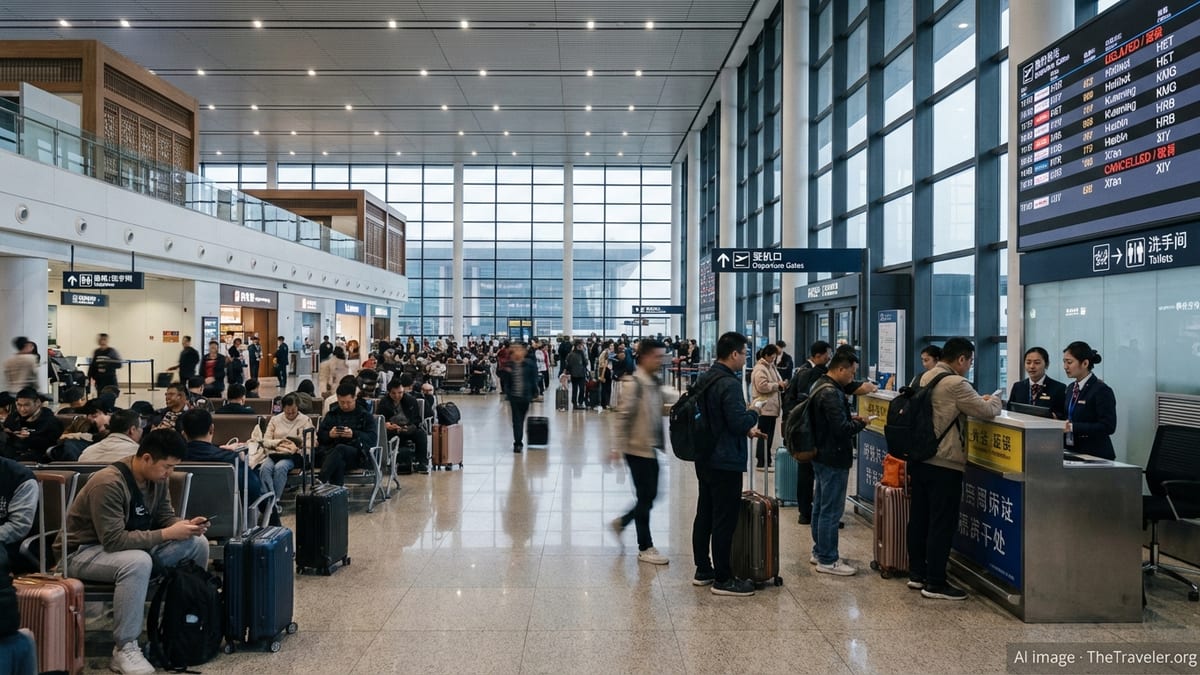
Scenes at affected airports in Inner Mongolia, Yunnan, Heilongjiang and Shaanxi have ranged from resigned queues at check-in counters to packed waiting halls where families and business travelers cluster around information screens. Many passengers report learning of cancellations only when they reach the airport, or through last-minute mobile alerts that leave limited time to adjust hotel and transfer plans.
At Hohhot and Xi’an, long lines have formed at service desks for China Express and China Eastern, with staff rebooking passengers onto later flights or alternative routes via Beijing, Shanghai, Chengdu or Chongqing. In Kunming, where regional connections to smaller destinations are critical for tourism, front-line staff have been working to secure hotel rooms and meal vouchers for those unable to travel the same day, particularly travelers connecting from long-haul international arrivals.
In Harbin, delays can be especially frustrating in winter periods, when passengers face freezing temperatures outside the terminal and crowded conditions inside. Limited late-night transport options from the airport to the city or nearby towns mean that a missed evening flight may automatically translate into an unplanned overnight stay.
Across all these airports, the uneven pace of information updates remains a common complaint. Even when airline apps and airport screens show a new departure time, further slippages are possible if the inbound aircraft or crew are themselves delayed, leaving travelers wary of leaving the gate area for fear of missing a sudden boarding announcement.
Practical Advice for Travelers Caught in the Disruptions
For passengers already in China or planning travel through Inner Mongolia, Xinjiang, Yunnan, Shaanxi or Hunan, proactive planning can significantly reduce the impact of ongoing suspensions and deferred flights. First, it is essential to monitor flight status directly through airline channels as well as airport information systems, beginning at least 24 hours before departure. China Express, China Eastern and Chengdu Airlines all provide real-time updates through their official apps and customer service hotlines.
Travelers with tight connections, particularly those linking domestic flights in Hohhot, Kunming, Harbin or Xi’an to international departures in Beijing, Shanghai, Guangzhou or Chengdu, should consider building in additional layover time or, where possible, booking through-tickets so that a single carrier is responsible for re-accommodation if disruptions occur. Separate tickets on different airlines can be risky when widespread delays are already reported.
For those already stranded at an airport, approaching the airline counter promptly after an announced cancellation or substantial delay is critical. Passengers should ask about rebooking options, endorsement of tickets to partner airlines, and eligibility for hotel accommodation, meal vouchers or ground-transport assistance. Keeping all receipts for food, local transport and accommodation can prove helpful when seeking reimbursement or travel insurance claims later.
Where distance and time allow, some travelers in China opt to switch to high-speed rail as a backup. Routes linking Xi’an, Zhengzhou, Changsha, Kunming and other major cities can offer reliable alternatives when air schedules become uncertain, though rail tickets can sell out quickly during disruption events and peak travel seasons.
Ticket Changes, Refunds and Passenger Rights
One of the most pressing questions for affected passengers involves their rights to refunds, free changes or additional support from airlines. Chinese carriers, including China Express, China Eastern and Chengdu Airlines, typically issue temporary policies during major disruption events that allow passengers on cancelled or significantly delayed flights to change dates or routes without extra fees, or to request a refund even on tickets that would normally be nonrefundable.
The exact terms vary depending on the cause of disruption and the type of ticket purchased. Weather-related cancellations may limit compensation beyond rebooking or refunds, while operational or crew-related issues can sometimes open the door to more generous assistance such as accommodation and ground transfers. Travelers are advised to check the latest notices on each airline’s official information channels and to screenshot relevant policy announcements for reference at the airport.
Travel insurance can also play a vital role, especially for international visitors combining multiple domestic segments within China. Policies that cover trip interruption, missed connections and additional accommodation costs are particularly valuable during periods of widespread operational stress. However, passengers should read the fine print, as some policies exclude disruptions caused by severe weather or classify them differently from mechanical or staffing problems.
For group tours and packaged itineraries, coordinators and travel agents often handle rebooking and claims on behalf of customers. Travelers in such groups should maintain close communication with tour leaders and keep copies of all travel documents, as airlines may require individual details even when dealing with bulk bookings.
How to Plan Upcoming Trips Through Affected Regions
Looking ahead, travelers planning to visit Inner Mongolia’s grasslands, Xinjiang’s deserts and mountain routes, Yunnan’s cultural and natural attractions, or historic cities such as Xi’an and Changsha should factor current disruption patterns into their itineraries. Building flexibility into flight dates and avoiding the tightest possible connections can greatly reduce stress if more services are suspended or deferred.
Experts generally recommend booking earlier departures in the day wherever possible. Morning flights are less exposed to the cumulative knock-on effects of delays that build through the afternoon and evening, particularly on routes served by smaller aircraft and regional carriers. Routing through major hubs with multiple daily frequencies can also provide more fallback options than relying on a single daily service to a remote destination.
Travelers should keep a backup plan in mind, especially for journeys involving Hohhot, Kunming, Harbin and Xi’an, where any shift in weather or traffic control restrictions can quickly affect departure boards. This might include identifying suitable high-speed rail alternatives, considering overnight stays near hub airports, or leaving nonessential activities for the final day in a city rather than the day of departure.
Despite the disruption, China’s domestic network remains one of the most extensive in the world, and airlines have strong incentives to restore normal schedules quickly. For travelers prepared with real-time information, flexible arrangements and an understanding of how grounded and disrupted flights are managed, it is still possible to navigate Inner Mongolia, Xinjiang, Yunnan, Shaanxi and Hunan with confidence.