

More news on this day
Spain’s two busiest airports were hit by a fresh wave of disruption on Friday as 19 flights were grounded and many more delayed in Madrid and Barcelona, with services operated by Qatar Airways, Ryanair, Emirates, Cathay Pacific and Iberia among those affected, stranding and rerouting thousands of passengers at the height of the early spring travel period.
Major Hubs Struggle as Airspace Crisis Ripples Across Europe
The latest disruption comes amid continuing upheaval in West Asia airspace that has already forced thousands of cancellations and diversions on Europe to Asia routes in recent days, pushing more pressure onto key European hubs. Airlines are juggling rapidly changing flight plans and safety advisories while trying to preserve Spain’s crucial long haul links via Madrid Barajas and Barcelona El Prat.
Airport sources said the 19 grounded services on Friday were a mix of long haul flights connecting Spain with Gulf and Asian hubs and short haul links feeding those intercontinental networks. Delays cascaded across both airports as crews and aircraft went out of position, with knock on effects on domestic routes between Madrid and Barcelona and other Spanish cities.
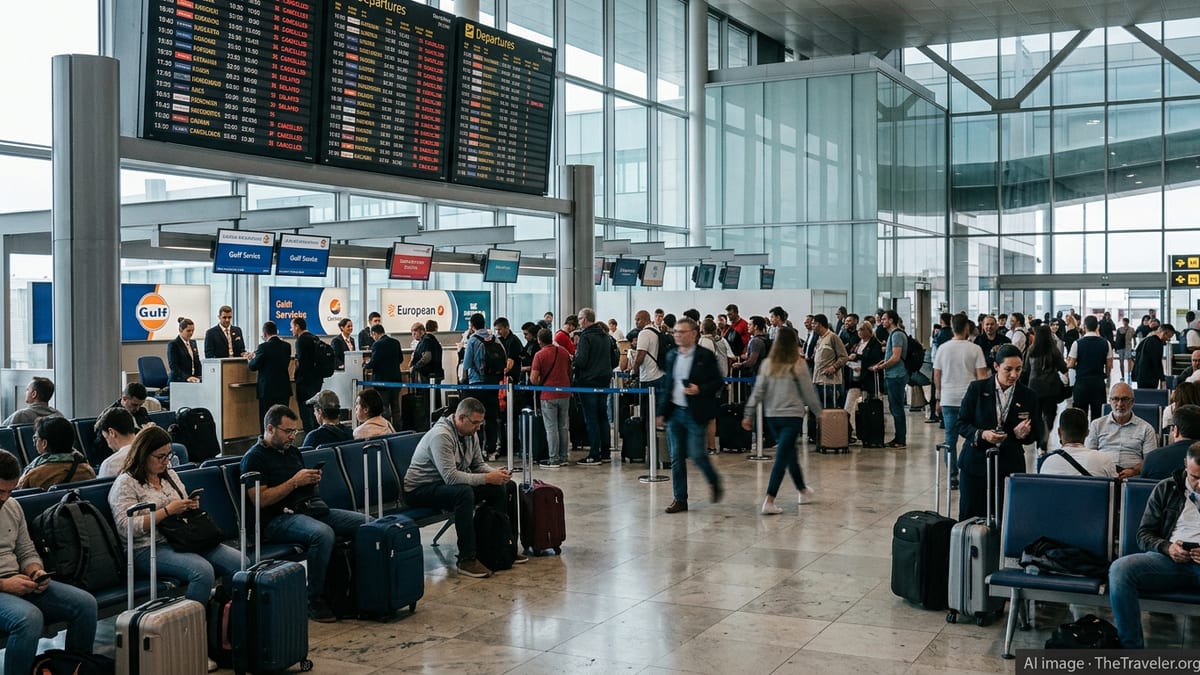
In Barcelona, which has seen an aggressive expansion of Gulf capacity over the past decade, staff reported crowded departure halls, long lines at transfer desks and mounting frustration among passengers left uncertain about when replacement flights would be available. At Madrid, operations were more stable but schedules remained fragile, with rolling delays affecting both morning and evening peaks.
Qatar Airways and Emirates Keep Gulf Links Under Review
Qatar Airways and Emirates, two of the largest foreign carriers serving Spain, have been among the most affected by the ongoing airspace closures, which complicate their role as connectors between Europe and destinations in Asia, Africa and the Indian Ocean. Both airlines have already been forced to cancel or consolidate multiple rotations to and from Europe as they adjust routings around restricted skies.
At Madrid and Barcelona on Friday, several departures and arrivals operated by the Gulf carriers were either grounded outright or subject to extended delays as planners recalculated flight paths, fuel loads and crew duty times. Airline representatives stressed that safety remained the overriding priority and that services would only operate when routes could be flown without violating current restrictions.
Travel agents in Spain reported difficulty finding alternative seats for customers booked on Qatar Airways and Emirates itineraries, particularly those headed to Southeast Asia and Australia. With many connecting options through the Gulf temporarily unavailable or flying at reduced capacity, some passengers were being rerouted via northern hubs or asked to delay their trips altogether.
Ryanair, Iberia and Cathay Pacific Face Knock On Operational Strain
The disruption has not been limited to Gulf airlines. Ryanair, Iberia and Cathay Pacific also reported operational challenges that contributed to the 19 grounded flights and a wider ring of delays around Madrid and Barcelona. Although their aircraft do not all transit the most heavily affected corridors, the broader reshuffling of European air traffic has tightened capacity and complicated crew planning.
Low cost giant Ryanair, which operates a dense network of domestic and intra European routes from Spanish airports, faced crew and aircraft rotation issues as earlier delays rippled through its schedule. Even short hops between Spanish cities were affected when incoming aircraft from other parts of Europe arrived late, leaving passengers facing missed connections and last minute gate changes.
Flag carrier Iberia, which relies heavily on Madrid as a long haul gateway, has already adjusted some Middle East services and has been closely watching developments that could affect its connecting flows. On Friday it again urged passengers to check their flight status before heading to the airport and offered flexible rebooking options on the most affected routes.
Cathay Pacific, which links Spain with Hong Kong and onward destinations across Asia, has also had to reconfigure parts of its schedule in response to the regional crisis. While its direct services to and from Spain remained limited in number, delays to aircraft and crew elsewhere in its network added further uncertainty for travelers connecting through Madrid and Barcelona.
Passengers Confront Long Queues, Rebookings and Rising Fares
For travelers caught in the middle of Friday’s turmoil, the experience was characterized by long queues, shifting departure times and a scramble for scarce seats on alternative flights. At both Madrid and Barcelona, airport information screens were dotted with notices of cancellations and significant delays, while loudspeaker announcements urged passengers to stay close to their gates.
Staff at airline customer service desks described a steady stream of requests for hotel vouchers, meal coupons and rebooking assistance as travelers abandoned missed connections or overnight layovers. Some passengers accepted rerouting via other European hubs, while others opted to abandon complex itineraries and return home, planning to travel once schedules stabilize.
Industry analysts warned that continued disruption in West Asia airspace, combined with surging demand ahead of Easter holidays, was already pushing up fares on some Europe to Asia and Europe to East Africa routes. With capacity constrained and many carriers flying longer, more fuel intensive routings, price sensitive travelers from Spain may face fewer options and higher costs in the weeks ahead.
Authorities and Airlines Urge Flexibility as Situation Evolves
Spain’s aviation authorities and airport operator Aena have been in close contact with airlines to manage flows at Madrid and Barcelona, coordinating slot allocations, gate usage and contingency plans as the crisis continues to evolve. While the number of grounded flights on Friday remained relatively small compared with overall daily traffic, officials underscored that the situation could change quickly if airspace conditions deteriorate further.
Airlines serving Spain have repeatedly urged passengers to build extra time into their journeys, keep contact details updated in their bookings and use mobile apps to track gate changes and departure times. They have also highlighted more flexible change and refund policies introduced in response to the airspace crisis, although availability of alternative flights remains constrained on some long haul corridors.
With uncertainty lingering over when normal routings through key Middle Eastern air corridors will resume, Madrid and Barcelona face the prospect of continued schedule volatility. For now, airlines and airports are focused on getting stranded passengers moving again and preserving as much of Spain’s global connectivity as possible while safety restrictions remain in force.