

More news on this day
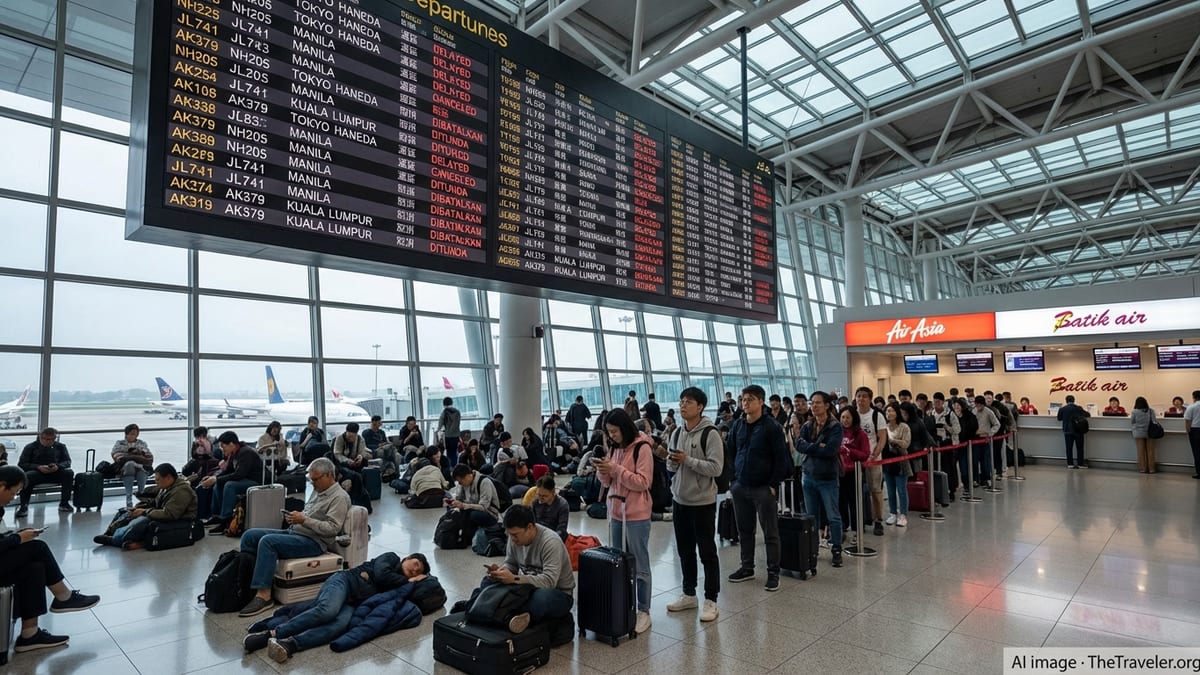
Travelers moving through Japan’s busiest air corridors faced another difficult day as 23 flights operated by United Airlines, Japan Airlines, All Nippon Airways and Lufthansa were grounded, triggering rolling delays at Narita, Tokyo, Osaka, Nagoya and Kagoshima and adding fresh strain to an already congested Asia-Pacific network.
Get the latest news straight to your inbox!
Grounded Flights Ripple Across Key Japanese Hubs
Published data from aviation tracking services and regional airport bulletins indicates that the grounding of 23 services affected a mix of international and domestic routes linking Japan with North America, Europe and major Asian hubs. United, Japan Airlines, All Nippon Airways and Lufthansa all appeared among carriers with cancelled or significantly delayed operations touching Japanese soil.
The disruptions were concentrated at Narita International Airport and the wider Tokyo area, with additional knock-on impacts reported at Osaka’s major airports, Nagoya’s Chubu Centrair hub and Kagoshima in southern Japan. These gateways handle large volumes of both business and leisure traffic, magnifying the effect of even a modest number of grounded flights.
Operational summaries show that several long-haul departures connecting Japan with North America and Europe were among the services affected, particularly those marketed by United and Lufthansa in partnership with Japanese carriers through codeshare agreements. Short-haul and domestic sectors operated by Japan Airlines and All Nippon Airways then shouldered the secondary burden as missed connections cascaded into later banks of flights.
On the ground, publicly available reports from airports and travel platforms described mounting queues at check in, rebooking counters and security screening as passengers sought alternative routings. The relatively small core of 23 grounded flights therefore translated into a disproportionately large wave of delays as schedules were redrawn throughout the day.
Tokyo and Narita Under Pressure as Asia-Pacific Congestion Builds
The latest disruption comes amid a broader pattern of congestion affecting key Asian hubs. Recent regional figures compiled by travel-industry outlets for April 12, 2026, point to thousands of delayed services and several hundred cancellations across Asia, with Tokyo repeatedly appearing among the most heavily impacted cities.
In this context, Narita and Tokyo-area airports are operating close to capacity both in terms of runway usage and terminal processing, particularly at peak inbound and outbound waves. When a cluster of long-haul services is removed from the schedule because of operational or weather-related issues, replacement options are limited and recovery windows narrow quickly.
Travel analysts note that the surge in international tourism to Japan since border restrictions were lifted has pushed passenger numbers at Narita and Tokyo to or beyond pre-pandemic levels. Immigration and security bottlenecks have already drawn attention in recent months, and unexpected cancellations simply add to that strain by forcing large groups of disrupted travelers back into already busy terminal spaces.
With many carriers concentrating flights in tightly timed departure banks, a handful of grounded aircraft can affect multiple onward connections to destinations across Japan and throughout Asia. For visitors, that means that even if their specific flight is listed as “on time,” delays earlier in the day can still lead to late arrivals of inbound aircraft, last-minute gate changes or missed connections.
Osaka, Nagoya and Kagoshima Feel the Knock-On Effects
While Tokyo and Narita account for the largest volume of traffic, the day’s disruptions also had visible effects at Osaka, Nagoya and Kagoshima. Osaka’s airports act as a vital secondary international gateway and a major domestic connector, and schedule changes at Tokyo-area hubs commonly spill over into Kansai-region operations.
Published coverage in recent weeks has already highlighted how airports such as Kansai International and Osaka Itami are juggling dense schedules from Japan Airlines, All Nippon Airways and a growing roster of international carriers, including European operators such as Lufthansa and North American airlines like United. When upstream flights into Japan are cancelled or delayed, aircraft and crew rotations through Osaka can be thrown off balance for several cycles.
Nagoya’s Chubu Centrair and Kagoshima, though smaller by comparison, play important roles in regional connectivity. Nagoya links central Japan to transpacific and regional Asian services, while Kagoshima is a key node for domestic tourism and business travel in Kyushu and the southern islands. Grounded flights touching these airports increase the risk of missed domestic connections, particularly for travelers attempting same-day transfers from long-haul arrivals.
In practical terms, passengers connecting through Osaka, Nagoya or Kagoshima after arriving on United, Lufthansa, Japan Airlines or All Nippon flights into Japan faced higher chances of missed or retimed domestic departures. Airline schedule data suggests that carriers attempted to consolidate loads and protect later bank departures where possible, but midday and early evening services remained vulnerable to rolling delays.
Travelers Advised to Build Flexibility Into Japan Itineraries
The latest wave of grounded flights serves as another reminder that travelers heading to or through Japan in 2026 should plan for operational uncertainty, even during what appears to be stable weather. Industry commentators point to several converging factors, including strong post-pandemic demand, tight aircraft and crew availability, complex codeshare networks and evolving airline schedules.
Publicly available airline timetables show that Japan’s major carriers are reshaping domestic and international networks through 2025 and 2026, with new seasonal patterns, adjusted frequencies and in some cases the suspension or consolidation of certain routes. At the same time, international partners such as United and Lufthansa continue to rebuild or reconfigure their own Asia services, creating a more intricate web of dependencies.
For individual travelers, this environment makes it more important to allow generous connection times when planning multi leg journeys involving Tokyo, Narita, Osaka, Nagoya or Kagoshima. Leaving additional buffer hours between long-haul arrivals and onward domestic flights can reduce the risk of misconnection when grounded aircraft or extended delays ripple through the system.
Travel platforms and airport announcements also emphasize the value of monitoring flight status closely on the day of departure and arrival. With conditions shifting quickly, especially when multiple carriers are adjusting operations simultaneously, the most accurate information is often provided only a few hours before departure as airlines finalize equipment assignments and crew rosters.
What Today’s Disruption Signals for Japan-Bound Tourism
Japan’s tourism sector has been in strong recovery mode, with international arrivals climbing and major airlines adding capacity into Tokyo, Osaka and regional destinations. The decision by United, Japan Airlines, All Nippon Airways and Lufthansa to ground 23 flights underscores how sensitive this recovery remains to operational turbulence.
Observers note that while the absolute number of grounded flights is relatively modest compared with total daily movements across Japan, the concentration among key intercontinental carriers magnifies the impact on high-value long-haul travelers. These passengers are more likely to hold complex itineraries linking multiple Japanese cities, meaning a disruption at one point can unravel carefully planned routes.
At the same time, the pattern of delays and cancellations seen across Asia points to structural challenges that go beyond any single airline or country. Airports must balance rapid demand growth with finite runway capacity and staffing, while airlines juggle fleet upgrades, maintenance windows and shifting international partnerships. Japan’s largest gateways are at the center of these trends, making them particularly prone to regional ripple effects.
For now, published data suggests that airlines are largely absorbing the disruption through same-day schedule tweaks rather than large-scale, multi day cancellations. However, the grounding of 23 flights involving United, Japan Airlines, All Nippon Airways and Lufthansa offers a timely snapshot of how quickly conditions can change, and why travelers to and within Japan may benefit from building a margin of flexibility into their plans.