

More news on this day
Flight disruptions are no longer isolated headaches but a structural weakness in global aviation, with recent analyses indicating they are costing the United States alone an estimated 30 to 34 billion dollars annually and reshaping industry priorities for 2026.
Get the latest news straight to your inbox!
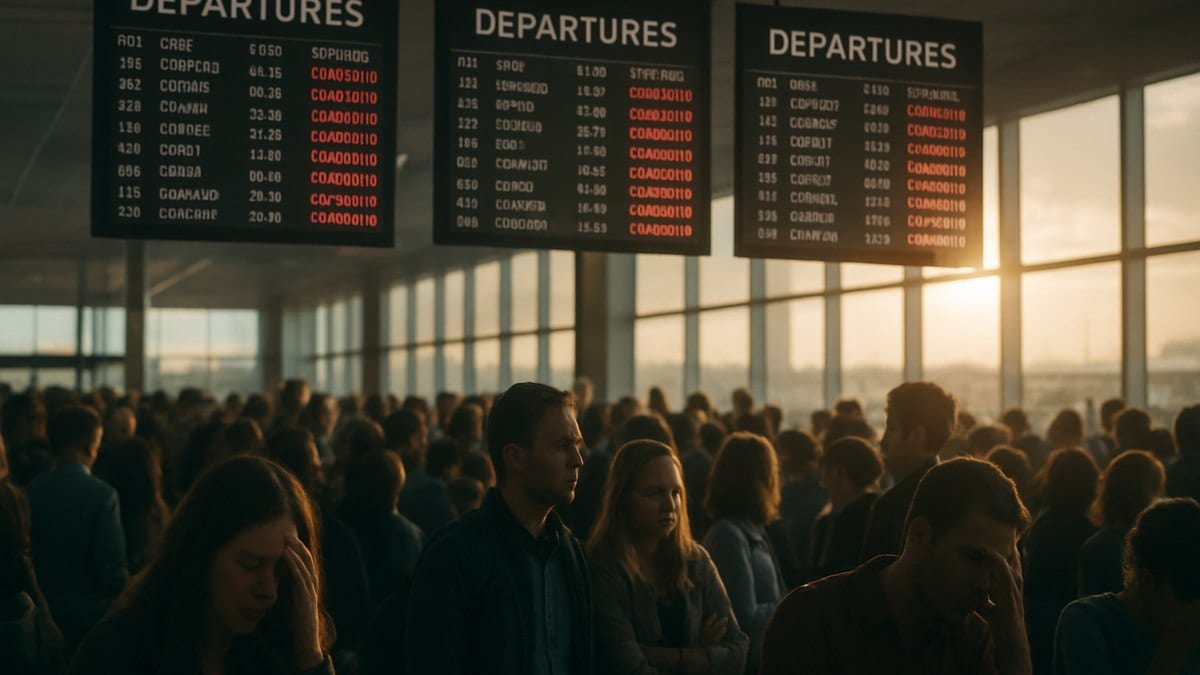
A Structural Problem, Not Just a Bad Travel Day
What was once treated as a seasonal or weather-driven nuisance has evolved into a chronic drag on aviation. Regulatory filings, industry datasets and economic studies compiled since 2022 consistently place the annual U.S. economic impact of flight delays and cancellations in the 30 to 34 billion dollar range, including airline costs, lost passenger time and wider spillover effects on business activity.
Research cited in U.S. Department of Transportation dockets and aviation economic papers traces this figure largely to three categories: direct operating costs for airlines, the value of time lost for passengers, and knock-on costs to sectors such as hospitality and retail. One analysis drawing on millions of disrupted flights in 2022 estimated that at least 200 million passengers in the United States were affected, with the aggregate disruption cost climbing into the mid-30 billion dollar band.
The trend has not eased as traffic recovered. Private data services tracking North American carriers report that U.S. airlines absorbed more than 30 billion dollars in delay-related losses in 2023 alone, while global consultancies describe disruptions as one of the main factors eroding the thin profit margins forecast for 2024 and 2025. As demand continues to grow into 2026, the burden of disruption is increasingly seen as systemic rather than cyclical.
Industry observers note that the 34 billion dollar figure likely understates longer term impacts, because it excludes lost confidence in air travel, deferred trips, and the reputational damage that drives passengers to change airlines or switch to other modes of transport where possible.
ATC Staffing, Aging Fleets and Supply Chain Strain
Much of the current disruption burden is linked to infrastructure and staffing constraints that are slow to fix. Analyses by aviation investment researchers and airline industry associations point to chronic air traffic control shortages in the United States as a major constraint, with some of the nation’s busiest hubs operating below planned staffing targets and relying heavily on overtime and rerouting.
Reports summarizing Federal Aviation Administration data indicate that in peak periods since 2023, staffing-related restrictions have led to temporary caps on traffic at key airports, translating into cascading delays across the network. At the same time, industrial action affecting air traffic services in Europe and other regions in recent years has further exposed how dependent modern aviation is on a relatively small number of control centers.
Aircraft availability is another stress point. A joint report from the International Air Transport Association and consulting firm Oliver Wyman projected an 11 billion dollar global hit in 2025 from supply chain bottlenecks and maintenance delays, as airlines are forced to keep older aircraft in service longer and face extended downtimes for parts and heavy checks. These constraints limit the spare capacity carriers can use to recover after irregular operations, prolonging disruption and increasing costs.
The industry’s well publicized technology failures underscore the exposure. The global IT outage linked to a major cybersecurity vendor in 2024, which triggered thousands of cancellations at multiple airlines, and ongoing groundings tied to specific aircraft models have each generated losses in the hundreds of millions of dollars for individual carriers. Analysts argue that together, these episodes illustrate how a single point of failure can send costs spiraling across the network.
Passengers Bearing the Hidden Cost of Disruption
For travelers, the financial cost of disruption is largely invisible but substantial. Studies prepared for regulators and consumer groups calculate the value of passenger time lost in delays, missed connections and rebookings, often using government benchmarks for the economic value of an hour of travel time. In the U.S. context, these studies suggest that lost time alone represents a significant share of the 34 billion dollar annual burden.
Consumer data platforms tracking flight delay statistics report that a sizable portion of passengers now change or cancel trips because of prior disruptive experiences. Surveys published in 2025 show that roughly four in ten travelers have delayed or abandoned at least one planned trip due to worries about delays, while others say they avoid tight connections or certain hubs perceived as prone to disruption.
Regulatory compensation schemes amplify the cost on airlines, particularly in Europe. Under European Union rules, travelers on long delays or cancellations can be entitled to fixed cash compensation per passenger in addition to refunds and care. Industry briefings in 2024 and 2025 place the potential exposure for European carriers in the billions of euros each year, with some estimates suggesting more than 6.5 billion euros in compensation linked to delays and cancellations in 2024 alone.
Consumer-rights litigation has added another layer. High profile cases in the United States following mass cancellation events, including weather-related meltdowns and technology outages, have forced airlines to provide refunds, travel vouchers and investments in systems upgrades that together amount to hundreds of millions of dollars. While these settlements are not included in standard disruption tallies, they contribute to the broader financial weight the sector carries.
Environmental and Operational Ripple Effects
Beyond the headline economic figures, disruptions carry a notable environmental footprint. Analyses commissioned by passenger advocacy groups and academic institutions estimate that additional taxiing, holding patterns and repositioning flights associated with delays and cancellations added around 9 million tons of carbon dioxide globally in a recent study year, or roughly 1 percent of total commercial aviation emissions.
Operationally, disruptions also force airlines into inefficient patterns of capacity use. Crews timing out, aircraft stuck at outstations, and mismatched schedules reduce daily aircraft utilization, eroding the business case for new investments and complicating the introduction of more fuel efficient models. Industry outlooks for 2025 and 2026 published by IATA highlight that while global demand is approaching or exceeding pre pandemic levels, capacity remains constrained in part because operators must build in buffers to manage irregular operations.
Hub airports feel this most acutely. Performance digests from European and North American air traffic organizations show that just a handful of congested hubs can account for a disproportionate share of reactionary delay across their respective regions. When weather, staffing or runway constraints hit these nodes, the knock on effects propagate to secondary airports and regional networks, multiplying the economic impact beyond the initial problem.
For airports and ground handlers, disruption drives overtime, equipment wear and additional customer service staffing. While some of these costs can be recovered through aeronautical charges and ancillary revenues, operators report in their public financial disclosures that sudden peaks in disrupted traffic reduce operational efficiency and strain terminal infrastructure originally designed for smoother passenger flows.
Turning a 34 Billion Dollar Drag into an Investment Case
The scale of the disruption bill is increasingly being framed as an argument for accelerated modernization. Industry and government studies dating back more than a decade have proposed multi billion dollar investments in upgraded air traffic management, digital flight operations tools and predictive analytics. Advocates for these programs point out that the annual cost of disruptions in the United States alone now rivals or exceeds the projected public share of some long term infrastructure initiatives.
Technology suppliers and airline operations teams are promoting artificial intelligence driven tools that can forecast crew and maintenance bottlenecks, optimize turnarounds and reroute aircraft more dynamically when storms or system failures occur. Trade press reporting in 2024 highlighted estimates that large carriers can lose roughly 100 dollars per minute in direct delay costs, a figure that has sharpened interest in automation capable of shaving even small amounts off average disruptions.
On the regulatory side, proposed rulemakings in Washington and Brussels seek to tighten customer service standards, improve transparency around delays, and require clearer contingency planning from airlines and airports. Public consultation documents argue that more robust planning, minimum service levels during disruptions and faster refund processes could reduce secondary economic damage by keeping passengers and businesses better informed.
With air travel demand projected to grow into 2026 and beyond, analysts increasingly describe the 34 billion dollar annual disruption burden as a standing tax on the system rather than an occasional shock. For policymakers and industry leaders, the question is shifting from whether disruptions can be eliminated to how far targeted investments can cut into that bill and restore confidence for both travelers and investors.