

More news on this day
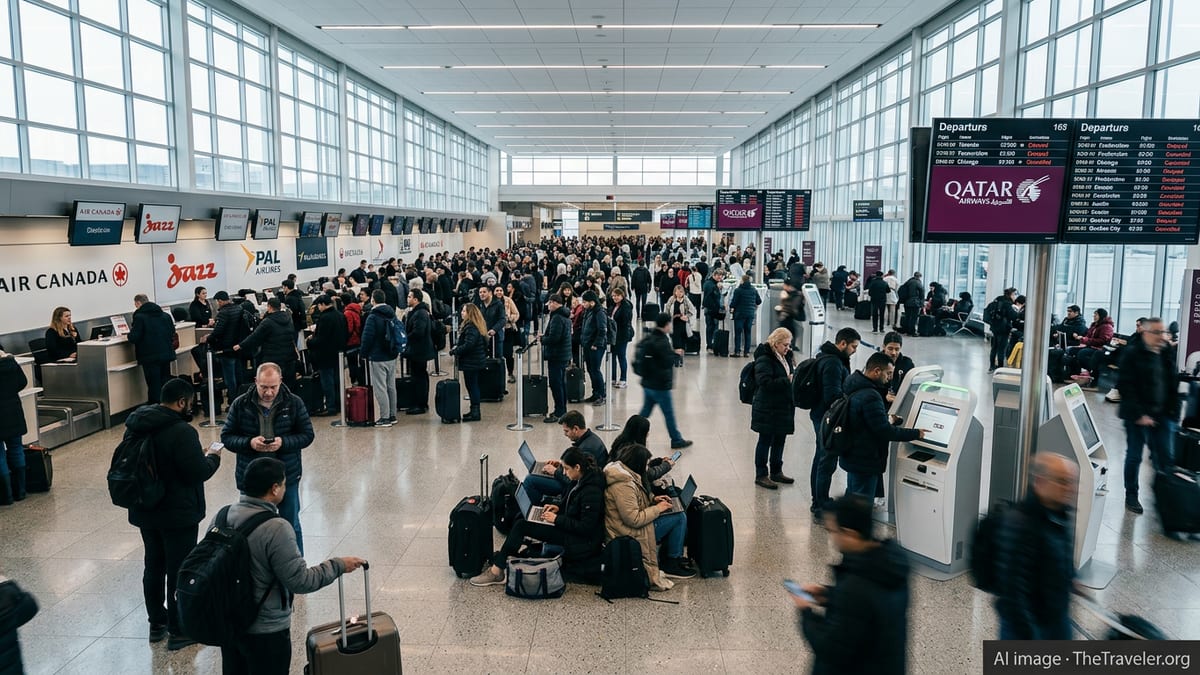
Passengers at Montreal–Trudeau International Airport faced a difficult travel day on March 6 as at least 16 flights were cancelled and many more delayed, disrupting busy corridors to Toronto, Fredericton, Chicago, Austin, Quebec City and several other North American destinations.
Multiple Airlines Hit as Operational Pressures Mount
The wave of disruptions at Montreal–Trudeau on Friday involved a mix of regional and mainline operators, including Jazz Aviation, PAL Airlines, Air Canada, Republic Airways and Qatar Airways. According to live airport and airline data, cancellations were concentrated in morning and late-afternoon departure banks, when aircraft and crew rotations are most tightly scheduled and the network is least able to absorb shocks.
Several of the cancelled services were marketed by Air Canada and operated by its regional affiliates under the Air Canada Express banner, notably Jazz and PAL Airlines, underscoring how dependent Montreal remains on feeder traffic to hubs such as Toronto Pearson and regional capitals in Atlantic Canada. US regional carrier Republic, which flies under major-brand codes to American hubs, was also among those affected, with knock-on effects for connections in Chicago and other Midwestern cities.
While 16 cancellations represent a fraction of Montreal–Trudeau’s daily movements, the impact on travelers was compounded by a larger pool of delayed flights. Many departures pushed back by 30 minutes to over two hours, forcing passengers to scramble for missed connections and putting added strain on ground operations already juggling rebookings and customer-service queues.
Qatar Airways, which has been contending with broader network upheaval linked to airspace closures in West Asia, contributed to the disruption profile in Montreal as its long-haul schedules were adjusted, leaving some travelers with last‑minute changes to long-planned international itineraries.
Key Routes to Toronto, Fredericton and Quebec City Disrupted
Among the hardest-hit routes were those linking Montreal with Toronto, Fredericton and Quebec City, vital corridors for both business and leisure travelers. Cancellations and rolling delays on these short-haul sectors quickly rippled through the system, as aircraft scheduled for quick turnarounds could not depart on time and crew duty limits loomed.
Flights to Toronto, traditionally one of Montreal–Trudeau’s most reliable shuttles, saw a handful of cancellations combined with significant delays. For passengers using Toronto Pearson as a springboard to Western Canada or transborder destinations, even modest schedule changes at Montreal translated into missed evening departures and overnight stays.
Service to Fredericton and other regional points in Atlantic Canada, largely operated by smaller regional aircraft under Jazz and PAL Airlines, was also curtailed. With fewer daily frequencies and limited spare capacity, rebooking options on these routes were sparse, leaving some travelers facing multi-stop reroutings through larger hubs or travel pushed back to the weekend.
Quebec City, a key intra‑provincial link for government, corporate and tourism traffic, experienced a mix of late departures and cancellations that strained rail and road alternatives as some passengers tried to switch modes at short notice.
Transborder Links to Chicago and Austin Affected
Transborder routes bore a share of the disruption, particularly services to Chicago and Austin. Flights feeding into Chicago, a major US hub, saw both cancellations and extended delays as partner airlines and regional operators adjusted schedules in response to aircraft availability and downstream congestion at connecting airports.
The Austin route, a growing leisure and tech‑sector link, was affected by at least one cancellation and additional delays, curtailing options for travelers heading to Texas for conferences, business meetings and onward connections across the southern United States. With limited daily frequencies on this city pair, a single scrubbed departure represented the loss of a full day’s capacity.
For passengers booked on US‑bound services, disruptions at Montreal–Trudeau compounded broader operational challenges across North American networks, where carriers have been wrestling with tight crew resources, residual winter weather patterns and the knock‑on effects of global airspace constraints.
Travelers arriving in Chicago and Austin from Montreal late in the day often found that onward flights to smaller US cities had already departed, prompting airlines to issue hotel vouchers where required and arrange early‑morning alternatives on Saturday.
Global Airspace Turmoil Adds to Local Strain
The situation at Montreal–Trudeau unfolded against a backdrop of significant global airspace disruption that has upended schedules for carriers such as Qatar Airways. Recent closures and restrictions affecting large parts of the skies over West Asia have forced airlines to cancel or reroute thousands of flights, altering aircraft rotations and crew planning far beyond the immediate region.
For long‑haul operators linking Montreal with the Middle East, Africa and Asia, the need to fly longer diversionary routes or to suspend certain sectors altogether has reduced scheduling flexibility. Aircraft that would normally cycle through Doha or other Gulf hubs and return to North America are now operating on stretched timelines, leaving less capacity to recover when irregular operations hit airports like Montreal.
Industry analysts note that while Friday’s disruptions at Montreal–Trudeau were modest compared with the large‑scale cancellations seen at some Gulf and European hubs in recent days, the knock‑on effects are increasingly visible in secondary markets. Long‑haul cancellations can remove critical inbound aircraft, which in turn pressures short‑haul networks relying on shared fleets and code‑share agreements.
This confluence of local operational pressures and global geopolitical turbulence has created an environment in which even a relatively small number of cancellations can cascade into wider schedule instability, particularly at airports that serve as both domestic connectors and international gateways.
Passengers Face Long Queues and Limited Rebooking Options
Inside Montreal–Trudeau’s terminal, the operational strain translated into long lines at check‑in counters and customer‑service desks as travelers sought alternatives. Airline staff spent much of the day processing rebookings, issuing meal vouchers where policies required, and answering questions from passengers anxious about missed connections and time‑sensitive trips.
With multiple carriers experiencing concurrent issues, rebooking options were constrained, especially on popular corridors to Toronto and other major hubs. Seats on remaining flights quickly filled, and some travelers were offered routings through secondary cities or departures pushed 24 hours or more into the future.
Many passengers turned to airline apps and websites to monitor status changes, which in some cases were updated only minutes before scheduled departure as carriers weighed whether crew and aircraft could be repositioned in time. Airport screens shifted repeatedly through the day as flights moved from on‑time to delayed, and then in some instances to cancelled.
Consumer advocates again urged travelers to document delays, keep receipts for unexpected expenses and familiarize themselves with compensation and care entitlements under Canadian and international regulations, noting that eligibility can vary depending on whether disruptions are deemed within an airline’s control.