

More news on this day
Travelers across Canada and the United States faced mounting frustration on Saturday as a fresh wave of cancellations and delays at Toronto Pearson International Airport disrupted journeys to and from major hubs including Ottawa, Detroit, Chicago, Vancouver, Atlanta and Doha.
Dozens of Flights Affected Across Major Carriers
Operational disruptions at Toronto Pearson on March 7 have resulted in 36 flight cancellations and 44 delays across a mix of domestic and international routes, according to airport and industry tracking data. The problems are concentrated among major network carriers, including Air Canada, WestJet, Delta Air Lines and Emirates, along with several regional and codeshare partners.
Air Canada and WestJet account for the bulk of affected flights, with cancellations rippling through their domestic networks to and from Ottawa and Vancouver, and onward to U.S. destinations via Toronto. Delta and Emirates have also reported disrupted operations, primarily on transborder and long-haul services that rely on Toronto as a key connecting point.
While the overall numbers are modest compared with large-scale weather or holiday meltdowns, the impact is being keenly felt because many of the affected services are core business and leisure routes. Passengers on early-morning and mid-day departures reported last-minute schedule changes and rolling delays that complicated onward connections.
Industry observers say the pattern of irregular operations reflects how tightly scheduled many carriers have become at Toronto Pearson. A small cluster of problems early in the day can quickly cascade into broader delays, particularly when spare aircraft and crew are already stretched from a busy winter travel season.
Routes to Canada, the United States and Qatar Disrupted
The disruption has been most visible on key Canadian domestic sectors linking Toronto with Ottawa and Vancouver, where Air Canada and WestJet operate dense schedules that feed into long-haul and transborder services. Cancellations on these routes left some travelers scrambling to secure same-day alternatives and forced others into overnight stays or lengthy re-routings.
Transborder flights between Toronto and major U.S. hubs such as Detroit, Chicago and Atlanta have also been hit with delays, affecting Delta-operated services as well as codeshare flights operated under Air Canada and WestJet flight numbers. Extended waits at U.S. preclearance facilities and gate hold programs added further strain to already tight turnaround times.
Internationally, passengers connecting in Toronto for flights serving Qatar and other Gulf region destinations reported schedule changes attributed to both operational pressures in Canada and wider instability in Middle East airspace. While Qatar-bound services are continuing, some itineraries involving multiple carriers have been rebooked or re-routed at short notice.
For many travelers, the combination of domestic, transborder and long-haul disruption at a single hub created a domino effect. Missed connections in Toronto forced airlines to re-accommodate passengers on limited remaining seats, leading to long queues at service desks and significant pressure on call centers throughout the afternoon.
Weather, Network Strain and Global Tensions Behind the Disruptions
Airline representatives and aviation analysts point to a mix of contributing factors behind Saturday’s disruption at Toronto Pearson. Residual winter weather in parts of Canada and the northern United States has continued to create localized ground delays and de-icing bottlenecks, which can quickly knock aircraft and crews out of position for later flights.
At the same time, the broader Canadian aviation network remains under strain from a busy winter season marked by multiple storms and capacity constraints. Airlines have been operating high load factors on core routes such as Toronto to Vancouver and Toronto to major U.S. hubs, leaving little slack to absorb even minor operational setbacks.
Global geopolitical tensions are adding a further layer of complexity. Ongoing military conflict and airspace restrictions affecting parts of the Middle East, including areas around Qatar and neighboring states, have forced airlines to reroute or suspend some services in recent days. That has led to longer flight times, tighter crew schedules and additional knock-on effects for global hub operations, including those in Toronto.
Operational experts note that while Toronto Pearson itself has remained open and functional, the airport’s role as a linchpin in transatlantic and transpacific networks means it is particularly vulnerable to disruptions far beyond Canadian airspace. When overseas routes are adjusted or held, aircraft rotations and crew planning at Pearson can quickly become unbalanced.
Passengers Face Long Lines, Missed Connections and Limited Options
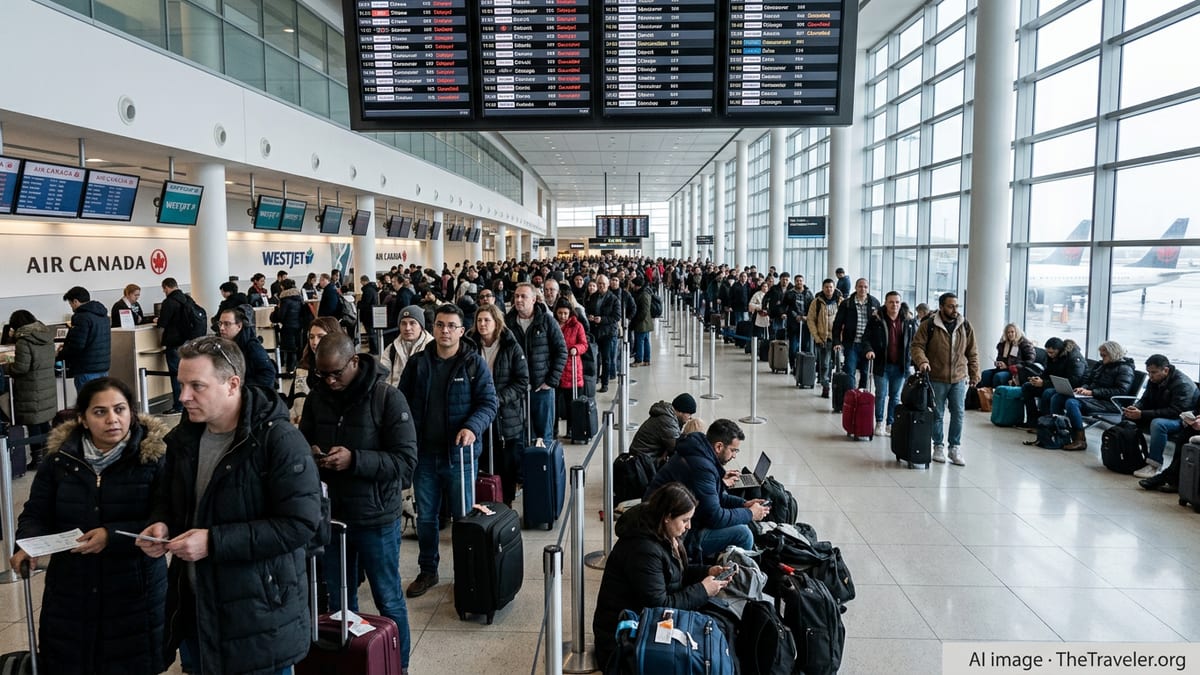
By midday Saturday, scenes of long lines at check-in counters, customer service desks and security checkpoints were reported in several terminals at Toronto Pearson. Passengers dealing with cancellations to Ottawa, Vancouver and U.S. cities such as Detroit, Chicago and Atlanta described waiting hours for rebooking assistance and alternative travel options.
Travelers connecting onward to Qatar and other Middle East destinations through partner hubs said the uncertainty around connecting flights heightened anxiety. Some were offered re-routings via alternate European or U.S. gateways, while others were advised to return home and await confirmed options for later in the week.
Accommodation proved to be another pressure point. With a concentration of cancellations on a limited number of high-demand routes, hotel availability near Toronto Pearson tightened quickly. Some passengers reported being offered vouchers for airport-area properties, while others said they were left to organize and pay for overnight stays on their own before seeking reimbursement.
Families traveling at the outset of March break and business travelers heading to early-week meetings voiced particular frustration, noting that even relatively small numbers of cancellations can have outsized personal and financial consequences when flights are fully booked and viable alternatives are scarce.
Advice for Travelers Heading to or Through Toronto Pearson
Airlines and airport authorities are urging passengers booked to travel through Toronto Pearson over the next 24 hours to monitor their flight status closely and allow extra time at the airport. Same-day schedule changes remain possible as carriers continue to reposition aircraft and crews and respond to evolving international conditions.
Travel experts recommend checking in online as early as permitted and signing up for airline notifications via text or app in order to receive real-time updates on gate changes, delays and rebookings. For those with tight connections, calling the airline or using its mobile app to explore alternative routings before arriving at the airport can improve the chances of securing a workable backup plan.
Passengers whose flights are significantly delayed or cancelled are being encouraged to familiarize themselves with Canadian air passenger protection rules, which set out minimum standards of treatment such as food and drink during extended delays and, in some cases, hotel accommodation or compensation. The specific entitlements depend on the cause of the disruption and the size of the carrier.
With the busy spring and summer travel seasons approaching, analysts say Saturday’s events at Toronto Pearson serve as a reminder that travelers should build buffer time into complex itineraries, especially when connecting between domestic, U.S. and long-haul international flights. For now, the focus remains on restoring punctual operations and moving stranded passengers to their destinations as quickly as capacity allows.