

More news on this day
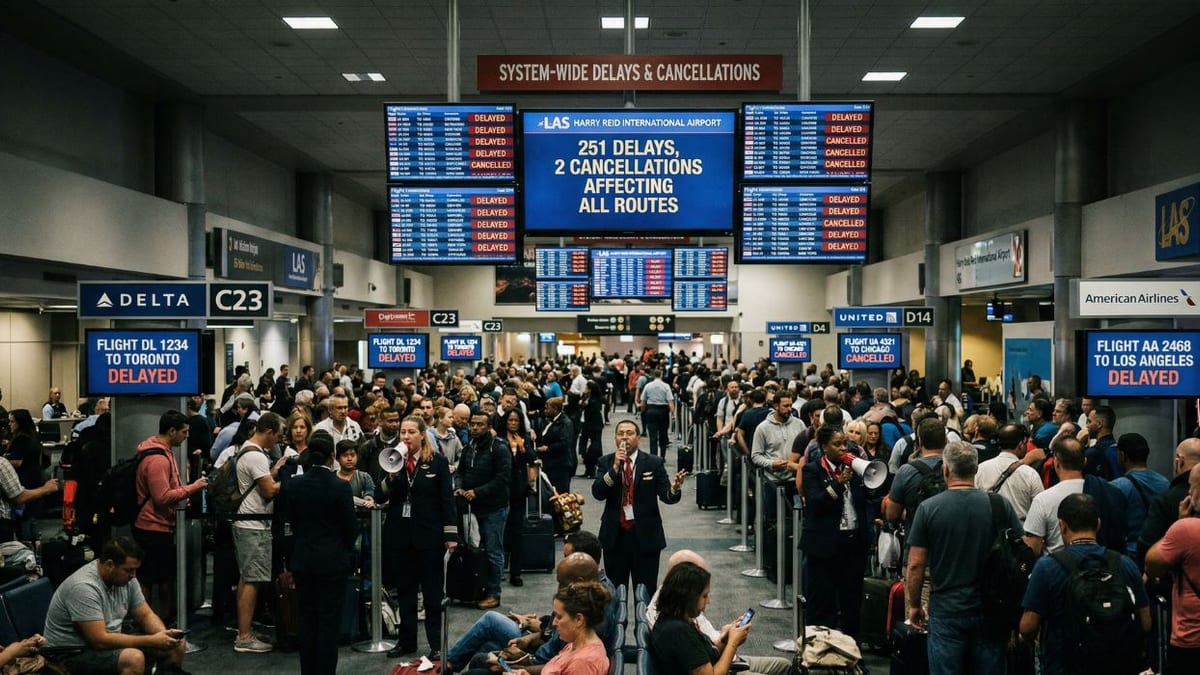
Travelers moving through Harry Reid International Airport in Las Vegas on April 11 faced a cascade of delays as 251 flights were reported late and two canceled, stranding passengers and disrupting connections across North America.
Get the latest news straight to your inbox!
Delays Ripple Across Major US and Canadian Hubs
Publicly available flight tracking data and industry reports indicate that the disruption at Harry Reid International Airport affected a broad mix of domestic and international services, including routes to Los Angeles, Chicago, Toronto, Denver and New York. The pattern mirrors a wider spike in delays seen at major US hubs in recent days, with weather systems and air traffic constraints cited in broader national coverage as key contributors.
At Las Vegas, the impact was concentrated in the late morning and afternoon bank of departures, when many carriers funnel traffic to onward connections. Flights to Los Angeles and Denver in particular appeared heavily affected, compounding pressure on already busy hubs that themselves reported elevated delay volumes this week.
Connections to Chicago, Toronto and New York were also disrupted, with late running departures from Las Vegas reducing the likelihood that travelers could make same-day onward flights. For many passengers, especially those relying on tight layovers, even moderate schedule slippage at Harry Reid translated into missed onward journeys and extended overnight stays.
The delay spike in Las Vegas comes amid a broader pattern of turbulence across the US aviation network in early April, as other airports such as Denver and Phoenix also reported high numbers of late and canceled flights. Industry analyses describe a fragile system in which localized weather or airspace restrictions at one hub quickly propagate through interconnected schedules nationwide.
Major Airlines Face Operational Strain
According to published coverage focused on Las Vegas operations, the disruption touched a broad portfolio of airlines, including Delta Air Lines, United Airlines and American Airlines, along with several low-cost and regional carriers. These three large network airlines maintain dense schedules from Harry Reid International Airport, with year-round services to key hubs such as Los Angeles, Denver, Chicago and New York.
When delays accumulate at a hub airport, aircraft and crew rotations are often knocked out of their planned sequence. Industry observers note that a late arriving aircraft from Denver, for example, may be scheduled to turn quickly to a New York or Toronto departure, so a single disruption can cascade into multiple subsequent delays. As a result, passengers at Las Vegas experienced not only late departures but also extended waits at gates while airlines repositioned aircraft and crews.
Operational data from recent months shows that Harry Reid International has rebounded strongly in passenger volumes, with carriers such as Delta, United and American expanding schedules to meet demand. That growth means more daily movements and tighter utilization of aircraft and gates, leaving less margin to absorb unplanned events such as thunderstorms, air traffic flow restrictions or temporary ground delays.
For airlines, managing such disruption often involves a mix of tactical measures, including swapping aircraft, consolidating lightly booked departures, or rebooking travelers onto later flights or alternative routings. On busy leisure travel days in a city like Las Vegas, where flights often depart at or near capacity, these options can be limited, leading to longer waits for available seats.
Passengers Confront Long Waits and Uncertain Itineraries
Travelers at Harry Reid International reported extended gate holds, shifting departure times and crowded concourses as the day progressed. With 251 flights delayed and two canceled, the volume of affected passengers quickly exceeded the capacity of immediate rebooking options, particularly on peak routes to Los Angeles, Denver and other western hubs.
Publicly available information on airline apps and airport displays showed rolling departure time adjustments, a common pattern during large-scale disruptions as carriers wait for updated aircraft arrival times and air traffic control release slots. For passengers, this can translate into hours of uncertainty, as gates alternate between boarding notices and further pushbacks of departure estimates.
Families and leisure travelers heading home from Las Vegas were among those most exposed, especially if they had fixed commitments the following day. Some travelers with missed connections in cities such as Chicago, Toronto or New York faced the prospect of overnight stays or rerouting through alternate hubs, adding hotel and meal costs to an already expensive travel day.
The airport’s status as a major origin and destination market also means a high proportion of passengers begin or end their journeys in Las Vegas. In disruption scenarios, these travelers may find it challenging to secure same-day alternatives, as many flights to key hubs already operate with high load factors, limiting available standby capacity.
Official Data Highlights Network Vulnerability
Aggregated airport status information published by federal aviation authorities showed Harry Reid International operating under delay conditions, aligning with the elevated disruption reported by travel industry outlets. While the data does not list causes for individual flights, it reflects the cumulative impact of weather, traffic management initiatives and operational constraints on overall airport performance.
National figures compiled for the past several days show thousands of delayed flights across the United States, with particular concentration at large hub airports. Analyses by consumer travel services point to thunderstorms over key corridors, high winds near mountain regions and periods of constrained air traffic capacity as primary drivers of recent disruption.
Experts note that airports such as Las Vegas, Denver and Phoenix play an outsized role in connecting traffic across the western United States. When one of these nodes experiences disruption, flights cascade through the network, affecting travelers far beyond the immediate region. The situation at Harry Reid International on April 11 fits this pattern, with delays spreading into connecting banks at airports across the country and into Canada.
The episode underscores the delicate balance between high aircraft utilization and resilience. Airlines and airports have rebuilt schedules to meet strong post-pandemic demand, but that efficiency can leave relatively little slack in the system when weather or airspace constraints squeeze capacity on a busy travel day.
Guidance for Travelers Navigating the Disruption
Consumer advocates and travel analysts consistently recommend that passengers facing large delay events rely on multiple information channels, including airline mobile apps, text alerts and departure boards, to track rapidly changing departure times and gate assignments. Publicly available guidance also stresses the importance of confirming rebooking options before leaving the airport, as seat availability can shift quickly when hundreds of travelers are vying for alternatives.
Travel rights in the United States vary by airline and situation, but carrier customer service policies typically outline options such as free same-day changes, rebooking on later flights and, in some cases, hotel and meal vouchers when disruptions are within an airline’s control. Travelers are often advised to retain receipts and document delays in case they seek reimbursement or file complaints later.
For those with travel scheduled through Las Vegas in the coming hours, industry reports suggest allowing extra time at the airport and preparing for ongoing schedule adjustments as airlines work through the backlog. Flexible travelers who can accept alternative routings, such as connecting through secondary hubs or nearby cities, may have better odds of reaching their destination the same day.
More broadly, the latest disruption at Harry Reid International illustrates how quickly conditions can change, even at airports that typically process heavy passenger volumes efficiently. For many travelers, building additional buffer time into itineraries and keeping contingency plans in mind has become a practical response to an aviation system that remains highly sensitive to shocks.