

More news on this day
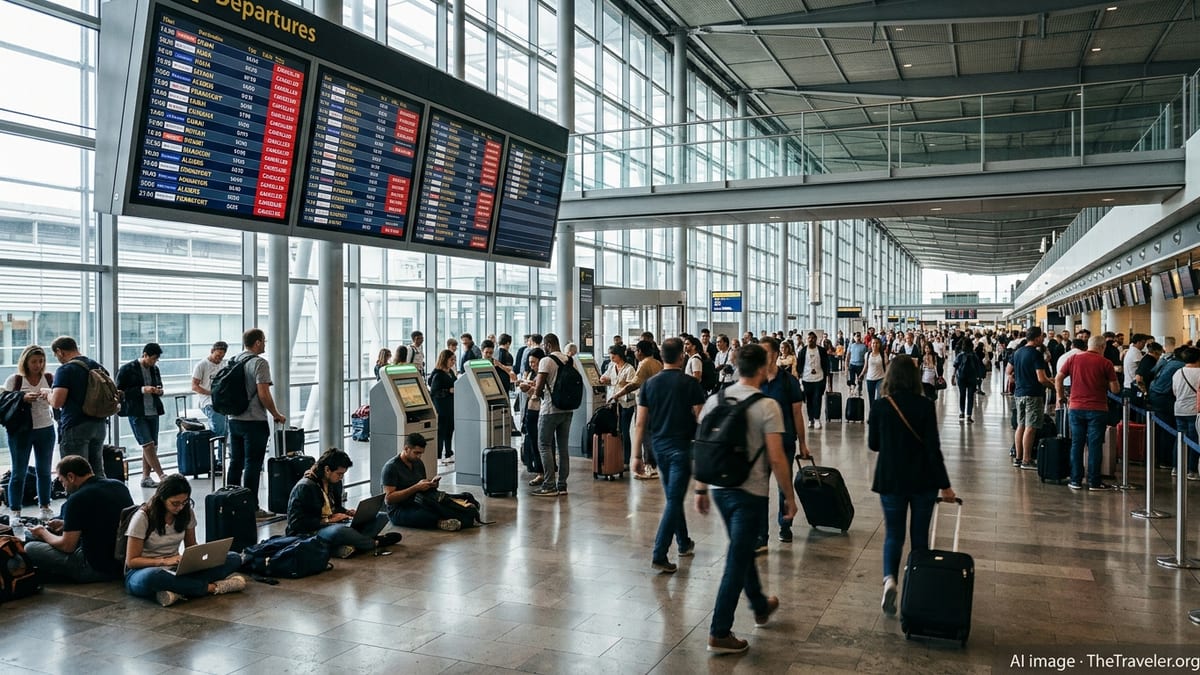
Travelers moving through Paris Charles de Gaulle/Roissy Airport are facing a fresh wave of disruption as multiple reports point to at least seven suspended flights and widespread delays on routes operated by Air France, Gulf Air and Qatar Airways, affecting traffic to and from Paris, Dubai, Riyadh, Algiers, Frankfurt and other major hubs.
Get the latest news straight to your inbox!
New Wave of Disruptions at Europe’s Second-Busiest Hub
Publicly available airport and airline information shows that Paris Charles de Gaulle, already under pressure from region-wide airspace restrictions, has seen a tightening of long-haul schedules involving key Middle East and North African destinations. Air France, Gulf Air and Qatar Airways all appear among the carriers adjusting or suspending services, including links to Dubai, Riyadh, Algiers and Frankfurt.
The latest wave of disruption follows weeks of instability in Gulf airspace that has forced airlines to reroute or temporarily ground services across the region. Coverage in international and regional media describes cascading effects on European hubs, including Paris and Frankfurt, as carriers work around closed or restricted air corridors and manage aircraft and crew rotations.
At Charles de Gaulle, Air France remains the dominant long-haul operator, and its network touches nearly all of the affected cities. Any suspension of even a handful of departures or arrivals quickly narrows options for travelers relying on the airport as a transfer point between Europe, the Middle East and Africa, heightening the impact of a relatively small number of canceled sectors.
Travel forums and live flight-tracking portals highlight extended ground times for some widebody aircraft, irregular gate changes and rolling departure delays as airlines adjust to fast-moving operational constraints. While the number of outright cancellations appears lower than during the earliest days of the Gulf airspace closures, knock-on delays are still rippling through the system.
Air France Cuts and Delays Hit Paris Links With Dubai, Riyadh and Algiers
According to recent coverage from European and Middle Eastern news outlets, Air France has trimmed parts of its Gulf and North Africa program from Paris while maintaining a skeleton of essential services. The carrier’s longstanding route from Paris Charles de Gaulle to Dubai International has been among those facing intermittent suspensions and schedule changes as flights are rerouted around sensitive airspace or consolidated onto fewer frequencies.
Services to Riyadh and Algiers have also seen temporary cancellations and extended delays on certain days, based on aggregated schedule data and flight tracking snapshots from early to mid March. These adjustments appear designed to prioritize aircraft and crew where demand is highest and where alternative connectivity is most limited, but they still leave gaps for travelers who had planned to connect through Paris.
Passengers with itineraries involving onward connections from Riyadh, Algiers or other regional cities report missed links in Paris after late-arriving inbound flights, resulting in unplanned overnight stays and rebookings onto heavily loaded alternatives. Even when flights do operate, longer routings around restricted areas can push crew duty hours close to regulatory limits, increasing the risk of last minute delays.
Air France’s public-facing advisories in recent weeks have emphasized safety and compliance with government directives as the primary drivers of schedule changes. Travelers are being directed toward online self-service tools and customer service channels to check eligibility for rebooking, vouchers or refunds when flights are canceled or significantly delayed.
Gulf Air and Qatar Airways Adjust Networks as Airspace Stays Tight
Gulf Air and Qatar Airways, both heavily dependent on Gulf-region hubs for their global networks, remain constrained by evolving airspace restrictions and security concerns, and those pressures are now clearly visible in their Paris operations. Public information on airline schedules indicates that Gulf Air has reduced or suspended selected services, with some passengers routed through alternative airports such as Dammam to maintain partial connectivity.
Qatar Airways, which has publicly described its scheduled operations as temporarily suspended at various points in recent weeks, has relied on limited relief and repatriation flights to major European destinations, including Paris and Frankfurt. Travel update notices circulated via the airline’s channels and widely shared on passenger forums describe narrow “corridor” operations, with a small number of flights prioritized for stranded travelers.
These constrained operations mean that Qatar Airways’ usual high-frequency links between Doha and Paris Charles de Gaulle remain far from normal, directly affecting travelers using CDG as a gateway to South and Southeast Asia, Australasia and parts of Africa. With fewer departures and complex routing, seats on remaining services are scarce, and alternative itineraries often involve multiple carriers and longer layovers.
For Gulf Air, the combination of restricted airspace and shifting demand has prompted schedule changes that reduce non-stop options between the Gulf and Paris. Passengers connecting beyond Paris to other European cities such as Frankfurt, Amsterdam or Madrid are finding that missed connections or equipment swaps can ripple through their journeys far beyond the original point of disruption.
Frankfurt, Dubai and Other Major Hubs Feel the Knock-On Effect
The suspension and delay of seven flights tied to Charles de Gaulle is resonating well beyond Paris itself. Frankfurt, one of Europe’s largest connecting hubs, is seeing altered arrival and departure patterns from Gulf and North African carriers, including relief flights and irregular operations by Qatar Airways and others. These changes can compress transfer windows, push back departure times and concentrate demand onto a smaller set of viable connections.
Dubai, typically one of the world’s most reliable mega-hubs, has endured an unusual period of volatility. While leading Gulf carriers are gradually rebuilding their schedules, widely circulated airline bulletins show that some routes to and from Paris and other European cities remain suspended or consolidated. Travelers who normally rely on Dubai for smooth one-stop connections between Europe and Asia are facing longer itineraries, backtracking routings and shorter booking horizons as carriers release schedules in smaller increments.
Riyadh and Algiers, important regional gateways in their own right, are also entangled in the disruption. Cancellations and delays on Air France and partner services moving through Paris can isolate these markets from parts of North America and Asia that typically depend on overnight connections via CDG. Even where local airports remain fully open, the loss of a few critical long-haul links can markedly reduce global reach.
Beyond the headline cities, secondary airports across Europe, Africa and the Middle East are absorbing diverted traffic and replacement services, often with limited infrastructure to handle sudden surges in connecting passengers. This secondary strain adds another layer of complexity for airlines already juggling crew positioning and aircraft maintenance schedules.
What Travelers Should Expect in the Coming Days
Publicly available information from airlines and airports suggests that conditions remain fluid, and travelers using Charles de Gaulle or connecting through affected hubs should expect continued schedule changes, rolling delays and occasional short-notice cancellations. While some carriers indicate gradual normalization over the second half of March, the pace of recovery is closely tied to security assessments and the reopening of key airspace corridors.
Passengers planning to fly with Air France, Gulf Air or Qatar Airways on routes touching Paris, Dubai, Riyadh, Algiers or Frankfurt are being advised, through multiple public channels, to monitor their bookings frequently and to arrive at the airport with additional time to navigate possible gate changes and longer check in queues. Many airlines are temporarily waiving change fees or offering more flexible conditions for tickets affected by the disruption.
Travel industry analysts note that even after official schedules stabilize, residual effects such as displaced aircraft, out of position crews and a backlog of rebooked passengers can keep load factors high and standby availability low for several days. As a result, those with essential travel in the near term may wish to secure confirmed itineraries rather than relying on last minute standby options.
For now, Charles de Gaulle’s role as a critical European gateway means that any suspension or delay involving its long haul services is felt across multiple continents. With Air France, Gulf Air and Qatar Airways all making tactical cuts or adjustments, the knock on impact remains significant for business and leisure travelers alike, and the outlook hinges on how quickly a more stable operating environment returns to the Gulf region.