

More news on this day
Targeted flight suspensions by Air France, Gulf Air and Qatar Airways at Paris Charles de Gaulle Airport have triggered a fresh wave of delays and missed connections across Europe, the Gulf and North Africa, with at least seven services canceled and schedules disrupted on key routes linking Paris with Dubai, Riyadh, Algiers, Frankfurt and other major hubs.
Get the latest news straight to your inbox!
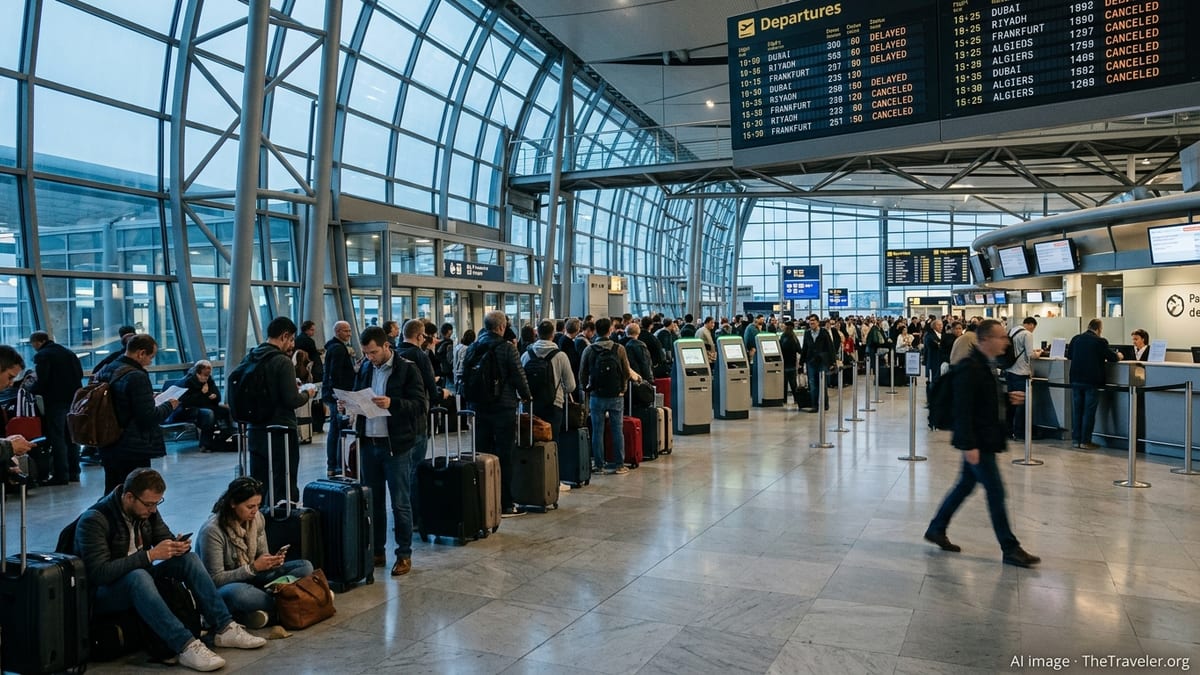
Targeted Cancellations Add Pressure at Roissy Hub
Reports from airline trackers and passenger channels on March travel days indicate that a cluster of seven flights involving Air France, Gulf Air and Qatar Airways was suspended at or through Paris Charles de Gaulle, better known locally as Roissy. The affected services are concentrated on trunk routes that normally move large volumes of business and transfer traffic between Europe and the Gulf, magnifying the impact beyond the individual flight numbers.
Air France has already been operating through a period of heightened disruption this winter, with earlier weather related capacity cuts at Charles de Gaulle and Orly and a series of ad hoc cancellations on long haul services. The latest suspensions, tied to operational constraints and the volatile security situation affecting parts of the Middle East, add fresh strain just as demand for spring travel picks up.
Gulf Air and Qatar Airways, which both rely heavily on feed from European gateways into their Gulf hubs, have been adjusting their timetables throughout March amid broader regional airspace restrictions. The temporary withdrawal of selected Roissy rotations reduces connectivity for passengers heading toward Bahrain, Doha and onward points in Asia and Africa, while also complicating crew and aircraft positioning.
Although only a limited number of flights have been formally suspended, publicly available data show that knock on delays and re timings are affecting a much larger slice of the schedule at Charles de Gaulle. Passengers on unaffected services are still experiencing extended ground times as aircraft wait for new routings around closed or congested airspace.
Ripple Effects Reach Dubai, Riyadh, Algiers and Frankfurt
The Paris centric disruptions are feeding directly into wider schedule volatility across major hubs including Dubai, Riyadh, Algiers and Frankfurt. Published coverage of the ongoing Middle East security situation shows that carriers serving Dubai and other Gulf airports have faced repeated airspace closures and constraint periods in recent weeks, forcing detours and rolling rescheduling.
For Dubai in particular, where tight connection windows are the norm, the suspension of even a small number of feeder flights from Paris can mean hundreds of passengers missing onward long haul departures. Airlines are responding with a mix of rebooking on later services, rerouting via alternative European gateways and, in some cases, shifting travelers to partner carriers when seats are available.
Riyadh and other Saudi airports are also feeling the effect as Gulf Air and Qatar Airways adjust their networks in response to route specific restrictions and changing demand. According to flight tracking snapshots and passenger accounts, some services that would typically route via Doha or other Gulf hubs are instead being funneled through secondary airports, adding hours to total journey times.
North African and European hubs are not immune. Algiers is connected to Paris by multiple daily services that carry both point to point traffic and onward connections to the Middle East. Any reduction in capacity at Roissy quickly leads to constrained seat availability between the Algerian and French capitals. Frankfurt, another key transfer point for traffic to and from the Gulf, has seen additional demand as travelers attempt to re route away from affected Paris flights.
Operational and Security Context Behind the Disruption
The latest wave of suspensions at Charles de Gaulle is unfolding against a complex backdrop of operational and geopolitical pressures. European aviation in early 2026 has been contending with severe winter weather, including snow and freezing temperatures that have already forced capacity reductions at Paris area airports, alongside crew shortages carried over from earlier seasons.
At the same time, a deteriorating security environment in parts of the Middle East has led to temporary closures and restrictions in several airspaces, including over portions of the Gulf region. Publicly available information on these closures shows that airlines operating to Dubai, Doha and other hubs have been required on short notice to reroute or suspend flights, often with very limited room to adjust crew schedules and aircraft rotations.
Carriers such as Air France, Gulf Air and Qatar Airways are therefore managing intersecting constraints: slot limits and de icing operations in Europe, dynamic no fly zones and traffic flow restrictions in the Middle East, and strong passenger demand as the late winter and early spring travel period continues. In this environment, even routine technical issues or minor delays can cascade quickly into full cancellations.
Industry observers note that long haul networks built around tightly timed hub banks are particularly vulnerable to such shocks. When a single inbound segment to a hub like Paris or Dubai is removed, the lack of spare aircraft and crews can make it difficult to protect all downstream connections, leading airlines to prioritize certain markets while temporarily suspending others.
Passengers Confront Long Queues, Rebookings and Uncertain Timelines
For travelers, the immediate effects of the Roissy related suspensions are being felt in long queues at transfer desks, busy airline call centers and rapidly changing itineraries. Reports from passenger forums describe situations where journeys involving Paris and Gulf hubs have been extended by many hours, with some travelers routed through unexpected intermediate airports such as Istanbul, Athens or southern European cities to bypass constrained corridors.
According to publicly accessible airline guidance, affected customers are generally being offered free rebooking on later services, refunds for unused segments or, where agreements exist, travel on partner airlines. However, limited seat availability during peak days and ongoing uncertainty over future schedule adjustments mean that not all passengers are able to secure preferred alternatives at short notice.
Travelers with complex itineraries involving multiple legs across Europe, the Gulf and North Africa are being advised via airline channels and airport information screens to check flight status frequently and to allow significantly more time for connections. In some cases, passengers have opted to break journeys overnight rather than risk tight connections through congested hubs.
Families and business travelers heading to destinations such as Dubai, Riyadh, Algiers and Frankfurt are also facing downstream challenges with hotel bookings, ground transport and meeting schedules, as arrival times shift repeatedly. Travel insurers and credit card protection schemes may soften some of the financial impact, but many travelers are still contending with lost time and rearranged plans.
Outlook for Charles de Gaulle and Regional Hubs
While the seven suspended flights represent a relatively small fraction of the daily movements at Charles de Gaulle, the pattern of targeted cancellations highlights how fragile long haul connectivity remains when exposed to simultaneous operational and geopolitical strains. Aviation data cited in recent coverage suggest that airlines are continuing to rebuild schedules in a cautious, incremental fashion rather than returning immediately to pre disruption frequencies.
For Paris, the near term outlook hinges on both improved winter operating conditions and a stabilization of the security situation along key Middle Eastern corridors. Any easing of airspace restrictions would give carriers more flexibility to restore suspended services, but ongoing crew and fleet constraints may still limit how quickly full schedules can be reinstated.
In the broader network, hubs such as Dubai, Riyadh, Algiers and Frankfurt are expected to continue absorbing diverted traffic from affected routes. Some carriers may see opportunities to capture market share by increasing capacity on alternative city pairs, while others focus on maintaining reliability on their core links to Paris and other European gateways.
For travelers planning itineraries through Roissy and the Gulf in the coming weeks, publicly available advisories increasingly emphasize flexibility. Recommendations include allowing generous connection times, monitoring bookings closely for schedule changes and considering backup routings where possible in case further short notice suspensions occur.