

More news on this day
Saudi Arabia’s low cost carrier flyadeal is rapidly expanding operations from Madinah’s Prince Mohammad bin Abdulaziz International Airport, turning the holy city into a strategic base that strengthens domestic connectivity and supports the Kingdom’s Vision 2030 tourism and aviation goals.
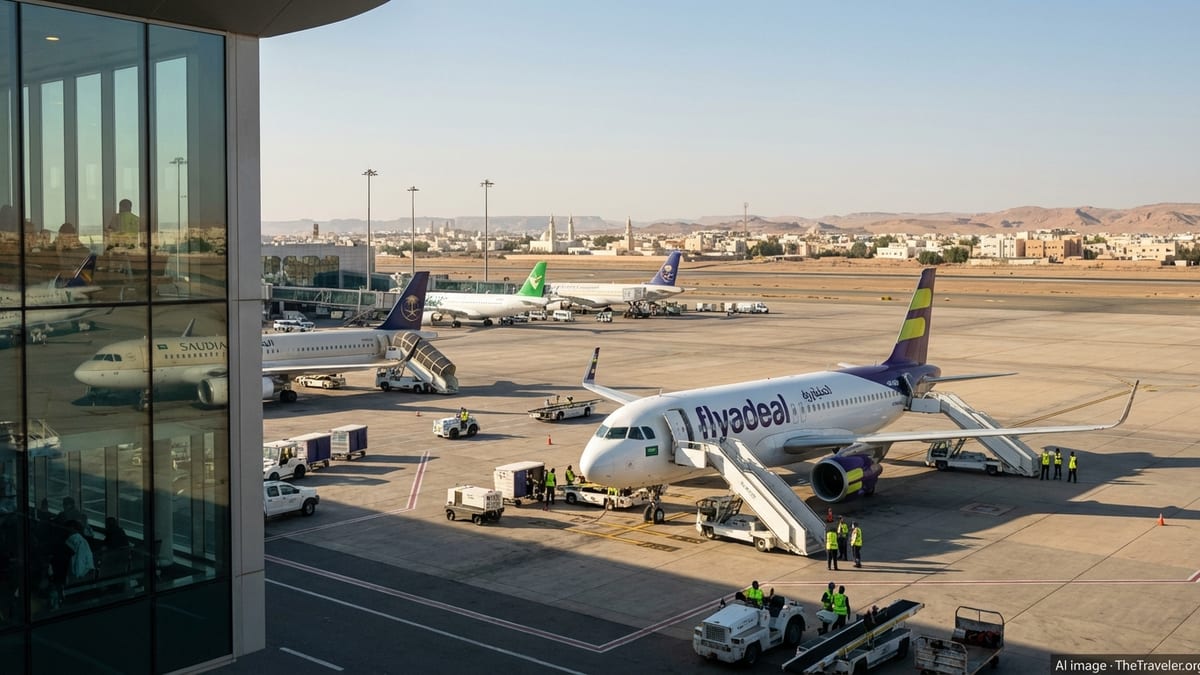
Madinah Becomes Flyadeal’s Fourth Operational Base
Flyadeal formally designated Madinah as its fourth operational base at the start of 2026, joining Riyadh, Jeddah and Dammam in the Saudia Group low cost carrier’s growing network. Two Airbus A320 aircraft are now permanently based at Prince Mohammad bin Abdulaziz International Airport, with plans to increase the number to four by the end of 2026 as demand builds on both domestic and international routes.
The move follows a substantial ramp up of services from Madinah. In early January the airline added five new routes, including an international link to Istanbul Sabiha Gokcen and domestic services to Abha, Al Hofuf, Jazan and Tabuk, lifting weekly capacity from the city by about 40 percent and expanding the destination list from three to eight.
Flyadeal executives describe Madinah as a natural choice for growth, citing its role as Islam’s second holiest city, a year round magnet for Umrah pilgrims and an increasingly important origin and destination market for Saudi residents and business travelers. Establishing a base allows more early morning departures, better aircraft utilization and the flexibility to open new city pairs that would be harder to sustain from other hubs.
The strategy aligns closely with Saudi Arabia’s National Transport and Logistics Strategy and its aviation component, which call for distributing traffic across multiple regional gateways rather than relying primarily on Jeddah. By anchoring aircraft and crews in Madinah, flyadeal is helping to reposition the city as a core pillar of the Kingdom’s evolving multi hub aviation system.
New Domestic Routes Strengthen National Connectivity
Flyadeal’s expansion from Madinah is focused heavily on domestic routes, reflecting Vision 2030 priorities to connect Saudi regions more tightly and stimulate internal tourism and commerce. After the initial January additions, the airline announced a further three domestic routes from its Madinah base to Jazan, Qassim and Arar, effective 1 March 2026. With these launches, flyadeal’s Madinah network now spans 10 direct destinations, most of them within the Kingdom.
The new services plug gaps in point to point connectivity that previously required travelers to backtrack through larger hubs. Cities such as Jazan on the Red Sea coast, Qassim in the central heartland and Arar in the Northern Borders region gain non stop access to one of the country’s principal religious and cultural centers. For residents of these regions, the services shorten journey times for pilgrimages, medical travel, education and business, while making it easier for Madinah based travelers to reach emerging domestic tourism spots.
Flyadeal is operating the routes with single class A320 aircraft, mirroring its wider low cost model of high utilization and simple onboard product. Industry analysts note that the combination of competitive fares and direct routings has the potential to stimulate new demand rather than simply divert traffic from full service carriers. As frequencies increase, the Madinah base is expected to function as a mini hub, allowing same day connections between secondary Saudi cities that previously had limited or no direct air links.
The focus on domestic connectivity is consistent with government targets to boost annual passenger volumes and ensure that at least 250 destinations are served by 2030. By adding frequencies and city pairs from Madinah, flyadeal is contributing capacity that helps the wider system absorb rapidly growing demand from residents and visitors.
Supporting Religious Tourism and Vision 2030 Tourism Targets
Madinah’s status as a spiritual center makes it central to Saudi Arabia’s broader tourism strategy, which aims to welcome 150 million visits annually by 2030. Flyadeal’s growing network from the city is designed to support both pilgrimage flows and the government’s push to encourage visitors to explore more of the Kingdom beyond the traditional Hajj and Umrah corridors.
The airline’s mix of domestic and selective international routes allows pilgrims to fly closer to their final destination and reduces pressure on Jeddah during peak seasons. Direct services from Madinah to Cairo and Istanbul, for example, provide additional options for large outbound and inbound markets, while domestic links enable religious visitors to pair their pilgrimages with trips to heritage areas such as AlUla or Red Sea coastal destinations reached via onward connections.
Officials and industry observers see low cost capacity as a key lever for making Saudi travel more affordable and accessible, particularly for repeat Umrah visitors and regional travelers with lower budgets. By embedding a value focused carrier in Madinah, authorities are creating a pricing and network alternative that complements full service operations and helps sustain year round demand outside the peak Hajj period.
Vision 2030 also emphasizes the economic diversification benefits of tourism. Additional flights bring more hotel nights, spending in transport and retail, and new employment opportunities at the airport and in ancillary services. As flyadeal deepens its presence in Madinah, the city’s role as both a destination and a starting point for wider exploration of the Kingdom is expected to grow.
Fleet Growth and Flyadeal’s Path to 2030
Flyadeal’s Madinah build up is underpinned by a sizeable fleet expansion program designed around Saudi Arabia’s long term aviation ambitions. Saudia Group has ordered 105 Airbus narrow body aircraft, with flyadeal allocated 12 A320neo and 39 A321neo jets, and the low cost carrier has separately committed to 10 Airbus A330 900neo wide bodies with options for additional units. These deliveries, scheduled from 2027, will take the airline’s fleet toward a target of around 100 aircraft by 2030.
The new generation narrow bodies will allow flyadeal to increase capacity and extend range to new regional markets while keeping operating costs low. The planned A330 900neo fleet will open long haul opportunities, positioning the airline to tap into future flows from Europe, South Asia and Southeast Asia directly into Saudi Arabia’s religious and leisure destinations.
Management has articulated a goal of roughly balancing domestic and international flying by 2030, compared with a network that is still weighted toward domestic routes today. Madinah is expected to remain a cornerstone of that strategy, handling a growing mix of short haul domestic sectors, regional links and, over time, selected medium haul services as aircraft with greater range enter the fleet.
Performance metrics provide further backing for growth. Independent data providers have ranked flyadeal among the region’s most punctual low cost carriers, supporting the brand’s value proposition for time sensitive travelers. Strong operational reliability from bases such as Madinah is seen as critical as the airline scales up frequencies and adds more complex patterns of connecting traffic.
A Key Piece in Saudi Arabia’s Multi Hub Aviation Map
Flyadeal’s expansion from Madinah illustrates how Vision 2030 is reshaping Saudi Arabia’s aviation geography. Rather than concentrating growth in a single megahub, authorities are encouraging carriers to develop multiple bases that collectively knit together the Kingdom’s regions and tourism projects.
While Riyadh is being developed as a major global hub and Jeddah remains central for Hajj traffic, airports such as Madinah are being upgraded to handle higher volumes and provide more direct access for visitors. Flyadeal’s decision to base aircraft in the holy city dovetails with infrastructure investments and plans for additional low cost carriers centered on other regions, including the Eastern Province.
For domestic travelers, the practical impact is a widening choice of routes, schedules and price points. For the state, the Madinah base represents another step toward its objective of connecting hundreds of destinations, attracting tens of millions of additional tourists and leveraging aviation as a driver of non oil economic growth by the end of the decade.
As new routes from Madinah come online and the fleet grows, flyadeal’s role in delivering that vision is likely to expand, reinforcing the city’s position as both a spiritual landmark and a modern aviation hub at the heart of Saudi Arabia’s transformation.