

More news on this day
International travelers heading from Beijing’s mega-hubs to the high plateau of Tibet in 2026 are entering a China that is markedly easier to access, yet still highly regulated once journeys extend into sensitive regions such as the Tibet Autonomous Region.
Get the latest news straight to your inbox!
Wider Visa-Free Entry and Longer Transit Windows
Publicly available information shows that by early 2026 China has turned visa policy into a key tool to revive inbound travel. A steadily expanding list of countries now enjoys short-stay visa-free entry of up to 30 days, while others can use transit waivers to visit without a full visa. Coverage in international media indicates that more than 70 countries are included in these visa-free arrangements, with further additions announced through 2025 and into 2026.
At the same time, China’s well-known transit-without-visa scheme has been upgraded. Policy notices reproduced by business and immigration advisories explain that the previous 72 and 144 hour visa-free transit has been extended to 240 hours in many major gateways, effectively allowing eligible travelers up to 10 days in selected regions when transiting to a third country. Travel industry summaries report that Beijing, Shanghai and other large hubs in 24 provincial-level areas are covered, significantly widening the scope for stopover tourism.
Recent statistics highlighted by travel intelligence firms note that tens of millions of foreign nationals used the extended transit waiver in 2025, underscoring how central this tool has become to China’s reopening strategy. For many travelers, this means that a carefully planned multi-city itinerary within the authorized areas can now be built around a long transit stay instead of a traditional tourist visa.
However, these visa-free and transit policies remain highly specific. Requirements typically include holding a passport from an eligible country, proof of an onward ticket to a third destination, and entry through one of the designated ports. Travelers are also expected to respect limits on where they can travel inside China under each scheme, so a detailed check against the latest consular or immigration guidance is essential before relying on visa-free entry.
Digital Arrival Cards and a More Automated Border
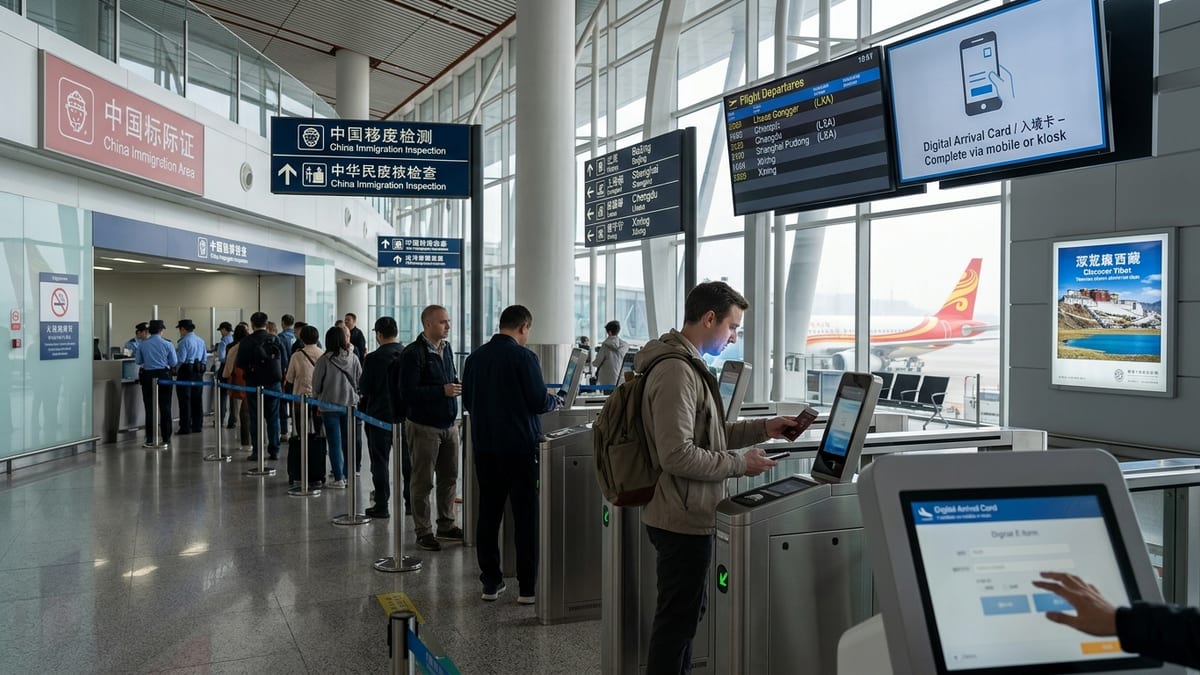
Alongside looser visa rules, China has started to digitize its arrival procedures. Posts on travel forums that summarize official notices indicate that a nationwide digital arrival card system was rolled out in late 2025, allowing foreign visitors to submit the information that used to be written on paper landing cards via mobile phone or kiosk before reaching the immigration counter.
According to these accounts, the digital card requires travelers to upload passport details, fill in basic personal data, declare their address in China and outline travel plans, then submit an electronic signature. Early user reports describe the process as straightforward but emphasize the need for a charged phone, reliable internet access on arrival or familiarity with the airport kiosks that are being installed to support those without local connectivity.
Airports are increasingly pairing the new arrival card with automated e-gates and biometric checks. Industry publications on Asia Pacific aviation trends describe a broader regional move toward “smart borders,” and China’s large hub airports are portrayed as part of this shift. For most international travelers the experience now includes scanning a passport, capturing facial images and sometimes fingerprints, followed by a shorter interaction with a border officer only when needed.
This modernization does not remove legal obligations. Travelers must still make sure their entry stamp, length of stay and permitted activity type match their actual plans. Reports compiled by visa information platforms note that those using transit waivers in particular must register accommodation details correctly and in some cases complete local police registration through their hotel or a dedicated online system.
What Changes for Trips That Include Tibet
The situation changes once an itinerary extends from Beijing, Shanghai or other mainland cities into Tibet. Tibet-focused tour operators and travel advisories that track policy developments for 2026 consistently state that foreign passport holders cannot travel independently in the Tibet Autonomous Region and must obtain a Tibet Travel Permit in addition to a valid Chinese visa or authorized visa-free stay.
According to these sources, the Tibet Travel Permit is arranged through a licensed Chinese travel agency, which uses a scanned passport and China visa page to apply on the traveler’s behalf. The permit is usually required before boarding flights or trains into Lhasa and is checked again at hotels and checkpoints around the region. Even travelers entering China visa-free or on transit waivers generally still need a standard Chinese visa in their passport if they plan to visit Tibet, since the regional permit is layered on top of national entry status.
Policy roundups published by Tibet specialist agencies for the 2025 to 2026 seasons indicate that, once in possession of the permit, foreign tourists can access the main open areas of the region with their organized tour. This typically includes Lhasa and a network of approved routes to major monasteries, lakes and viewpoints. However, exploration beyond these routes remains tightly controlled, with some border regions and sensitive counties entirely closed to foreign visitors for security or environmental reasons.
Travel advisories also stress that Tibet is subject to occasional short-notice closures for foreigners, frequently around major national anniversaries, sensitive political dates or during periods of heightened security. Such suspensions can affect both new permit approvals and the validity of permits already issued. Prospective visitors are encouraged by agencies and guidebooks to avoid scheduling Tibet as the final, non-flexible leg of a long Asia trip, and instead build contingency plans in case dates have to be shifted.
Planning an Itinerary from Beijing to the Plateau
For international travelers who want to pair China’s big-city experiences with Tibet’s landscapes in 2026, the updated entry system shapes how itineraries should be built. Guides produced by China and Tibet tour specialists recommend starting with a clear decision on visa type: relying on a 240 hour transit waiver might be suitable for city-based tourism within limited regions, but a full visa is usually the safer option for complex trips that include remote areas and possible date changes.
Once visa status is clear, the Tibet segment needs to be planned backward. Agencies generally advise confirming a Tibet Travel Permit and tour arrangement before booking nonrefundable domestic flights or trains into Lhasa. Because permits can only be issued once the China visa or confirmed entry status is in place, travelers coming from countries that enjoy visa-free entry may still opt to obtain a visa specifically to avoid complications when applying for Tibet documentation.
Route planning also has to account for altitude and logistics. Travel health resources and trekking guides note that many visitors prefer to acclimatize by spending a day or two in cities such as Xining, Chengdu or Shangri-La before continuing to Lhasa. With China’s train network and domestic flight schedules closely tied to the main eastern hubs, Beijing often serves as the international gateway for long-haul arrivals, but onward travel to Tibet typically involves a connecting domestic leg rather than a direct international-to-Tibet route.
Accommodation rules add another layer. Hotel registration systems in mainland China require foreign guests to stay only at properties licensed to host non-Chinese citizens, and this requirement applies equally in Tibet. Visitors moving from international hotels in Beijing to guesthouses on the plateau are therefore advised, in many guide-style overviews, to ensure bookings are made through reputable platforms or agencies that can confirm compliance with foreign guest regulations.
Key Compliance Risks for 2026 Travelers
While recent policy shifts are widely described as the most open China has been to foreign tourists in years, analysts and travel law commentators underline that compliance expectations have not relaxed. One frequently cited risk is misunderstanding the geographical limits attached to visa-free and transit entries. The extended 240 hour transit scheme, for instance, often restricts movement to specified provinces, which may not include Tibet or other border regions, regardless of how long the stay is permitted.
Another risk concerns registration obligations. Background notes in visa policy summaries recall that foreign visitors who fail to register their address on arrival, either through their hotel or local police systems, may face penalties that can include future bans on using visa-free transit. In the context of a Beijing to Tibet trip, this makes it particularly important to check that each overnight stop, including homestays or smaller lodges in Tibetan areas, is properly documented.
Travel security advice services also point to the sensitivity of photography, mapping devices and drones in Tibet and other frontier areas. Regulations publicized by regional authorities and echoed in tour operator briefings warn against photographing certain infrastructure, military sites or police installations, and typically prohibit recreational drone use without special approval. Non-compliance can lead to questioning, fines or in serious cases removal from restricted zones.
Finally, policy watchers note that China’s entry and exit rules remain dynamic. Visa-free trial schemes for specific nationalities are often introduced with fixed end dates, then extended or revised. Requirements for digital arrival cards, health declarations or app-based check-ins can also change on short notice. For 2026 travelers, the most reliable approach is to treat any itinerary, including those from Beijing to Tibet, as dependent on checking the latest official notices and reputable travel advisories shortly before departure and again just prior to entering sensitive regions.