

More news on this day
Thailand’s crucial Songkran travel season is approaching under a darkening economic and geopolitical sky, as exploding fuel costs, surging airfares and heightened regional tensions threaten to choke off visitor demand and derail the country’s fragile tourism-led recovery.
Get the latest news straight to your inbox!
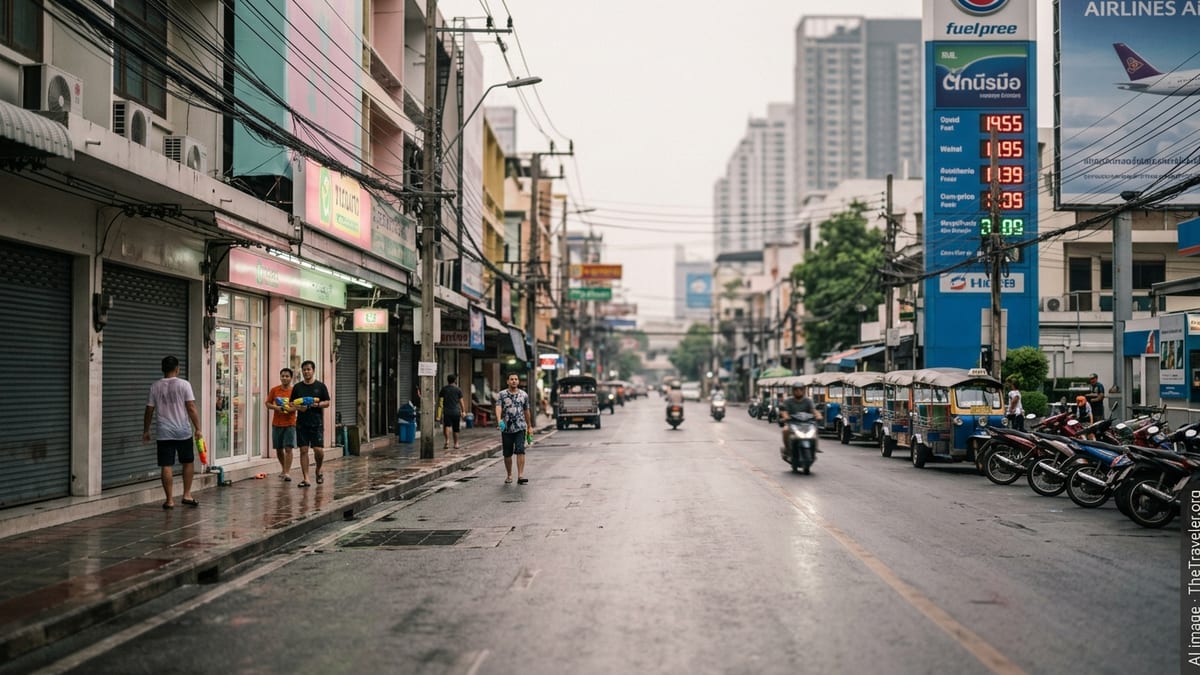
Songkran Under Pressure as Costs Spiral
Songkran, celebrated in mid-April and traditionally one of Thailand’s busiest travel periods, is emerging as an early stress test for the country’s 2026 tourism outlook. Airlines across Asia are raising fuel surcharges as global jet fuel benchmarks climb, feeding directly into higher ticket prices at a moment when households worldwide are already strained by lingering inflation and slower growth. The result is a peak season that is shaping up to be noticeably more expensive for both international arrivals and domestic travellers.
Recent fare data and airline notices across the wider region point to sharp increases in surcharges on tickets issued for early to mid-April, overlapping with Songkran travel dates. Industry monitors show that jet fuel prices have rebounded in recent months after a period of relative stability, driven in part by supply constraints and trade rerouting linked to geopolitical disruptions. For Thailand, which relies heavily on medium-haul flights from East Asia and long-haul connections from Europe, North America and the Middle East, sustained fuel inflation is feeding into structurally higher travel costs.
Higher airfares come at a fragile time for Thailand’s tourism sector. After a strong rebound in 2023 and 2024, multiple economic bulletins from Thai banks and international institutions through 2025 highlighted a clear loss of momentum, with visitor numbers and tourism receipts underperforming earlier projections. Estimates published in late 2025 pointed to foreign arrivals and revenue still well below pre-pandemic peaks, as weaker global demand, safety concerns and regional competition weighed on what had been expected to be a banner year.
Songkran normally provides a decisive boost to these figures, drawing millions of domestic trips and attracting visitors from China, Europe and within Southeast Asia. This year, however, high transport and accommodation costs are increasingly cited in public commentary as deterrents, with travellers either shortening stays, trading down to cheaper options, or diverting to rival destinations offering lower prices.
Geopolitical Tensions Cloud Travel Sentiment
The squeeze from fuel prices is being amplified by an unsettled geopolitical backdrop that is undermining traveller confidence and complicating flight operations. Heightened tensions and intermittent conflict in parts of the Middle East have forced some airlines to reroute services, increasing flight times and fuel burn on Europe–Asia corridors that are critical for Thailand’s long-haul market. Insurance costs and risk premia on certain airspaces have also ticked higher, adding another layer of expense that can eventually filter through to fares.
Beyond the direct aviation impact, global reports on trade disputes, new tariff rounds and broader geoeconomic fragmentation have cast a shadow over economic growth prospects in key source markets. International financial institutions have repeatedly warned that escalating trade and security tensions could dampen investment and consumer confidence in Asia, directly affecting discretionary spending on travel. For Thailand, where tourism has been positioned by the current administration as a primary growth engine, such external shocks pose a structural vulnerability.
Regional competition is sharpening in this context. Neighbouring destinations including Vietnam, Malaysia and Indonesia are aggressively marketing themselves as better-value alternatives, benefitting in some cases from weaker local currencies and targeted incentive schemes. Analysts note that when airfares rise across the board, perceived value at the destination becomes even more decisive, and Thailand’s longstanding pricing advantage is less clear than it was a decade ago.
Security perceptions are another piece of the puzzle. While Thailand continues to be marketed globally as a safe and welcoming destination, localised incidents, ongoing political debates and online discussion around crime and scams have eroded confidence among some potential visitors. In a climate of geopolitical uncertainty, such narratives can weigh more heavily on destination choice, especially when combined with rapidly rising travel costs.
Economic Recovery at Risk of Losing Its Tourism Lifeline
Thailand’s broader economic outlook has been closely tied to tourism’s performance. World Bank and domestic research reports released over 2024 and 2025 consistently pointed to visitor arrivals and tourism receipts as central drivers of growth, especially as exports remained weak and investment subdued. While some projections envisioned a full return to or even a modest surpassing of pre-pandemic arrival levels by the mid-2020s, more recent assessments have turned cautious, with several Thai banks revising 2025 and 2026 tourism forecasts downward as recovery stalled.
Central to this reassessment is evidence that tourists are both fewer and spending less per trip than anticipated. Industry surveys collected during 2025 highlighted declining average expenditure, with travellers trading luxury hotels and premium tours for mid-range accommodations and budget experiences. The combination of softer volumes and weaker per-capita spending has left overall tourism revenue significantly below earlier expectations, despite headline arrival figures that, on paper, appear comparatively resilient.
The risk for 2026 is that Songkran, instead of reinforcing recovery, exposes how fragile demand has become in the face of cost and confidence shocks. If high airfares and concerns about regional instability suppress bookings during what should be a peak period, analysts warn that annual growth projections for both tourism and the wider economy may need to be cut again. Monetary policy documents in late 2025 already flagged tourism’s slower-than-expected rebound as a key downside risk to growth and employment.
Domestic tourism, which played a critical stabilising role during earlier phases of the pandemic and recovery, is also under strain. Local consumers are confronting high household debt, flat real incomes and tighter credit conditions, making discretionary travel more sensitive to price spikes in fuel, accommodation and food. Without a robust domestic travel cushion, the economy is more exposed to any external shock that reduces foreign arrivals.
Airlines, Hotels and Small Businesses Caught in the Squeeze
Behind the macroeconomic charts, the shifting Songkran outlook is already being felt through Thailand’s tourism value chain. Airlines serving the country face a difficult choice between absorbing higher fuel and financing costs or passing them on through higher fares and surcharges that risk weakening demand. Many carriers entered 2026 with thin balance sheets after years of pandemic disruption and only a partial earnings recovery, limiting their capacity to shield passengers from rising operating expenses.
Hospitality operators are encountering similar pressures. Hotels and guesthouses in Bangkok, Chiang Mai, Phuket and other Songkran hotspots report higher utility and staffing costs, along with increased expenditure on safety, marketing and digital distribution. Larger international chains may be able to leverage scale, loyalty programmes and diversified regional portfolios, but smaller independent properties and family-run guesthouses, which make up a significant share of Thailand’s accommodation stock, are more vulnerable to any last-minute drop in bookings.
Tour operators, transport providers and street-level businesses that depend on Songkran crowds are watching booking patterns nervously. Publicly available booking data and anecdotal reporting suggest a shorter booking window compared with pre-pandemic years, as travellers delay decisions in the hope of price relief or greater clarity around global events. This late demand visibility makes it harder for operators to manage staffing, inventory and cash flow, while also limiting their ability to plan promotions or adjust capacity.
In secondary cities and rural destinations that the government has tried to promote as part of a more inclusive tourism strategy, the stakes are high. World Bank analysis has previously underscored the role of tourism in supporting incomes in these areas, where alternative economic opportunities can be limited. A weak Songkran season risks widening the gap between major hubs that can still attract higher-spending visitors and smaller communities that rely on volume-driven domestic and regional tourism.
Policy Responses and the Narrow Window for Stabilisation
Thai policymakers are under growing pressure to safeguard tourism’s contribution to the economy without locking in unsustainable subsidies or distorting the market. In recent years the government has rolled out a mix of visa relaxations, promotional campaigns and targeted stimulus measures aimed at boosting arrivals and encouraging spending. Initiatives branding 2025 and 2026 as showcase years for tourism and sports signalled an ambition to reassert Thailand’s regional leadership as a destination.
Economic research from multilateral institutions and domestic banks has repeatedly emphasised, however, that short-term marketing pushes are unlikely to offset structural headwinds such as high travel costs, demographic shifts in key markets and intensifying competition. Analysts argue that to cushion the impact of volatile fuel prices and geopolitical shocks, Thailand will need to deepen air connectivity with a broader mix of carriers and routes, strengthen safety and consumer protection frameworks, and accelerate investments in sustainable, higher-value tourism products.
In the nearer term, the focus ahead of Songkran is on practical steps to make travel more predictable and affordable. These include clearer communication around domestic transport pricing, crowd management and safety measures, and efforts to smooth the visitor experience at airports and key transport hubs. Industry groups are also calling for closer monitoring of accommodation and tour pricing to avoid opportunistic spikes that could further damage perceptions of value.
Whether these efforts will be enough to offset the drag from exploding fuel costs and rising geopolitical risks remains uncertain. As the water fights and temple ceremonies that define Songkran draw near, Thailand finds itself in a delicate balancing act: trying to protect a vital economic pillar in an era when global shocks travel as quickly as the jets bringing visitors to its shores.