


More news on this day
Gdańsk is moving ahead with plans for a new rail facility capable of handling 750‑metre freight trains, positioning the Baltic port city for larger cargo flows and closer alignment with European rail standards.
Get the latest news straight to your inbox!
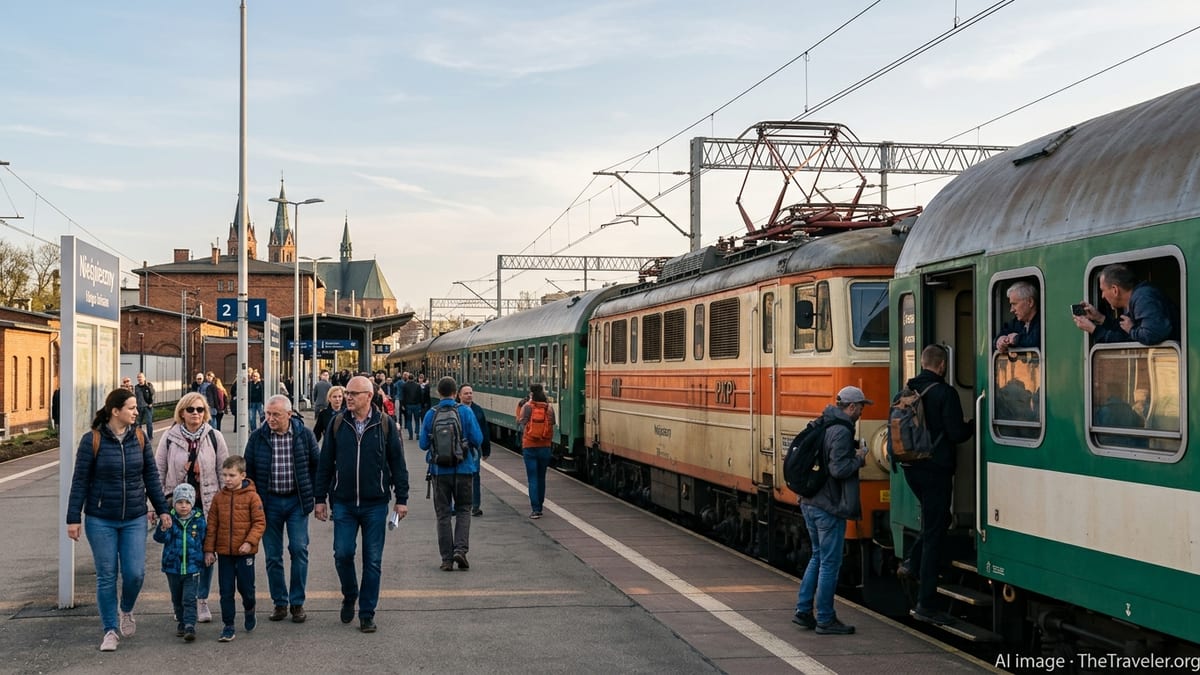
Strategic upgrade to meet European freight standards
The planned rail facility in Gdańsk is designed around the 750‑metre benchmark that has become a de facto standard for interoperable freight trains across much of Europe. Longer, heavier trains allow operators to move more containers or bulk cargo per path, improving the economics of rail freight on key north south and east west corridors.
Reports on European freight policy highlight that 750‑metre trains are increasingly seen as the optimal length for cross border services, balancing capacity gains with the constraints of station loops, signalling blocks and level crossings. By preparing for these longer formations, Gdańsk is seeking to ensure that its inland connections do not become a bottleneck as shipping lines deploy larger vessels and as inland logistics hubs expand.
The city already handles substantial rail volumes linked to the Port of Gdańsk and nearby container terminals. Publicly available information on Polish rail infrastructure points to continuing pressure on mixed passenger and freight lines serving the Tri City area, reinforcing the case for modern sidings and dedicated freight capacity that can receive longer trains without disrupting regional commuter services.
The new project is intended to integrate with national rail upgrades that aim to improve line capacity, axle loads and signalling, creating a backbone capable of hosting more and longer freight trains between the Baltic coast, Silesian industrial region and neighbouring countries.
Port of Gdańsk and inland terminals seek extra capacity
The initiative is closely linked to the growth of the Port of Gdańsk, which has emerged over the past decade as a major deep sea gateway for Central and Eastern Europe. Container terminals serving the port have invested in additional tracks and rail-mounted cranes to support higher rail shares, positioning Gdańsk as an alternative to traditional North Sea hubs for Asia Europe and intra European trade.
Industry reports on the Polish container market indicate that rail is gaining a larger role in hinterland distribution from Baltic ports, particularly for flows to logistics clusters in southern Poland and to neighbouring markets such as the Czech Republic and Slovakia. A facility capable of receiving 750‑metre trains is seen as a logical next step in this evolution, allowing block trains to run at European standard lengths between coastal terminals and inland hubs.
Existing lines around Gdańsk already host significant freight traffic, including flows to bulk terminals and refinery facilities. However, many sidings and passing loops were originally designed for shorter trains, limiting the ability to assemble or receive full length European freight services without complex shunting. The new installation is expected to provide reception, overtaking and staging tracks dimensioned for 750‑metre sets, reducing dwell times and improving punctuality.
In parallel, Polish national freight operators are renewing wagon fleets and promoting intermodal services that can take advantage of longer train lengths. The Gdańsk project is therefore emerging at a time when rolling stock, operational practices and infrastructure are gradually aligning around the 750‑metre standard.
Relieving pressure on mixed traffic lines
One of the stated goals of the project is to ease pressure on busy passenger corridors in the Tri City agglomeration, where commuter services already run at high frequencies. Analyses by the Polish rail regulator describe how mixed operation of frequent suburban trains and slower, heavier freight can constrain capacity and limit timetable flexibility, especially on two track sections.
By providing a modern freight facility away from the most congested passenger stations, planners aim to concentrate shunting, train assembly and overtaking movements in an area purpose built for heavy rail operations. This approach is consistent with broader European practice, where freight yards and long sidings are often located just outside dense urban passenger nodes to minimise conflicts at junctions.
Longer reception tracks also make it easier to schedule freight trains in fewer but more concentrated paths. Instead of running several shorter trains, operators can consolidate loads into 750‑metre formations, reducing the number of slots needed on heavily used lines. For a metropolitan rail network that carries large numbers of daily commuters, this can translate into more stable passenger timetables and a lower risk of knock on delays.
The Gdańsk scheme is also expected to improve operational resilience during disruptions. With additional tracks sized for full length freight trains, dispatchers gain more options for re-routing, overtaking or temporarily holding trains without blocking main running lines, which can be critical during maintenance works or unplanned incidents.
Environmental and modal shift ambitions
European transport policies increasingly encourage the use of rail for medium and long distance freight as a way to reduce greenhouse gas emissions and road congestion. Poland has echoed these objectives in national strategies that call for higher rail market share, particularly on key corridors linking ports, industrial areas and border crossings.
The ability to run 750‑metre freight trains from Gdańsk is closely tied to these modal shift ambitions. Longer trains typically mean lower emissions per tonne kilometre, since locomotive power and crew costs are spread over more cargo. When combined with modern electric traction and upgraded infrastructure, this can make rail a more competitive alternative to long haul trucking on busy corridors connecting the Baltic coast with the interior of Europe.
For the city of Gdańsk and its surrounding region, a greater reliance on rail freight also has local benefits. Shifting heavy cargo from road to rail can reduce heavy truck traffic on urban and suburban roads, with potential gains in air quality, noise levels and road safety. Planning documents for Polish ports have frequently highlighted the need to improve hinterland rail capacity in order to avoid a surge in port related truck movements.
As shipping lines add new services to Baltic ports and logistics operators consolidate flows through regional hubs, the ability to offer reliable, high capacity rail connections becomes an important factor in securing new trade lanes. The proposed Gdańsk facility is being framed as part of this broader effort to position the city as a sustainable gateway for Central and Eastern European supply chains.
Integration with wider rail modernisation in Poland
The Gdańsk project is unfolding against a backdrop of extensive rail modernisation across Poland, much of it supported by European funding instruments focused on core network corridors. Upgrades include track renewals, new signalling systems and selective extension of passing loops to accommodate 750‑metre freight trains on priority routes.
Recent technical reports on the Polish rail network underline the need for coherent planning so that investments at ports, freight yards and on main lines reinforce each other. A terminal designed for long freight trains has the greatest impact when it is connected to corridors where similar train lengths can be operated without restrictions at intermediate stations and junctions.
Gdańsk is positioned on several important axes, including north south connections toward Silesia and east west routes that form part of trans European freight corridors. With growing interest in rail based links between Central Europe and markets to the east, rail capable port cities such as Gdańsk are seen as strategic nodes where seaborne and land based corridors intersect.
While detailed timelines and technical specifications for the new facility are still being refined, the decision to plan for 750‑metre freight operations signals an intention to align Gdańsk with emerging European norms. For shippers, logistics providers and rail operators, that alignment could translate into more efficient services, better reliability and expanded options for sustainable transport in the years ahead.