

More news on this day
Germany has begun rolling out Europe’s new Entry/Exit System alongside Spain, France, Portugal, Italy, Greece, the Netherlands and other Schengen states, marking a significant shift in how Canadian travelers are identified, registered and monitored at the continent’s external borders.
Get the latest news straight to your inbox!
What Europe’s New Entry/Exit System Actually Does
The European Union’s Entry/Exit System, commonly referred to as EES, is a large-scale digital border management platform that records crossings of non-EU nationals arriving for short stays in the Schengen Area. Public documentation from EU institutions describes it as an automated IT system that replaces manual passport stamping with electronic records, capturing biographical and biometric information every time an eligible traveler enters or leaves participating countries.
The system became operational on October 12, 2025, and is being introduced progressively at airports, seaports and land crossings over a period of up to six months, with full coverage of Schengen external borders expected by April 2026. Official EU communications indicate that 29 European countries, including Schengen-associated states such as Norway, Switzerland, Iceland and Liechtenstein, are part of the rollout.
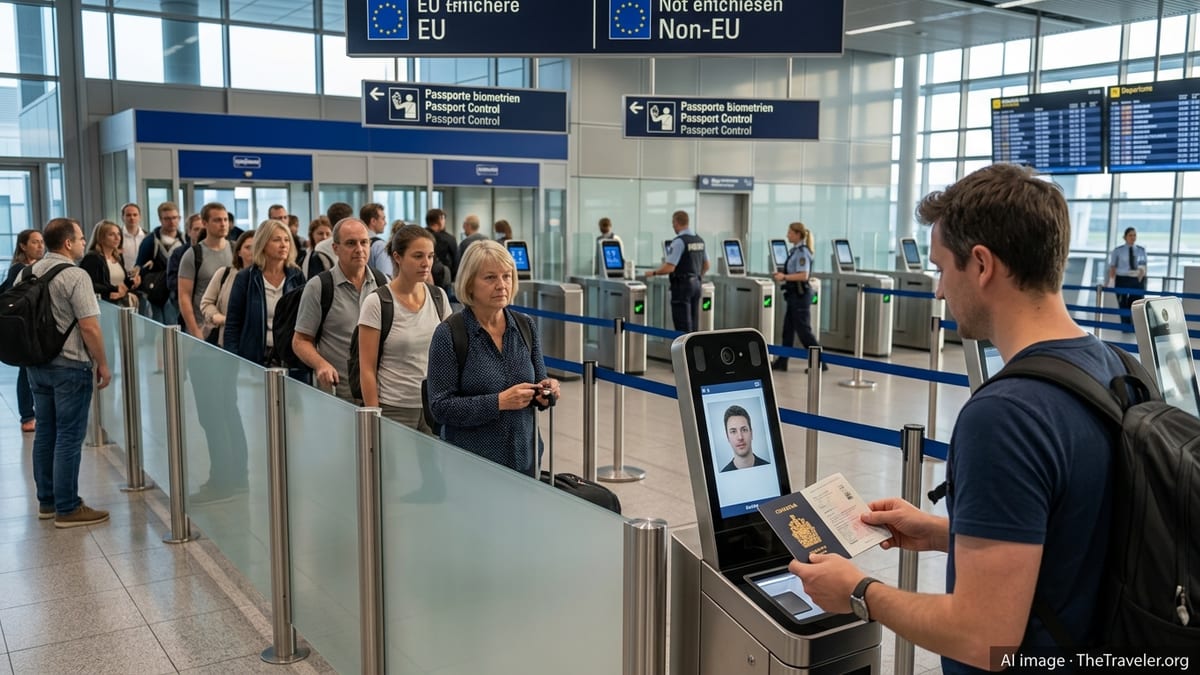
Under EES, border checks for affected travelers now involve scanning a passport and enrolling or verifying fingerprints and a facial image, alongside recording the date, time and place of entry or exit. The digital record replaces in-passport ink stamps and is designed to make it easier for authorities to see how long a visitor has stayed in the Schengen Area, particularly in relation to the 90-days-in-180-days limit that applies to many visa-exempt nationals, including Canadians.
Germany Joins Major Southern and Western European Gateways
Germany’s participation means that one of Europe’s busiest aviation and rail hubs is now aligned with the EES procedures already being introduced in Spain, France, Portugal, Italy, Greece, the Netherlands and other Schengen members. Publicly available information from European institutions and national governments shows that all Schengen states are required to connect their border crossing points to the shared system as part of a coordinated rollout.
For Canadian visitors, this is particularly significant at major German airports such as Frankfurt, Munich and Berlin, which serve as key entry points and transfer hubs for travel throughout the continent. As EES equipment comes online, travelers arriving from Canada can expect to encounter new self-service kiosks or biometric stations, often before meeting a border guard for final inspection.
Germany has longstanding experience with automated border checks through its EasyPASS system for select nationalities, but EES introduces a standardised, EU-wide framework that goes beyond previous voluntary programs. The new rules bring Germany into a common regime with other popular destinations such as Spain’s Mediterranean airports, France and the Benelux region, where EES infrastructure is also being deployed to handle rising volumes of international travelers.
What Changes for Canadian Travelers
For Canadian passport holders visiting Germany or any other Schengen country for tourism, business or family trips of up to 90 days in any 180-day period, the most visible change is the use of biometrics and digital records instead of physical stamps. At first entry after EES activation, Canadians will typically be asked to provide fingerprints and have a live facial image captured. On subsequent trips, the system is expected to verify existing biometric templates rather than collecting them again, provided the data is still valid.
The EES record includes personal details, travel document data, biometric identifiers, and the time and place of border crossings. According to EU-level information, these records are meant to help detect overstays, strengthen the external border and streamline checks by making accurate travel histories instantly available to border staff. For Canadians who frequently travel to Europe, this means that the cumulative number of days spent in the Schengen Area will be calculated digitally, reducing the scope for human error associated with manual stamp counting.
Importantly, EES does not change Canada’s current visa-exempt status for short stays in the Schengen Area. Canadians can still travel without a visa for trips that respect the 90/180-day rule. However, in the coming years they will also need to obtain a separate travel authorisation under the European Travel Information and Authorisation System, or ETIAS, which EU institutions indicate is scheduled to begin after EES is fully in place. When ETIAS takes effect, Canadian travelers will have both an advance electronic authorisation and biometric registration at the border.
Airports, Land Crossings and the Risk of Longer Queues
Although EES is intended to speed up border checks over the long term, the transition period may bring occasional bottlenecks, particularly at busy airports and high-traffic land crossings. Experience reported from early implementation at some external borders suggests that first-time biometric enrollment can take longer than a traditional passport stamp, especially when travelers are unfamiliar with fingerprint scanners or facial capture kiosks.
European institutions have highlighted that the phased rollout is designed to give border authorities time to adjust staffing levels, fine-tune procedures and expand automated lanes. Nevertheless, media coverage from ports of entry on Europe’s periphery has already drawn attention to longer waits at peak times, with transport operators and freight drivers voicing concerns about the impact of new electronic checks on travel schedules.
Canadian travelers connecting through hubs such as Frankfurt, Amsterdam, Paris or Madrid should therefore allow extra time to clear border controls during the first months of EES operation. Airlines and airports are gradually updating their guidance, advising non-EU passengers to check in earlier and move promptly to border control when boarding passes are issued. Over time, as biometric data is reused and passengers become familiar with the process, queues are expected to stabilise or shorten.
Balancing Security, Data Protection and Traveler Experience
The Entry/Exit System sits at the intersection of border security, migration management and privacy law. EU policy documents describe EES as part of a broader effort to modernise the Schengen Area’s information systems, placing it alongside existing large-scale platforms such as the Schengen Information System and the Visa Information System. The aim is to give border authorities faster and more reliable tools to verify identities, detect document fraud and identify overstays.
At the same time, supervisory bodies and data protection authorities at European level have highlighted the sensitivity of storing biometric data on such a scale. Publicly available guidance stresses that EES is subject to strict data retention limits and access rules, with built-in safeguards on how long biometric templates and travel histories can be kept and who may consult them. Canadians using the new system will not see these controls directly, but they form a key part of the legal framework behind the technology in Germany and across the Schengen zone.
For travelers, the practical trade-off is a more structured, technology-driven border experience in exchange for fewer manual stamps and potentially quicker processing once the new system beds in. Canadians heading to Germany, Spain, France, Portugal, Italy, Greece, the Netherlands and other participating countries are entering a new era of European travel, where biometric checks and digital records quietly underpin the familiar freedoms of short-stay, visa-exempt visits.