

More news on this day
Overnight rail travel between Paris and Berlin is set for a fresh chapter as European Sleeper prepares to relaunch the iconic night train link, reinforcing efforts by Germany and France to reconnect their capitals by low‑carbon rail.
Get the latest news straight to your inbox!
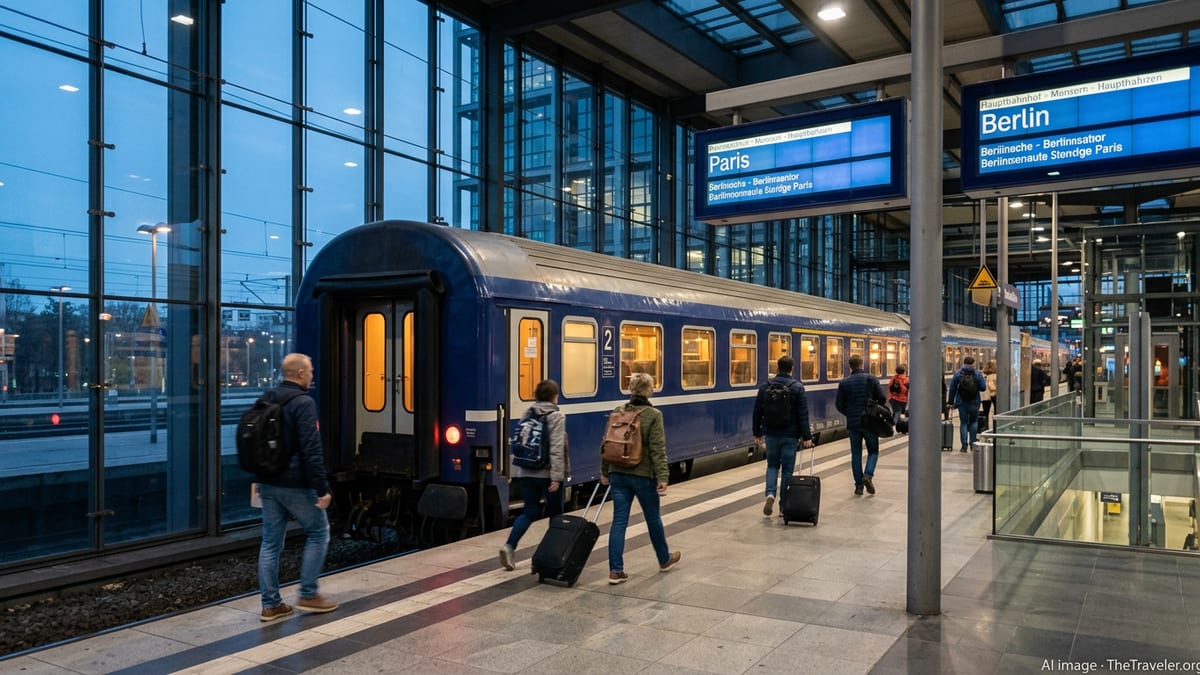
A Symbolic Route in Europe’s Night Train Revival
The overnight connection between Paris and Berlin has long carried symbolic weight, linking two capitals that sit at the heart of European politics, culture and commerce. After years without a direct sleeper link, the route returned in December 2023 under the Nightjet brand, operated by Austria’s ÖBB in partnership with Deutsche Bahn and SNCF. The service quickly became a flagship for Europe’s revived interest in night trains as a climate‑friendlier alternative to short‑haul flights.
Publicly available information shows that the Nightjet operated several times a week, with plans to ramp up to daily service as rolling stock and infrastructure capacity allowed. Passenger figures reported for 2024 indicated tens of thousands of travelers using the Paris–Berlin night train despite periods of disruption, suggesting robust demand for overnight rail between the two capitals.
However, funding changes in France have altered the landscape. Reports indicate that the French government decided to withdraw specific subsidies for international night trains from 2026 onward, prompting ÖBB to schedule the end of its Paris night services, including the Berlin route, in December 2025. That impending gap has opened space for new operators to step in and reshape the Paris–Berlin sleeper market.
Against this backdrop, the announcement by Belgian‑Dutch cooperative European Sleeper that it will relaunch the Paris–Berlin night train in March 2026 has drawn wide attention. The move is seen by many observers as a sign that night trains linking France and Germany are shifting from a state‑backed experiment toward a more market‑driven model.
European Sleeper Steps In With a 2026 Relaunch
According to published coverage, European Sleeper plans to begin operating a new night train between Paris and Berlin in late March 2026, restoring a direct overnight option shortly after the planned withdrawal of the Nightjet service. The cooperative, which already runs a Brussels–Berlin–Prague night train, aims to leverage its existing cross‑border experience and rolling stock agreements to enter one of Europe’s most high‑profile city pairs.
The planned Paris–Berlin train is expected to run several nights per week in each direction, with services from Paris to Berlin reportedly operating on selected weekdays and returns from Berlin on alternate days. The train will offer a mix of seated coaches, couchettes and sleeper cabins, reflecting a model that European Sleeper already uses on other routes. The operator has outlined intentions to use 12 to 14‑carriage formations to balance capacity with operational flexibility across three national rail networks.
European Sleeper has emphasized, in its public materials, that there is sufficient demand to sustain a night train between the French and German capitals without the type of start‑up subsidy that previously underpinned the Nightjet operation. Analysts note that the cooperative’s crowdfunding and community share model spreads financial risk while simultaneously testing market appetite for overnight rail among environmentally conscious travelers.
Timetabling remains one of the final hurdles before launch. The company is working with infrastructure managers in France, Belgium and Germany to secure overnight paths on busy main lines. Observers point out that the successful allocation of slots will be crucial to ensure departure and arrival times that are genuinely convenient for passengers seeking to maximize sleep and daylight time at their destination.
Franco‑German Rail Cooperation Extends Beyond the Sleeper
The renewed Paris–Berlin night train is only one element of a broader rail rapprochement between Germany and France. Publicly available information shows that Deutsche Bahn and SNCF have already strengthened daytime high‑speed links, culminating in a new direct service between Paris and Berlin that launched in December 2024. That high‑speed connection reduces journey times to around eight hours, enhancing rail’s competitiveness versus air on the route.
Officials from both countries have previously framed the expansion of rail services as part of joint climate and mobility goals. By providing both daytime and overnight options, the Franco‑German rail network increasingly offers travelers a viable alternative to short‑haul flights, particularly for business trips and weekend tourism. The overnight train relaunch by European Sleeper complements this strategy by giving passengers the option to travel while they sleep and arrive in the city center early in the morning.
Industry observers say that the coexistence of high‑speed daytime trains and night services illustrates a maturing rail market between the two capitals. Day trains capture travelers who value speed and daytime productivity, while night trains appeal to those seeking to save on hotel nights, reduce their carbon footprint or enjoy a slower, more relaxed journey. Together, these services deepen practical and symbolic links between France and Germany at a time when cross‑border cooperation is a prominent theme in European policy debates.
European Sleeper’s entry onto the route also highlights a diversification of operators in the Franco‑German rail space. While SNCF and Deutsche Bahn continue to play central roles through high‑speed services, the night‑train segment is increasingly characterized by smaller, agile companies willing to experiment with new business models and international ticketing partnerships.
What Travelers Can Expect On Board
While final details of the onboard product will be clarified closer to launch, European Sleeper’s existing services offer a clear indication of what passengers on the Paris–Berlin line can expect. Trains typically feature three main comfort categories: standard seats for budget travelers, shared couchette compartments for those wanting to lie flat at a moderate price, and classic sleeper cabins aimed at passengers seeking more privacy and comfort.
On other routes, the cooperative has used refurbished rolling stock with updated interiors, power sockets and basic amenities, positioning the experience somewhere between traditional night trains and modern hotel‑style sleepers. For the Paris–Berlin relaunch, publicly available information suggests a similar configuration, with the focus on reliable comfort rather than luxury. Simple onboard catering, including snacks and hot drinks, is expected to be available, though full dining‑car service is not typically part of the model.
Passenger advocacy groups often highlight night trains as a way to transform long‑distance travel into part of the holiday itself, and the Paris–Berlin route is no exception. Departures from central stations such as Paris‑Est and Berlin Hauptbahnhof allow travelers to start and end their journeys in the heart of historic cityscapes, avoiding airport transfers and early‑morning security queues. The overnight timing also enables travelers to maximize their time in both cities, a key selling point for short city breaks.
Given the route’s popularity and limited capacity per train, observers expect strong advance demand once ticket sales open. Existing experience with overnight services in Europe suggests that family compartments, private sleepers and peak‑season dates can sell out quickly, while standard seats may remain available closer to departure. Prospective travelers are therefore likely to benefit from early planning once timetables and booking platforms are finalized.
A Test Case for Europe’s Low‑Carbon Travel Future
The relaunch of the Paris–Berlin night train is being closely watched as a test case for how Europe’s rail sector can support climate objectives while operating on commercially sustainable terms. Environmental organizations have long argued that overnight trains are one of the most effective tools for shifting passengers from short‑haul flights to rail on distances of 800 to 1,500 kilometers, a band that includes many trans‑European city pairs.
Data cited in media coverage of the previous Nightjet service shows that tens of thousands of passengers already chose the train over other modes during its brief recent run, despite construction‑related disruptions and relatively limited marketing. Advocates say this indicates significant latent demand that could be unlocked with more stable timetables, better integration into national booking platforms and clearer information about comfort levels and pricing.
The Paris–Berlin corridor is particularly emblematic because it connects two countries that regularly present themselves as engines of European integration. A functioning, well‑used night train between their capitals sends a signal about practical cross‑border cooperation on everyday issues such as mobility, tourism and climate policy. If European Sleeper can demonstrate sustained occupancy and positive finances on the route, it may encourage further overnight links between France, Germany and neighboring states.
At the same time, the project underscores ongoing questions about the role of public funding in international night trains. The transition from a subsidized model under ÖBB to a commercially oriented operation by European Sleeper will likely inform future debates in France, Germany and at European Union level about when and how governments should support cross‑border sleeper services. For travelers, however, the most visible outcome is simpler: the renewed ability, from 2026, to board an evening train in one capital and wake up in the other, as Germany and France reconnect overnight by rail.