

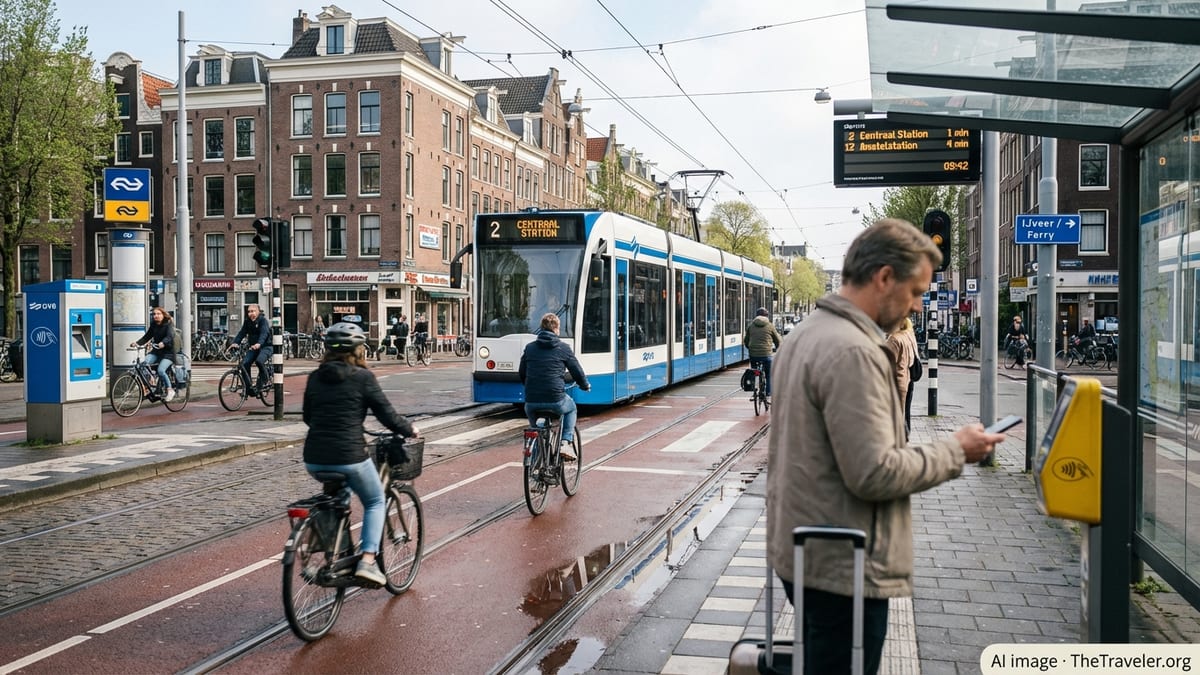
Amsterdam is one of Europe’s easiest cities to navigate without a car, but working out how trams, bikes, ferries and ticketing systems fit together can still be confusing for first-time visitors. Between new digital travel cards, contactless bank card payments and a maze of bike lanes, the options have never been better, or more complex. This guide breaks down how to get around Amsterdam efficiently in 2026, from landing at Schiphol Airport to gliding along canals and cycling like a local.
Understanding Amsterdam’s Public Transport Network
Amsterdam’s public transport is dense, reliable and designed for people who do not own a car. The backbone of the system is run by GVB, the municipal operator that manages almost all trams, the metro network, most city buses and free ferries across the IJ. Regional operators such as Connexxion, EBS and Arriva handle lines that reach the suburbs and nearby towns, while national rail company NS connects Amsterdam with the rest of the Netherlands.
Easy transport makes it simpler to cover the main things to do in Amsterdam. For most visitors, GVB services cover nearly everything you need inside the city: trams criss-cross the canal belt and residential neighborhoods, the metro links the center to the south and east, and buses fill the gaps late at night and in areas where tracks do not run. Schedules are frequent throughout the day, with trams and metros typically running every few minutes at peak times and every 10 to 15 minutes in the evening. Night buses take over once trams and metros stop around half past midnight.
Public transport is integrated in terms of payment and information rather than a single “all-operators” ticket and also supports popular day trips from Amsterdam. You will often use the same ticket type or payment method to board different modes, but some travel passes only cover GVB, while others also include NS trains and regional buses. Understanding the difference between purely city-focused tickets and broader regional options will help you avoid unexpected costs or fines.
Signage and announcements are generally clear and provided in both Dutch and English, which makes the system approachable even if it is your first time in the country. Stations and stops display electronic boards with real-time departure data, and most travelers rely on a combination of Dutch national journey-planning apps and standard mapping apps to navigate in real time.
Ticketing, Contactless Payments and Travel Cards
Until a few years ago, the OV-chipkaart smart card was the standard way to pay for public transport across the Netherlands. While it is still recognized, the country has largely shifted to open payments and app-based tickets. In Amsterdam, three main options now cover most scenarios: contactless payment with a debit or credit card, fixed-period GVB tickets and broader passes that include regional travel and airport connections.
If you are staying a short time and do not want to think about special products, contactless payment is the most straightforward choice. You simply tap your physical bank card, phone or smartwatch on the card readers when you enter and exit trams, buses or metro gates. The system calculates your fare afterward based on distance and a boarding fee. One important detail is that each traveler must use a separate card or device, so couples and families will need at least one payment method per person.
For visitors making intensive use of GVB services, day and multi-day tickets can be better value and easier to manage. GVB’s current tariffs for 2025 list a 1-day ticket at 9.50 euros and multi-day passes from 15.50 euros for 2 days up to 42.50 euros for 7 days, all covering unlimited travel on GVB trams, buses, metros and ferries within the city during their validity period. These passes are calendar-time based from first check-in and are particularly handy if you expect to hop on and off trams frequently.
If you plan to combine city travel with airport trips and regional excursions, the Amsterdam Travel Ticket and the Amsterdam & Region Travel Ticket provide wider coverage. The Amsterdam Travel Ticket includes NS train rides between Schiphol Airport and Amsterdam, as well as unlimited GVB travel within the city. The Amsterdam & Region Travel Ticket extends this to regional buses, trams and metros in the wider metropolitan area, including popular day-trip destinations such as Zaanse Schans, Haarlem, Volendam, Edam and the North Sea beaches. Prices in 2025 for the regional ticket start at just over 20 euros for one day and increase with duration.
Riding the Trams and Metro Like a Local
Trams are the most iconic part of Amsterdam’s public transport, gliding along tree-lined canals and through busy squares. For visitors staying in the city center or the nineteenth-century ring, trams are often the quickest and most scenic way to move between neighborhoods. Route maps posted at stops show line numbers and destinations, while digital displays list the next arrival times. You board through any door on modern low-floor trams and tap in at the nearest card reader, then tap out as you exit.
Etiquette is straightforward. Stand clear of the doors while others alight before boarding, move into the aisle rather than blocking the entrance and keep luggage close to you rather than on seats. Priority seating near the doors is reserved for travelers with mobility needs, pregnant women and older passengers. Conductors or roving inspectors can check that you have tapped in correctly, and traveling without a valid check-in can result in an on-the-spot fine even if you are carrying a valid pass that you forgot to scan.
The metro system is smaller than those in some capitals but very useful for crossing longer distances quickly. Lines connect Amsterdam Centraal with suburbs such as Noord, Bijlmer, Amstelveen and the emerging districts in the southeast. Stations are equipped with automatic gates, so you will need to tap in and out to open them, even if you are using a travel card. Metros typically run from early morning until around 00:30, after which night buses replace them along major corridors.
Trams and metros are generally safe and clean, but like most urban systems they can be crowded during rush hours and on popular nightlife routes. Keeping bags closed and in front of you is sufficient in most situations. For those with limited mobility, most stops have level boarding and lifts in stations, although smaller tram stops may lack raised platforms on narrow streets. GVB’s network maps and website highlight fully accessible routes if you need step-free access.
From Schiphol Airport to the City and Back
Sitting just under 20 kilometers from the center, Schiphol Airport is well integrated into Amsterdam’s transport network. The fastest and most common link is the train. NS runs frequent services from the station underneath the terminal to Amsterdam Centraal, as well as to Amsterdam Zuid and other city stations. From arrivals, you follow the “Trains” signs to Schiphol Plaza and take escalators or lifts down to the platforms. Trains to Centraal typically run up to eight times an hour during the day and take about 15 to 20 minutes.
Tickets for the train can be bought from yellow and blue machines in Schiphol Plaza or as e-tickets on NS and third-party apps. Contactless payment at gates is also available for pay-as-you-go travel if you are comfortable with the system. The Amsterdam Travel Ticket and Amsterdam & Region Travel Ticket include these airport train rides together with city transport, which simplifies matters if you do not want to think about separate tickets.
For some visitors, especially those staying near Museumplein, the Rijksmuseum or Leidseplein, the red Amsterdam Airport Express bus line 397 is another strong option. It departs from stop B17 outside Schiphol Plaza and runs roughly every 7 to 10 minutes during daytime hours, with a night version operating as line N97. The journey time to the main city stops is around 25 to 30 minutes, depending on traffic. Buses feature low floors, luggage space, Wi-Fi and contactless payment, but like trains they require each person to use their own ticket or card.
Schiphol’s bus station is currently undergoing a multi-year renovation that began in late 2024, with temporary bus stops introduced while a new, larger and more directly connected facility is built. Construction is scheduled to continue into 2027, which means signage and walking routes to buses may change during your visit. Travelers should allow a few extra minutes to find the correct temporary stop and follow airport wayfinding signs rather than relying solely on older guidebooks or memory.
Cycling in Amsterdam: Joys, Risks and New Rules
Cycling is a defining feature of Amsterdam’s identity and an efficient way to reach places that trams do not serve directly. Around a third of all journeys in the city are made by bike, and the infrastructure reflects that: there are protected lanes, bike-specific traffic lights and a wealth of dedicated parking facilities. For many visitors, renting a bicycle offers a sense of freedom and immersion that is hard to match by any other means of transport.
However, Amsterdam’s cycling culture has changed in recent years, and it is no longer the slow, gentle experience many people picture. The rapid spread of e-bikes and heavy, wide-tyred “fatbikes” has increased speeds on cycle paths and contributed to a noticeable rise in collisions. Local safety organizations report thousands of injuries each year linked specifically to fast electric bikes, especially among teenagers, and medical professionals have become more vocal about the risks. In response, city officials are exploring new restrictions in certain areas, including bans on fatbikes in selected parks.
For visitors, this means cycling requires attention and respect for local norms. The basic rules are simple: stay in the marked bike lanes where present, keep to the right, signal clearly when turning and always give way to pedestrians at designated crossings. Do not ride on pavements, even if they look empty, and avoid cycling side by side on narrow paths. Traffic lights with bicycle symbols apply directly to you, and ignoring them can result in fines as well as dangerous near-misses with trams or cars.
Helmets are not legally required for standard bikes, and most locals still ride without them, but they are a sensible precaution for anyone unfamiliar with the pace of Amsterdam traffic. If you are renting a bike for children or planning to use electric models, asking the rental shop for helmets and clear instructions is advisable. Above all, remember that you are entering a fast-moving system with its own etiquette rather than a leisure track; ride with confidence but not aggression, and keep phone use and photography to a minimum while moving.
Bike Rentals, Shared Bikes and Where to Ride
Amsterdam offers a wide range of rental options, from traditional city bikes with coaster brakes to modern e-bikes and cargo bikes. Many rental shops cluster around Centraal Station, Leidseplein and major hotel districts, and several national chains and local businesses provide online booking. Prices vary but you can expect to pay roughly the cost of a few tram tickets per day for a standard bike, with discounts for multi-day rentals or packages combined with guided tours.
One of the best values for travelers planning a museum-heavy itinerary is the I amsterdam City Card. Updated in 2025, the card includes a 24-hour free bicycle rental alongside unlimited GVB public transport, a canal cruise and entrance to many museums. For those who want a single product covering sightseeing, bikes and city transport, this can offset the card’s cost quickly, especially at the 48- or 72-hour levels. Remember that the bike rental is time-limited to a single 24-hour period regardless of card duration, so plan that cycling day carefully.
Amsterdam also has several bike-sharing schemes, but these typically require local bank accounts or long-term subscriptions and are not aimed at short-stay visitors. Tourists tend to find traditional rental shops more straightforward, as they accept international credit cards and provide maps, locks and advice. Whatever option you choose, always lock your bike securely with at least one robust lock through the frame and front wheel, and use official racks rather than leaving bikes loose on bridges and railings, where they are more vulnerable to theft and removal.
For relaxed rides, choose routes that keep you largely away from the busiest commuter flows. The green belt in Vondelpark, the canals of the Jordaan, the Eastern Docklands, and the paths along the Amstel River offer scenic cycling with fewer tram tracks and complicated junctions. Experienced riders can explore further afield to villages like Durgerdam or the Zaanse region using marked long-distance cycle routes, but beginners may want to start with a guided tour to get comfortable with Dutch rules and hand signals.
Combining Trams, Ferries and On-Foot Exploration
Amsterdam’s compact size makes it ideal for a hybrid approach that combines short tram hops with walking, ferries and occasional bike rides. Many first-time visitors underestimate how quickly they can walk between central districts; in practice, you can often cross from Centraal Station to the Rijksmuseum via the canals in under 30 minutes on foot, absorbing the cityscape as you go. Trams and buses then serve as backups when the weather turns, when you have luggage or when you are heading to more distant neighborhoods such as De Pijp, Oost or Bos en Lommer.
Free ferries across the IJ are one of the city’s hidden transport gems. Departing from behind Centraal Station, they whisk pedestrians, cyclists and scooters to Amsterdam-Noord in a matter of minutes. These ferries are part of the GVB network but do not require tickets. They provide quick access to cultural venues, waterfront terraces and modern residential areas north of the river. Boarding is straightforward: simply queue in the marked lanes, wait for the ramp to lower, walk or wheel on, and clear the entry area before the ferry departs.
When planning itineraries, it often makes sense to group sights by neighborhood rather than zigzagging across town. You might spend a morning exploring the Jordaan and Nine Streets on foot, then take a single tram ride to Museumplein for the afternoon. In the evening, another short tram or bus trip gets you to De Pijp or Oost for dinner. This reduces the time you spend in transit and allows you to experience Amsterdam’s street life between major landmarks rather than seeing it primarily through tram windows.
Apps and digital journey planners have become central to this experience. Dutch national planners and local transit apps offer real-time updates on delays, diversions and platform changes, and many integrate with contactless payment accounts to show your recent check-ins. While paper maps still exist, especially as free handouts in hotels and visitor centers, most residents navigate entirely by phone, and visitors will find the same tools useful, particularly when temporary construction or events disrupt usual routes.
Travel Passes, City Cards and Choosing What Fits Your Trip
With multiple overlapping cards and passes on offer, choosing the right product can be one of the trickier parts of planning how to get around Amsterdam. The main decision points are how many days you will stay, how intensively you will use public transport and whether you plan to visit lots of museums and attractions or simply wander neighborhoods.
The I amsterdam City Card remains the most comprehensive option. Available in durations from 24 to 120 hours, it includes unlimited GVB city transport, a canal cruise, a 24-hour bike rental and access to a wide range of museums and attractions both in Amsterdam and the surrounding region. A recent price structure puts the shortest cards at about 60 euros for 24 hours, with the 72-hour option offering particularly strong value for travelers who want three full days of visits. The card is now largely digital, managed through a dedicated app that generates QR codes for scanners on trams, buses and metros.
However, the City Card does not include NS trains or some regional buses, which means it does not cover the train between Schiphol Airport and Amsterdam or longer intercity journeys. This is where products such as the Amsterdam Travel Ticket and the Amsterdam & Region Travel Ticket come into play. These passes sacrifice free museum entries but include both the airport train and unlimited regional travel for fixed periods, making them attractive for travelers focused on day trips rather than museum-hopping.
For minimalists who plan to walk most of the time and only use transport for the airport and occasional long hops, pay-as-you-go contactless travel or individual GVB day tickets can be fully sufficient. You might buy a single multi-day GVB pass for the portion of your stay when you are most active in the city, then travel to and from Schiphol separately using train tickets. Calculating a rough estimate of expected rides per day beforehand often clarifies which option offers best value.
The Takeaway
Getting around Amsterdam in 2026 is both easier and more flexible than ever for visitors willing to embrace a mix of transport modes. Trams and the metro remain the backbone of urban movement, supported by frequent buses and iconic free ferries, while bikes continue to define the city’s character even as new rules emerge to manage the rise of fast electric models. Digital tickets, contactless payments and app-based journey planning have modernized the experience, but they have also added complexity that rewards a bit of advance research.
The key is to match your choices to the kind of trip you want. If museums and attractions are your priority, a City Card that bundles public transport, bike rental and entry fees may be the smoothest route. If you are keen on regional day trips from the outset, an Amsterdam & Region Travel Ticket might serve you better. Travelers who prefer spontaneity can rely on contactless payments and simple GVB passes, using trams and ferries as needed while exploring most of the city on foot or by bike.
Whatever combination you choose, the city’s infrastructure is designed to support car-free journeys from the moment you land at Schiphol to your last evening ride along the canals. Take a little time to understand the system, respect local cycling etiquette and keep an eye on evolving rules around electric bikes and park access. In return, you will gain a seamless, sustainable and deeply local way of experiencing one of Europe’s most distinctive urban landscapes.
FAQ
Q1. Do I still need an OV-chipkaart to use public transport in Amsterdam?
Not necessarily. While the OV-chipkaart is still accepted, most visitors now use contactless payment with a bank card or phone, or choose GVB day passes and city travel cards. The system is moving toward open payments rather than relying on a single nationwide smart card.
Q2. Are trams or the metro better for getting around the city center?
Trams are generally more useful in the historic center and canal belt because they follow surface routes through key squares and shopping streets. The metro is faster for longer journeys to neighborhoods such as Noord, Bijlmer and Amstelveen. Most visitors end up using both depending on destination and time of day.
Q3. What is the easiest way to travel from Schiphol Airport to central Amsterdam?
The train from Schiphol’s underground station to Amsterdam Centraal is usually the quickest and most convenient option, with frequent departures and a travel time of about 15 to 20 minutes. For hotels near Museumplein or Leidseplein, the Amsterdam Airport Express bus line 397 can be more direct.
Q4. Is it safe for beginners to cycle in Amsterdam?
Yes, but it can feel intense. Bike lanes are well designed, yet traffic on them moves quickly, especially with many e-bikes. Beginners should choose quieter routes, avoid rush hours and consider joining a guided bike tour before riding independently. Wearing a helmet, while not mandatory, is a sensible precaution.
Q5. Does the I amsterdam City Card include travel to and from Schiphol Airport?
No. The City Card covers GVB trams, buses, metros and ferries within Amsterdam, but it does not include NS trains or regional airport buses. If you want a pass that includes the airport connection, consider the Amsterdam Travel Ticket or Amsterdam & Region Travel Ticket instead.
Q6. How late do trams and metros run at night?
Most trams and metro lines run until around 00:30. After that, a network of night buses covers major routes until early morning. Night buses are included in GVB day and multi-day tickets and in the I amsterdam City Card’s transport coverage.
Q7. Can I use one contactless bank card to pay for the whole family?
No. Each traveler must check in and out with their own payment method or ticket. A single bank card or phone counts as one traveler, so families and groups should ensure that each person has a separate card, device or valid ticket.
Q8. Are the ferries across the IJ free to use?
Yes. The blue-and-white GVB ferries that run from behind Amsterdam Centraal Station to various points in Amsterdam-Noord are free for pedestrians and cyclists. You can simply board without tapping a card or buying a ticket.
Q9. What should I do if I forget to tap out when leaving a tram or metro?
If you are using contactless payment or a stored-value card, forgetting to tap out may result in a higher default fare. With fixed-period GVB passes or city cards, you will not be overcharged, but correct check-out is still required under the travel conditions. Get into the habit of tapping both when you enter and when you leave.
Q10. Is it necessary to rent a bike, or can I see the city on foot and by tram?
It is perfectly possible to experience Amsterdam using only walking and public transport. Many visitors never rent a bike and still enjoy the city fully. Renting a bicycle is an optional extra that can be memorable if you feel comfortable cycling in mixed traffic, but it is not essential for reaching major sights or neighborhoods.