

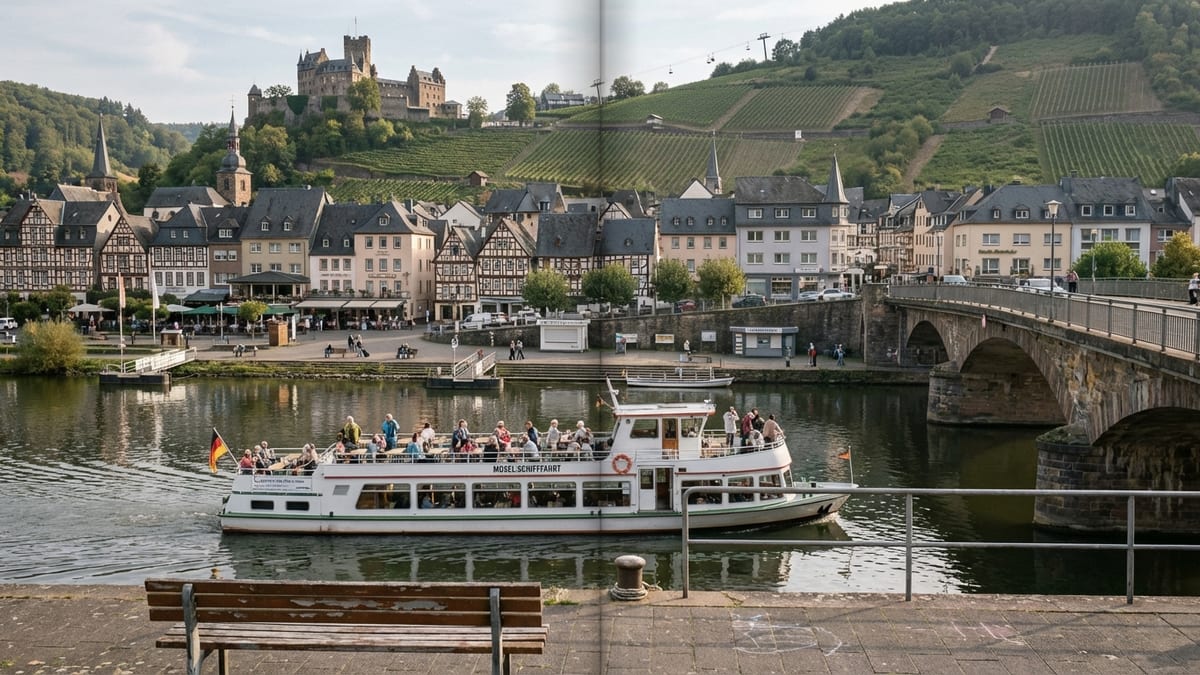
Cochem, strung along a scenic bend of the Moselle River, is compact enough to feel intimate yet rich enough in routes, ferries, hiking paths and rail links to reward several days of exploration.
Getting around here is part of the pleasure: riverboats nose past vine covered slopes, regional trains snake between valleys, and footpaths climb from half timbered lanes to castle viewpoints. Understanding how these pieces fit together will help you move smoothly between Cochem’s riverfront, vineyards and neighboring towns, whether you arrive for a day trip or a longer Moselle stay.
Understanding Cochem’s Layout and Transport Hubs
Cochem is built in layers. At river level sit the promenade, boat piers and old town, packed with wine taverns and narrow lanes. A little higher up rises the train station and the main road that follows the Moselle. Above all of it, Reichsburg Cochem dominates the skyline, while vineyards and walking trails climb the surrounding hills. Knowing where each transport option plugs into this geography makes planning far easier and simpler to cover the main things to do in Cochem.
The central rail hub is Cochem (Mosel) station on the south side of the river. It is within walking distance of the historic center, with most visitors reaching the old town via a short downhill stroll and a bridge crossing. Riverboats normally dock along the Moselle promenade on the opposite bank from the station, so expect a five to ten minute walk between train and boat depending on which pier your cruise line uses.
Cars and regional buses follow the B49 road which shadows the river. For most visitors, however, driving is optional rather than essential. Cochem’s core is compact and largely walkable, with many hotels, wine bars and restaurants clustered in and around the old town. From here, you can transition easily to the riverside promenade, hiking paths and the chairlift access point without the need for local public buses. All these transport options also enable popular day trips from Cochem.
Arriving and Departing by Train
Trains are the most straightforward way to reach Cochem and to connect it with other Moselle or Rhine towns. Cochem (Mosel) station sits on the busy Koblenz Trier line, with frequent regional services in both directions. From Koblenz, journeys are typically under an hour on regional express or regional stopping trains, while connections from Trier are of a similar duration.
From Cologne or Frankfurt, you usually travel via Koblenz, changing there onto the Moselle line. The change is simple, as these are standard regional corridors with regular intervals during the day. Seat reservations on regional trains are generally not required, and ticket machines at larger German stations offer English language options and accept international credit cards, which makes last minute purchases easy.
Once you arrive in Cochem, reaching the center on foot is straightforward. From the station, follow the signed route downhill toward the Moselle and cross the bridge to reach the old town. Even with luggage, most visitors find the walk manageable in around ten to fifteen minutes, though taxis wait in front of the station if you prefer a short ride. Many hotels on the station side of the river can be reached on foot in under ten minutes without crossing the bridge at all.
Using Regional Trains for Day Trips
Cochem’s position on the Moselle rail line makes it a practical base for exploring other river towns without a car. To the west, trains connect to Ediger Eller and onward to Bullay, Traben Trarbach and Trier. To the east, Koblenz serves as a gateway for switching onto Rhine routes toward Boppard, St Goar and Mainz. Journey times are short enough that you can comfortably plan half day or full day excursions in multiple directions.
Regional tickets in Rhineland Palatinate are designed with visitors in mind. Day tickets often cover unlimited travel on regional trains, many buses and in some cases local trams across the state or wider transport associations. If you are traveling as a couple or family, group regional day passes can be particularly economical compared with buying individual single tickets for each leg.
For flexible exploring, it is worth checking whether your accommodation provides a guest card through the local transport association. Many Moselle towns participate in schemes that offer discounted or free use of regional buses and trains when you stay in a registered hotel or guesthouse. Even when this is not included, having a regional day ticket gives you the freedom to spontaneously stay an hour longer in a riverside café or hop off in a small village if a church tower or hillside ruin catches your eye from the train window.
Exploring the Moselle by Boat
Seeing Cochem and its neighbors from the river offers a different perspective on the Moselle valley. During the main season, sightseeing cruises and short hops between local towns run from the piers along Cochem’s promenade. Schedules are generally concentrated between late March and mid October, with one hour panorama trips and longer downstream or upstream excursions depending on the operator and the time of year.
One of the well known companies on this stretch operates one hour panoramic cruises from Cochem with seasonal timetables. For example, in 2026 a typical program includes daily departures from Tuesday to Sunday between late March and mid October, with up to six sailings a day at set times such as mid morning, lunchtime and late afternoon. Boats usually offer commentary in German and English, alongside a café style menu of drinks and snacks served at your seat.
Beyond short sightseeing trips, some services link Cochem with nearby wine villages, allowing you to disembark, explore and return later in the day by boat or by train. As timetables can change year by year, you should confirm departure times locally when you arrive in Cochem, either at the ticket kiosks on the riverfront or through your hotel reception. Advance booking is rarely essential for the standard one hour cruises, but can be useful on peak weekends or festival days.
Cruises operate in almost all weather conditions, but heavy rain or unusually high or low water levels may affect schedules. On cooler days, interior lounges provide protection from the elements while still giving river views, whereas in high summer, open decks are popular for photography and sun. Whichever season you visit, bring a light layer, as wind on the water can make temperatures feel cooler than in town.
Walking Routes in and around Cochem
On foot is often the most rewarding way to move around Cochem once you have arrived. The old town’s streets are narrow and atmospheric, better suited to pedestrians than to cars. From the riverfront, short but steep lanes climb to Reichsburg Cochem, offering views back down to the Moselle framed by rooftops and church towers. Wayfinding is intuitive, with frequent signposts to the castle and other landmarks.
Beyond the center, a network of marked trail routes leads into the vineyards and forests. The long distance Moselsteig passes through the Cochem area, providing options for everything from gentle strolls between wine villages to strenuous hill walks. Sections near Cochem are well signposted and maintained, making it easy to choose a route that fits your fitness level and time available.
One popular viewpoint walk combines the riverside promenade with a climb to hilltop lookouts over Cochem and the Moselle. Starting from the bridge, you can follow signposted paths that climb steadily through vines and woodland. At various points you emerge onto terraces with sweeping views of the river’s wide curve, the town below and the castle perched on its rocky outcrop. In clear weather, sunrise and late afternoon are especially beautiful times to attempt these ascents.
Footwear matters more than distance in Cochem’s walking routes. Even short climbs can involve cobbled streets, uneven paths and steep stairs. Sturdy shoes with some grip will make the experience more comfortable, particularly after rainfall when paths can become slick. A small daypack with water, light snacks and a rain jacket will be sufficient for most outings.
The Cochem Chairlift and Hilltop Views
An unusual transport option in Cochem is the chairlift that rises from the edge of town up to the Pinnerkreuz viewpoint above the Moselle. The lift offers open double chairs and covered chairs, carrying passengers over vineyards and woodland to a panoramic terrace and café high above the town. From there, hiking paths radiate into the hills, and you gain a bird’s eye view of the river’s curve and the castle.
As of late 2025, the operator has announced a closure period extending until March 27, 2026, with operations resuming after that date. Ticket prices published by the company show separate one way and return fares, with reduced prices for children and group discounts. The chairlift normally operates seasonally from late March through early or mid November, with hours varying by month and occasionally shortened during rainy weather or storms.
When in service, the chairlift base station is reached on foot from the town center, typically via a ten to fifteen minute walk that climbs gently away from the riverfront. Even for those not planning longer hikes, a round trip ride is a relaxed way to break up a day of castle visits and riverside strolls. The ride itself is calm and relatively slow, making it suitable for travelers of various ages who are comfortable with heights.
At the top station, a terrace café offers refreshments with a commanding view across Cochem and the Moselle valley. From here, marked walking trails allow you to continue on foot to other viewpoints and back down toward town. For safety, the operator specifies that children under 12 must ride accompanied by an adult and does not transport large dogs. Before planning your day around the chairlift, it is prudent to verify current opening hours locally, especially early or late in the season.
Scenic Riverside Strolls and Urban Walking
For those who prefer level ground, the Moselle promenade in Cochem is ideal. Paved walkways hug the riverbank on both sides, passing boat piers, outdoor cafés and lawns where locals and visitors linger in good weather. Benches line the promenade, inviting slow travel between bridge, park and old town views without the need for any vehicle at all.
Crossing the main bridge over the Moselle is almost a rite of passage for new arrivals. From mid span, you see the old town clustered on one side, vineyards and wooded hills on the other, and boats gliding below. Early morning often brings a softer, misty atmosphere, while evenings can deliver dramatic skies and reflections as the castle lights come on.
Within the old town itself, walking is the primary mode of movement. Streets are narrow and sometimes cobbled, with traffic restricted or slow. Small squares open suddenly between tall houses, and staircases hide between shopfronts leading to higher alleys. It is easy to wander without a fixed plan for an hour or two, pausing at wine bars or bakeries as you go. Because distances are short, even travelers with modest fitness levels can enjoy much of the old town on foot.
For orientation, picking up a simple town map from the tourist office or your hotel is helpful. These often highlight short circular walks that link the main bridge, castle access paths, chairlift base station and riverside viewpoints. In practice, however, getting pleasantly lost is part of Cochem’s charm, and you are rarely more than a few minutes from a familiar landmark.
Combining Transport Modes for Flexible Itineraries
Cochem rewards mixing trains, boats, and walking routes into fluid itineraries. A typical day might begin with a morning train to a neighboring village, followed by a riverside hike back toward Cochem along vineyard paths, then a late afternoon boat cruise to rest your legs while still sightseeing. By understanding the basic schedules and distances, you can weave these elements into a trip that feels both relaxed and varied.
Short journeys between towns on the Moselle often take only 10 to 20 minutes by regional train. This means you can ride out to a village, walk one section of the Moselsteig back toward Cochem, and still have time for a castle tour or a chairlift ride in the same day. When the chairlift is operating, it can form a natural end point for a hike, allowing you to descend to town with minimal strain on knees and ankles.
For river experiences, you might choose an early evening panorama cruise rather than a midday sailing, especially in summer when long daylight hours and warm temperatures make sunset on the water particularly atmospheric. Boats, trains and walking paths all share the same valley, so you are never too far from a way back to Cochem if the weather changes or you decide to shorten your outing.
Planning tools help, but flexibility is valuable. Timetables can shift with seasons and local events, while trail conditions change with recent rain or heat. By keeping at least one mode in reserve each day, such as a known return train or an hourly boat service, you can adapt smoothly and keep your focus on the views instead of the clock.
The Takeaway
Getting around Cochem is less about covering distance and more about choosing the vantage point that suits you. Trains bring you along the Moselle’s bends efficiently and connect the town to Koblenz, Trier and beyond. Boats slow your pace further, turning the valley itself into an unfolding panorama. Walking routes, from cobbled alleys to vineyard trails, immerse you in the textures of everyday life and the landscapes that make the Moselle so distinctive.
With the chairlift providing an aerial alternative when in operation, Cochem offers a rare mix of transport options within a small, easily navigable footprint. Whether you design your days around scenic hikes, river cruises, regional day trips or simply aimless wandering through the old town, movement here becomes part of the experience rather than an obstacle. Arrive with a basic sense of the rail line, boat season and walking possibilities, and you will find that getting around Cochem is as memorable as the destinations themselves.
FAQ
Q1: Is a car necessary to get around Cochem and the Moselle valley?
For most visitors, a car is not necessary. Cochem is compact and walkable, regional trains run frequently along the Moselle between Koblenz and Trier, and in season there are riverboats and well marked hiking paths. A car can be useful for reaching more remote side valleys, but within Cochem itself and for nearby towns, public transport and walking usually suffice.
Q2: How far is Cochem’s train station from the old town and riverfront?
The station is roughly a ten to fifteen minute walk from the old town and main river promenade, depending on your pace and luggage. The route is mostly downhill from the station toward the Moselle, followed by a bridge crossing to reach the historic center. Taxis are available outside the station if you prefer not to walk.
Q3: When do river cruises and boat trips operate in Cochem?
Sightseeing cruises typically run from late March through mid October, with one hour panorama trips and longer excursions offered by different operators. Schedules vary by company and season, but during summer it is common to find multiple departures per day, often from late morning into early evening. Outside this period, services may be very limited or paused entirely.
Q4: Is the Cochem chairlift currently running?
According to the operator’s latest information, the chairlift is closed through March 26, 2026 and is scheduled to reopen on March 27, 2026, resuming its usual seasonal operation afterward. As opening hours and specific dates can change, especially due to weather or maintenance, confirm locally closer to your visit.
Q5: Are there easy walking routes suitable for casual strollers rather than serious hikers?
Yes. The riverside promenade on both banks of the Moselle offers flat, paved walks ideal for casual strolling. Within the old town, short loops through narrow lanes and small squares provide atmospheric walks without steep climbs. Even if you prefer not to tackle the hillsides, you can still enjoy excellent views from the bridge and lower streets.
Q6: Can I combine a boat trip with a hike or train journey in a single day?
Combining modes is one of the best ways to explore. Many visitors take a train to a nearby village in the morning, walk a section of the Moselsteig or another marked trail, and then return to Cochem by boat in the afternoon, or reverse the sequence. Because distances and travel times are short, it is feasible to fit a hike, a cruise and time in town into the same day.
Q7: What type of tickets should I buy for regional train travel around Cochem?
Look for regional day tickets that cover Rhineland Palatinate or the local transport association area. These passes often allow unlimited travel on regional trains and some buses for a day, and versions exist for solo travellers and small groups. If you are making multiple journeys in one day, such tickets usually offer better value than buying separate singles.
Q8: Is Cochem suitable for travelers with limited mobility?
The river promenade and bridge are relatively level, and many cafés and boat piers are accessible, so visitors with limited mobility can enjoy the riverside and parts of town. However, the old town’s steeper lanes, cobblestones and stairways, and the paths to Reichsburg and hilltop viewpoints, may pose challenges. If accessibility is a priority, it is advisable to choose accommodation near the promenade and to check in advance with boat operators and hotels about specific access features.
Q9: How should I dress for walking routes in and around Cochem?
Comfortable, closed shoes with some grip are recommended, even for short walks, because surfaces can be uneven and sometimes steep. Bring layers to adapt to changing temperatures, especially if you are moving between shaded forests, open vineyards and breezy riverfronts. A light rain jacket is useful year round, and in summer, a hat, sunscreen and water are essential for exposed hillside paths.
Q10: Are there guided options for exploring Cochem’s routes and transport?
Yes. Local guides and tour companies offer themed walking tours of the old town and castle, as well as organized day trips that combine train or coach transport with visits to nearby villages and wine estates. Some river cruises include commentary focused on history and wine culture. Booking a guided experience on your first day can provide helpful orientation to routes and options that you can then explore independently.