

Saudi Arabia has long been associated with highways and private cars, but the reality on the ground is changing fast. Major cities now have modern metros and growing bus networks, while high speed and intercity trains link key regions. For visitors who prefer not to drive, it is increasingly realistic to explore the Kingdom using only public transport, licensed taxis and digital ride services.
Understanding Saudi Arabia’s New Public Transport Landscape
Public transport in Saudi Arabia has expanded rapidly in recent years, especially in major cities such as Riyadh, Jeddah, Dammam and Madinah. What was once a car centric environment now includes metro systems, structured bus networks, high speed rail and improved taxi regulation. For travelers, this means more choice, clearer information and a growing emphasis on predictable schedules and cashless payment.
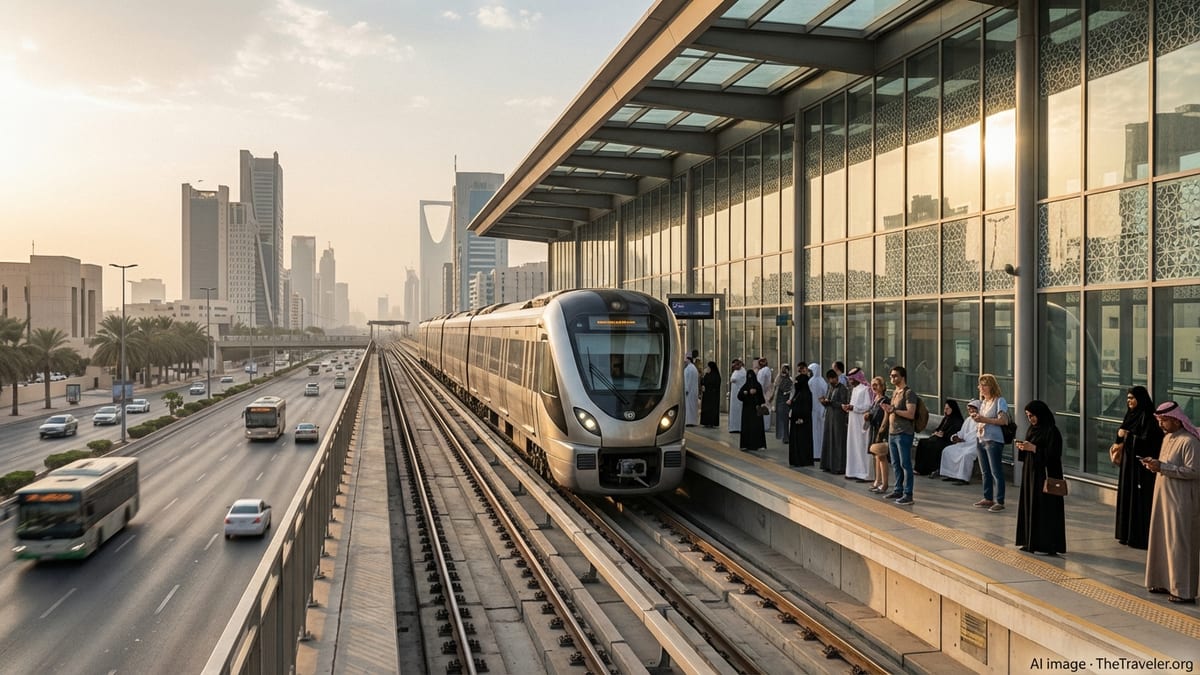
Riyadh now operates a full six line metro network covering about 176 kilometers with 85 stations across the capital. The final Orange Line entered service in early 2025, giving the city an integrated driverless network that has since been recognized as one of the largest of its kind anywhere. Services are designed to connect business districts, residential zones, shopping areas and cultural landmarks, and to ease pressure on the city’s congested roads.
Alongside rail, Saudi Arabia has invested in structured urban bus systems, often operated by SAPTCO, the national bus company. These city routes run in Riyadh, Jeddah, Medina, Dammam and several other urban centers, using modern low floor buses, electronic payment and extended operating hours. For visitors, these buses can be especially useful for medium length journeys across town, or for reaching destinations that sit beyond walking distance from metro or rail stations.
At the national level, Saudi Arabian Railways runs the North South Railway and the Riyadh Dammam line, while the Haramain High Speed Railway links Makkah, Madinah, Jeddah and King Abdulaziz International Airport. To complement these rail corridors, long distance buses connect most major cities and many secondary towns. When combined with licensed taxis and ride hailing apps, these services offer a realistic alternative to renting a car, especially for travelers who focus on a few regions rather than trying to cover the entire country on one trip.
Riding the Riyadh Metro and City Buses
For visitors staying in the capital, the Riyadh Metro is often the easiest introduction to getting around without a car. The six color coded lines run across the city from early morning until around midnight, stopping at key hubs such as King Khalid International Airport, King Abdullah Financial District and central commercial areas. Trains are driverless and air conditioned, and stations are typically clean, well lit and clearly signed in Arabic and English.
Tickets are sold as timed passes rather than per journey, with options such as a two hour ticket, three day pass, weekly pass and monthly pass. Prices have been set with residents and commuters in mind, and authorities continue to refine fare structures, including annual and student options. Payment is typically handled through contactless cards, ticket machines at stations or the official mobility app, which also shows route maps and real time service information.
The metro is backed up by an expanded bus network that reaches deep into residential neighborhoods. Many routes are structured to feed major metro stations, making it possible to travel from outlying districts into the center with a single change. Buses are modern and air conditioned, usually with separate doors and areas that take local cultural norms into account, and with designated spaces for passengers with limited mobility.
When using buses in Riyadh, visitors should plan a little extra time, since road traffic can be heavy at peak hours. Routes and timetables are available through official transport apps, station information boards and on board announcements. Cashless payment is the rule rather than the exception, so it is worth setting up an account in advance or purchasing a reloadable card soon after arrival. With a little preparation, the combined metro and bus system can replace nearly all urban taxi rides for many itineraries.
Exploring Jeddah, Dammam and Other Cities by Bus and Future Rail
While Riyadh currently offers the most advanced rail network, other Saudi cities also provide workable options for travelers who prefer not to drive. Jeddah has a structured public bus network operated in partnership with SAPTCO, with dozens of stops and several main routes that cover much of the urban area. These buses run for long service days, typically from early morning until late evening, and connect central districts, shopping areas and many of the city’s waterfront zones.
In Dammam and the wider Eastern Province, urban buses link Dammam with nearby cities such as Khobar and Qatif, plus residential districts and commercial areas. Services vary in frequency, and schedules are more limited than in Riyadh, but for patient travelers they can be a useful backbone, particularly when combined with short taxi hops. Buses here are also modern and air conditioned, and electronic payment is widely used.
Several additional cities, including Medina, Taif and Qassim, have seen the rollout of branded public bus services that operate on defined routes with fixed stops and published timetables. These networks are often newer and still evolving, so visitors may notice that some drivers and passengers are still adjusting to fixed boarding points and payment methods. Checking the latest route maps through official city or operator apps is essential, since lines can be adjusted as new neighborhoods open or demand shifts.
Looking ahead, authorities have signaled that more urban rail projects are planned or under study in cities beyond Riyadh, and that existing bus networks will become more frequent and better integrated with intercity transport. For visitors, this means that over the next few years, relying on public transport is likely to become steadily easier, especially in tourist focused destinations that are investing in better local mobility to support major events and growing visitor numbers.
High Speed and Intercity Trains Across the Kingdom
Saudi Arabia’s rail network provides an important backbone for travelers who want to move between cities without flying or driving. The flagship line for many visitors is the Haramain High Speed Railway, which connects Makkah and Madinah through Jeddah and King Abdulaziz International Airport. Trains run at high speeds on dedicated tracks, with modern rolling stock, reserved seating and clear luggage rules, offering an efficient alternative to road travel on one of the country’s busiest corridors.
The Haramain route typically offers several services per day in each direction, with frequencies adjusted during peak seasons such as Ramadan and the Hajj period. Tickets are sold in different classes, with varying seat layouts and amenities, and prices tend to rise as trains fill up, so advance booking is recommended when possible. Stations are purpose built, air conditioned and signposted in Arabic and English, and are usually connected to local taxi and bus services to handle onward travel within each city.
Beyond the Haramain line, the long established Riyadh Dammam railway links the capital with the Eastern Province, providing another practical option for travelers who prefer not to drive across the desert. The North South Railway runs from Riyadh up toward the northern regions, serving cities such as Hail and Qassim before continuing toward mining and border areas. These intercity trains are generally slower than the Haramain service but still comfortable, with air conditioned coaches, allocated seating and basic onboard services.
Saudi Arabian Railways continues to expand and order additional trains to meet growing demand, particularly on the high speed corridor. Authorities have announced plans to increase capacity significantly toward the end of this decade, signaling an expectation that more residents and visitors will depend on rail. For travelers, this underscores the value of checking current timetables and booking platforms shortly before a journey, since frequencies and rolling stock can evolve as new trains are delivered and new segments open.
Long Distance Buses, Domestic Flights and Last Mile Options
Even with expanding rail services, long distance buses remain a core part of Saudi Arabia’s public transport network. SAPTCO and other operators run scheduled coaches between major cities and many smaller towns, often stopping at dedicated bus stations on the edges of urban areas. These buses are typically air conditioned, assigned seat coaches with reclining seats and luggage holds, and can be a cost effective way to traverse long distances where train service is not yet available.
On popular routes such as Riyadh to Jeddah or Riyadh to Dammam, buses can run several times a day, including overnight services that allow travelers to save on accommodation. Travel times are longer than flying or high speed rail, but ticket prices are usually lower, and services are designed to be reasonably comfortable in the kingdom’s hot climate. It is wise to bring extra water and a light jacket or scarf, since air conditioning can feel intense during long trips.
Domestic flights are another important tool for travelers who do not want to drive, especially when covering long distances between regions such as Riyadh, Jeddah, Abha, Tabuk or Jazan. Several local and regional airlines operate extensive domestic networks, and airports in major cities have clear taxi ranks and, in some cases, public transport links like the Riyadh Metro or dedicated airport buses. Flight prices vary by season and demand, so checking options early is useful when planning an itinerary that spans multiple regions.
Once you arrive at a bus station, railway station or airport, you will usually complete your trip with a licensed taxi or ride hailing service. Official taxis are regulated and required to use meters, and designated stands are common at major hubs. Several international style ride hailing apps operate widely in Saudi Arabia, offering clear pricing estimates and app based payment. Travelers should avoid accepting rides from unlicensed drivers, particularly around airports, since authorities have stepped up enforcement and fines against unauthorized passenger transport.
Licensed Taxis, Ride Hailing and Cultural Etiquette
Taxis and ride hailing services fill the gaps between fixed route public transport and your final destination, and they are especially important in neighborhoods that are not yet linked to metro or bus stops. In most large cities, you will find official beige colored taxis with rooftop signs and regulated fares. At airports, railway stations and shopping malls, there are usually clearly marked taxi queues where dispatchers or signs indicate which vehicles are licensed to carry passengers.
Ride hailing apps are widely used by residents and visitors alike, and can be a convenient way to overcome language barriers since the pickup and drop off points are selected on a map. Cars are generally modern and air conditioned, and fares are shown in the app before you confirm your ride. Paying through the app is common, but drivers may also accept cash for certain platforms. During peak periods and in congested areas, surge pricing and longer wait times are possible, so building a little flexibility into your schedule is sensible.
When using taxis and ride apps in Saudi Arabia, it is worth keeping local customs in mind. Many drivers will expect men and women who are not related to sit in certain ways, and solo female travelers may prefer to sit in the back seat and use ride services that allow them to share trip details with friends or family. Dress codes are more relaxed for foreigners than in the past, but modest clothing is still advisable, especially outside major international hotel zones.
Communication with drivers is usually straightforward in basic English, particularly in major cities, but keeping key addresses written in Arabic script on your phone can smooth out any confusion. For safety, always confirm your name and destination before getting into a ride hailed car, and check that the license plate matches the app. If anything feels uncomfortable, it is acceptable to cancel a ride and request another, or return to a staffed taxi rank inside a bus or rail station.
Planning, Safety and Practical Tips for Car Free Travel
Successfully navigating Saudi Arabia without a car requires more planning than driving, but the payoff can be significant, especially if you want to avoid the stress of unfamiliar road rules and heavy traffic. Start by focusing your itinerary on one or two regions with strong public transport, such as Riyadh plus a side trip on the Haramain line, or Jeddah with excursions to nearby coastal or historic sites using buses and licensed taxis. Trying to cross the entire country using only public transport in a short time can lead to long days and limited flexibility.
Digital tools are central to planning. Each major operator typically has its own app or website for route maps, schedules and ticket purchases. Using these, you can check first and last metro and bus departures, see whether weekend schedules differ from weekdays and confirm how early you need to arrive for intercity trains. Because services are still evolving, it is wise to recheck details close to your travel dates rather than relying on information gathered months in advance.
Safety standards on official public transport are generally high, with modern vehicles, surveillance cameras on many buses, and visible security staff in large metro and rail stations. That said, basic travel precautions still apply. Keep valuables secure and out of sight, avoid very crowded vehicles when you have large luggage if you can, and stay aware of your surroundings when using your phone near open doors or station entrances. At night, favor well lit stations and official taxi ranks over informal pickup points.
Weather is another factor. Saudi Arabia’s climate can be extremely hot for much of the year, and even short walks between stations and final destinations can be uncomfortable in the middle of the day. When planning journeys, aim to schedule longer outdoor segments for early morning or evening, carry water and sun protection, and factor in the possibility of dust or sand in the air. Air conditioning inside vehicles and stations is usually strong, so layering your clothing can help you adjust as you move between outdoor heat and indoor cool.
The Takeaway
Thanks to major investments in metros, buses and rail, getting around Saudi Arabia without a car is now more practical than ever, especially in and between major cities. The Riyadh Metro has become the backbone of urban travel in the capital, while structured bus networks and the Haramain High Speed Railway provide key links in other regions. Long distance coaches, domestic flights and widespread ride hailing services fill in the gaps, giving visitors multiple ways to move without getting behind the wheel.
Public transport in the Kingdom is still evolving, and some routes and schedules remain a work in progress. For travelers who are willing to plan carefully, stay flexible and combine metros, trains, buses and licensed taxis, the reward is a deeper, slower experience of Saudi cities, from new business districts to historic cores and coastal promenades. With each passing year, the country’s car free options are expanding, making it easier for visitors to explore comfortably while aligning with broader goals of sustainability and reduced congestion.
FAQ
Q1. Can I visit Saudi Arabia’s major cities without renting a car?
Yes, you can travel between and within major cities such as Riyadh, Jeddah, Makkah, Madinah and Dammam using a mix of metros, high speed and intercity trains, long distance buses, domestic flights, licensed taxis and ride hailing apps.
Q2. How reliable is the Riyadh Metro for tourists?
The Riyadh Metro is generally reliable, with frequent services, extended operating hours and clear bilingual signage, making it a strong option for visitors moving around the capital without a car.
Q3. Is public transport available from Riyadh’s airport into the city?
Yes, the Riyadh Metro includes service to King Khalid International Airport, and there are also licensed taxis and ride hailing options at the terminals for last mile connections.
Q4. How do I buy tickets for the Haramain High Speed Railway?
You can usually buy Haramain tickets online, through official apps or at station ticket counters and machines, with seat reservations required and prices that vary by class, date and demand.
Q5. Are women allowed to use public transport alone in Saudi Arabia?
Yes, women can and do use metros, buses, trains and ride hailing services on their own, although many choose to sit in certain sections or seats in line with personal comfort and local customs.
Q6. What is the best way to get around Jeddah without a car?
In Jeddah, a combination of the city bus network for main corridors and licensed taxis or ride apps for shorter trips or late night journeys usually works well for most visitors.
Q7. Do Saudi buses and trains accept cash payments?
Many services are moving toward electronic and contactless payments, though some ticket counters still accept cash, so it is safest to have a card and a small amount of local currency.
Q8. How far in advance should I book intercity trains or buses?
For busy periods and popular routes, booking several days in advance is sensible, while at quieter times you may find same day or next day availability, especially on buses.
Q9. Are there late night public transport options?
Metro and city bus operating hours vary, but many finish around midnight, so after that time you will usually rely on licensed taxis or ride hailing apps for late night travel.
Q10. Is public transport safe for solo travelers?
Official public transport in Saudi Arabia is generally considered safe, especially when using well lit stations, licensed taxis, reputable ride apps and basic personal safety precautions.