

More news on this day
From the coastline of Ghana’s Volta Region to cultural stages abroad, Agbadza, the signature dance of the Ewe people, is shifting from martial memory to a powerful symbol in Ghana’s cultural tourism strategy.
Get the latest news straight to your inbox!
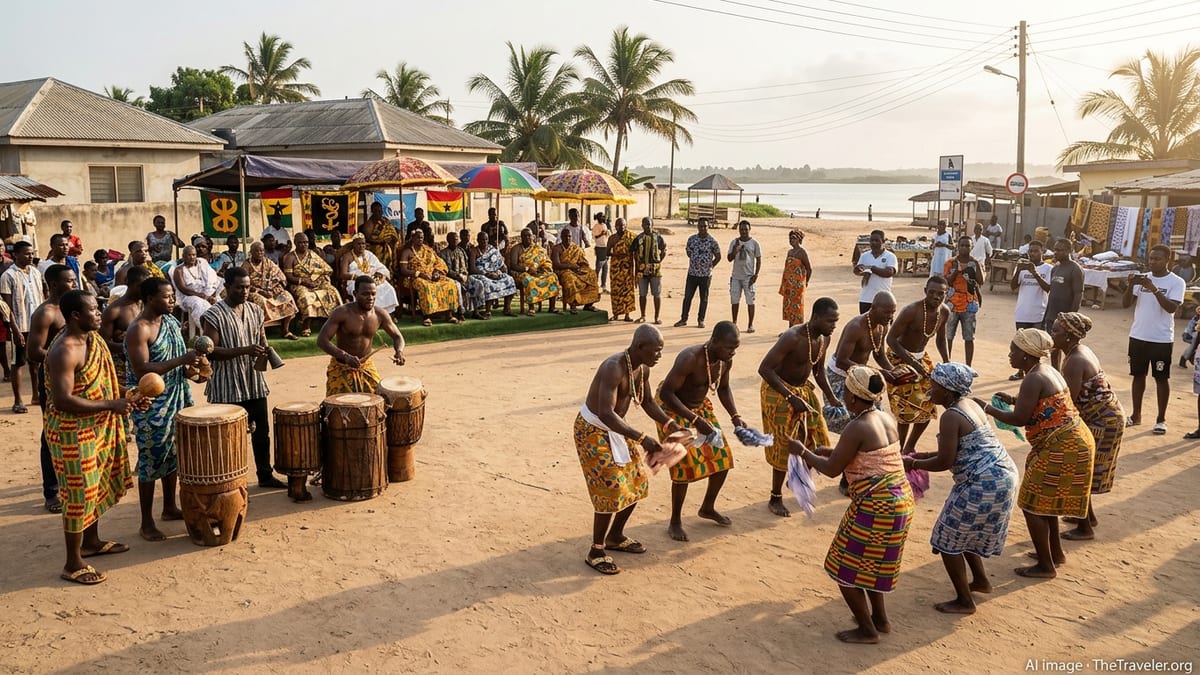
From Battlefield Signals to Festival Centrepiece
Agbadza is widely described in academic and cultural literature as a transformation of an older Ewe war dance known as Atrikpui, once used to prepare fighters and recount exploits in battle. Over time, that ritual function softened into a recreational genre performed at gatherings, funerals and public celebrations. Today, the dance is closely identified with Ewe ethnic identity across Ghana, Togo and parts of Benin, yet its battlefield roots remain embedded in the lyrics, drum language and movements.
Publicly available historical accounts explain that Agbadza’s choreography mimics the nimble movements of birds and warriors, with bent knees, forward-leaning torsos and sweeping arm gestures. The music is built around interlocking drum parts, gourd rattles and iron bells, producing a dense rhythmic texture that invites mass participation. What once served to signal courage on the battlefield now encourages dancers of all ages to join open circles at festivals and community events.
Within Ewe communities, Agbadza functions as an informal history classroom, carrying stories of migration, conflict and resilience through song texts. Researchers who have documented the genre note that its continued popularity, despite the decline of traditional warfare, reflects its ability to adapt to contemporary occasions while preserving core patterns and meanings. That adaptability is increasingly important as Ghana positions cultural heritage as a driver of regional tourism.
Hogbetsotso and the Volta Region’s Tourism Appeal
The most visible showcase for Agbadza in Ghana is the annual Hogbetsotso festival of the Anlo Ewe in the Volta Region, where the dance anchors processions, durbars and community reunions. Festival descriptions circulated by regional cultural agencies emphasise that Agbadza, formerly known as a war dance, now serves as the official dance of the Anlo people and is performed vigorously at the grand durbar. Recent editions of Hogbetsotso have drawn thousands of visitors, including domestic tourists and members of the diaspora travelling specifically for the cultural experience.
Regional authorities and tourism operators increasingly promote Hogbetsotso as part of a broader Volta tourism circuit that combines lagoons, beaches, craft markets and festivals. Travel features highlighting “must-see” Ghanaian festivals for 2025 frame Hogbetsotso as a key event, citing the spectacle of Agbadza drumming, the Glimetoto historical re-enactments and the colourful regalia of chiefs as major draws for visitors. The festival calendar, released by the National Commission on Culture and regional bodies, positions this November celebration as both a heritage event and an economic opportunity for hotels, transport operators and local vendors.
In planning information for the 2025 edition, committees under the Anlo State Council have publicised launch events and mini durbars in multiple Volta towns, a sign that Hogbetsotso is evolving into a multi-site attraction. Observers note that the expanded format provides more platforms for Agbadza performances, from community warm-up events to the main durbar, giving tour groups several entry points across the festival week.
Agbadza on National Registers and International Stages
Beyond festivals, Agbadza has entered formal cultural policy frameworks in Ghana. A recent edition of the National Register on the Intangible Cultural Heritage of Ghana, circulated by the National Folklore Board, lists “Traditional Dance of the Ewes: Agbadza” under performing arts, identifying it as part of efforts to safeguard living traditions. The register sits alongside Ghana’s engagements with UNESCO’s Intangible Cultural Heritage system, where highlife music and dance were added to the Representative List in 2025, highlighting a wider push to document and valorise performance genres.
Although Agbadza itself has not yet been inscribed on the UNESCO list, cultural commentators point out that its inclusion in the national register positions it for future nomination and offers a framework for training, documentation and transmission. These measures, in turn, support tourism by ensuring that performances remain vibrant and authentic even as they adapt to stage and festival formats geared toward visitors.
Ghana’s diplomacy has also provided higher-profile stages for Agbadza. Public information from Ghanaian embassies describes how traditional dances such as Adowa, Kpanlogo and Agbadza feature in cultural programmes abroad, from national day receptions to arts festivals. These curated presentations are designed to offer foreign audiences a snapshot of Ghana’s cultural diversity, and they often serve as soft marketing for tourism, showcasing music, costumes and communal energy that visitors can experience more fully at source in Ghana.
Universities and arts institutions outside Ghana have incorporated Agbadza into West African drum and dance ensembles, exposing students and audiences to the genre through concerts, workshops and lecture-demonstrations. Programmes in North America and Europe present Agbadza as one of the most common Ewe genres, underlining its suitability for participatory performance and making it a gateway for potential cultural tourists who first encounter the dance on campus stages.
New Audiences, Diaspora Interest and Creative Adaptations
As Ghana’s tourism promotion increasingly leans on culture, Agbadza has begun to appear in contemporary settings beyond traditional festivals. Travel and lifestyle coverage of the Chale Wote Street Art Festival in Accra, for example, highlights occasional traditional drumming and dance segments that sit alongside graffiti, installations and live music, giving urban audiences and foreign visitors a condensed, experimental taste of Ghanaian performance forms.
Tourism-oriented blogs and tour operators now package Volta Region itineraries that combine lagoon cruises, coastal forts and festival visits, often mentioning Agbadza as a signature experience for travellers who wish to “dance with the community.” While the depth of engagement varies, the presence of Agbadza in brochures, social media campaigns and destination videos has increased the visibility of Ewe culture within Ghana’s wider tourism narrative, which has long been dominated by coastal castles and national parks.
Members of the Ghanaian and Ewe diaspora also play a role in this shift. Cultural events in cities such as London, New York and Berlin frequently feature Agbadza segments, promoted through community associations and student groups. These performances double as informal tourism marketing, as organisers share information about visiting Hogbetsotso or other Volta festivals, encouraging second- and third-generation migrants to reconnect with ancestral towns through travel.
Creative reinterpretations are emerging as well. Contemporary choreographers in Ghana experiment with Agbadza steps in fusion pieces, while drumming ensembles adapt its rhythms for new compositions. Academics caution that excessive stylisation risks diluting ritual meanings, but many artists argue that carefully framed innovation keeps the genre relevant and attractive for younger audiences, including those encountering it first as spectators on a city stage.
Balancing Cultural Integrity and Visitor Demand
The growing tourism focus on Agbadza raises questions about how to balance commercial interest with community ownership. Scholars of intangible cultural heritage note that when a ritual practice becomes a tourism product, there is a risk of shortening performances, simplifying complex song texts or staging dances outside their traditional contexts to satisfy visitor schedules. In the case of Agbadza, which historically unfolds over extended sequences and includes segments of prayer, storytelling and improvisation, such compression can alter the experience for both performers and local participants.
Ghanaian cultural agencies and local organisers are responding by developing guidelines and documentation that stress community leadership in how Agbadza is presented. Training programmes for youth groups and cultural troupes in the Volta Region, supported by district assemblies and heritage initiatives, emphasise learning full repertoires rather than only the most showy sections suited for stage. These measures aim to ensure that touristic performances remain grounded in local values and knowledge systems.
At the same time, tourism planners argue that well-managed cultural programming can generate revenue for rural communities through performance fees, craft sales and hospitality services. Reports on recent Hogbetsotso editions describe spikes in hotel bookings, transport demand and small business activity during festival week. For many residents, Agbadza is not just an emblem of identity but a practical economic asset that can support artisans, drummers and dancers without severing the genre from its historical roots.
As Ghana continues to develop its intangible heritage register and pursue strategic tourism growth, Agbadza stands as a prominent case study. It illustrates how a once-martial Ewe dance can evolve into a national and international attraction, provided that the communities who created and sustain it remain at the centre of decisions about how it is taught, staged and shared with the world.