

More news on this day
Airlines around the world are rapidly cancelling and rerouting flights across the Middle East as the Iran war and a widening regional conflict trigger sweeping airspace closures, damaged hubs and a sudden rupture in key links between Europe, Asia and Africa.
Get the latest news straight to your inbox!
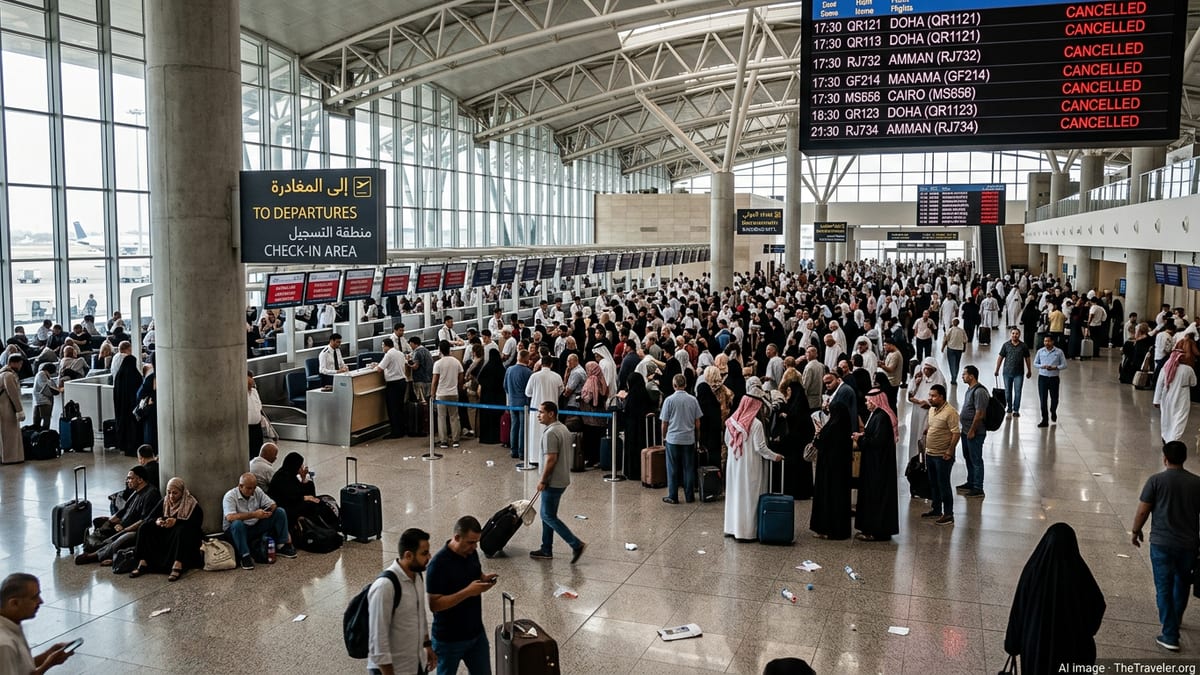
Rapid escalation turns key skies into no-fly zones
Publicly available aviation data and news coverage indicate that since late February 2026, large sections of airspace over Iran, Iraq, Israel, Kuwait, Bahrain, Qatar and parts of the Gulf have been closed or heavily restricted. The shift followed United States and Israeli strikes on Iran and subsequent retaliatory attacks that disrupted operations at major airports including Dubai, Abu Dhabi and Kuwait City.
Industry trackers report that thousands of flights have already been cancelled, with one global analysis suggesting that routes carrying roughly 3 million passengers a month have been removed from schedules in a matter of weeks. Capacity to and through Middle Eastern hubs has been cut by more than half as airlines seek to avoid conflict zones, higher insurance costs and extended flight times around the Arabian Peninsula or via Central Asia.
This disruption is rippling far beyond the immediate region. Europe to Asia corridors that routinely overfly Iran and surrounding states are facing detours of two to five hours, sharply higher fuel burn and complex crew scheduling. Travel-planning platforms and passenger-rights groups are reporting growing numbers of stranded travelers as aircraft and crews are left out of position across multiple continents.
Analysts note that even compared with earlier aviation shocks, such as the closure of Russian airspace in 2022, the speed and geographic concentration of the current Middle East restrictions represent an unprecedented stress test for global route networks.
European and Asian carriers lead wave of suspensions
According to schedule filings and airline statements cited in recent specialist aviation coverage, European legacy carriers have enacted some of the most extensive cancellations. Air France has extended a broad suspension of services to major Middle East destinations, including Dubai, Riyadh, Tel Aviv and Beirut, into April 2026, disrupting an estimated 170 European feeder connections that relied on those routes.
Other large European groups, including Lufthansa and British Airways, remain largely absent from the region’s core hubs as they follow conflict-zone advisories from regional safety bodies. Travel industry reports note that war-risk insurance restrictions are shaping which airlines can operate into United Arab Emirates and Gulf airspace, leaving carriers based outside Europe and North America to shoulder a greater share of limited remaining traffic.
In Asia, published reports show that Singapore Airlines has extended the cancellation of its Singapore–Dubai flights until at least the end of May 2026, eliminating its only nonstop link to one of the world’s busiest connecting hubs. The airline initially suspended the route on March 1 as the conflict escalated and has since filed multiple extensions while assessing evolving airspace and security conditions.
Low-cost and regional operators are being drawn into the disruption as well. A mix of Asian and Middle Eastern carriers serving secondary cities now face knock-on delays and rolling cancellations as their aircraft are forced onto longer routings or lose access to traditional refueling and transfer points in the Gulf.
Middle Eastern airlines slash regional networks
Carriers based within the Middle East are simultaneously cutting back. A regional advisory circulated to shipping and aviation clients in early March reported that Egypt’s flag carrier had suspended flights from Cairo to a long list of destinations, including Dubai, Abu Dhabi, Sharjah, Beirut, Doha, Amman, Dammam, Bahrain, Baghdad, Erbil and Kuwait, citing airspace closures and security concerns.
Morocco’s Royal Air Maroc has also moved to reduce exposure, announcing that flights to and from Doha will remain halted until the end of June 2026, while services connecting Casablanca with Dubai are suspended until at least the end of May. The airline framed the cuts as a temporary safety measure while monitoring developments across the Gulf and wider region.
Lebanese media and passenger advisories from late February and early March describe partial shutdowns of Beirut’s connectivity as Middle East Airlines cancelled multiple services to Gulf cities and Iraq in response to surrounding airspace closures. Other carriers, including Air France, Iraqi Airways and Qatar Airways, have also scrubbed selected Beirut flights, concentrating operations on corridors judged more reliable.
The net effect is a patchwork of suspended routes and skeletal schedules across the Levant and Gulf that leaves travelers heavily dependent on a shrinking number of operating airlines and corridors, notably via Turkey, Egypt and parts of South Asia.
Rerouting bottlenecks and rising fares hit global travelers
As major Middle East hubs scale back, airlines are racing to re-stitch long-haul connectivity using alternative waypoints. Recent coverage from regional outlets highlights how Egypt has quickly become a critical bridge between Europe and Asia, with carriers funnelling traffic via Cairo and Egyptian airspace before continuing to destinations further east.
Elsewhere, long-haul operators are pushing more traffic through Istanbul, Indian metros and select Southeast Asian hubs, creating new congestion points. Aviation analytics firms report that the additional flight time on many Europe–Asia services now ranges from two to four hours, straining crew-rostering rules and prompting more fuel stops, particularly for older widebody aircraft.
For passengers, the immediate impact is visible in fewer available seats and higher prices. Specialist fare trackers cited in recent business coverage indicate that economy-class fares on some Europe–Dubai and Europe–Doha itineraries have jumped by 20 to 50 percent as travelers compete for limited alternatives via remaining hubs such as Muscat or Jeddah. In North America and Asia-Pacific, itineraries that once connected smoothly over the Gulf are now being rebuilt around longer routings through Europe, driving both higher costs and extended journey times.
Travel-disruption services and consumer-rights organizations are urging passengers to check airline apps and airport departure boards frequently, as rolling cancellations and gate changes have become common even where flights initially appear on schedule. Many carriers are offering fee-free rebooking or refunds, but re-accommodating passengers on alternative services has become increasingly difficult on peak days.
Financial strain mounts as disruption drags on
Beyond the immediate travel chaos, sector observers are warning about mounting financial pressure on airlines as the conflict and airspace closures persist. Aviation-focused outlets have reported estimates of roughly 40,000 flights cancelled in just over a week across 10 Middle Eastern countries, representing close to two thirds of scheduled operations in some markets.
The combination of lost revenue, higher fuel costs and elevated insurance premiums is already weighing on balance sheets. Commentators in Dubai and European financial centers note that some weaker carriers entered 2026 with thin cash buffers after years of pandemic recovery and restructurings, leaving them vulnerable to another prolonged shock.
In Europe, low-cost operator Ryanair has publicly flagged the possibility of cancelling up to 5 to 10 percent of its flights through the summer if the conflict continues to disrupt jet fuel supplies and push prices higher, a sign that even airlines not directly serving conflict zones are bracing for indirect impacts. Market analysts suggest that if oil remains elevated and key airspace remains closed into the second half of 2026, consolidation pressures could accelerate across parts of the industry.
Regulators and travel bodies are reminding passengers that, in many jurisdictions, airlines remain obligated to refund cancelled flights even when disruptions are triggered by war or security events, though entitlement to additional compensation is more limited. Consumer advocates advise travelers with upcoming itineraries touching the Middle East to monitor advisories closely and to consider flexible tickets or travel insurance that specifically covers route closures and extended diversions.