

More news on this day
A cascade of flight disruptions in early 2026, spanning IT failures, airspace closures, aircraft software issues and extreme weather, is turning routine trips into multi‑day ordeals and exposing how deeply modern air travel depends on fragile, highly centralized infrastructure.
Get the latest news straight to your inbox!
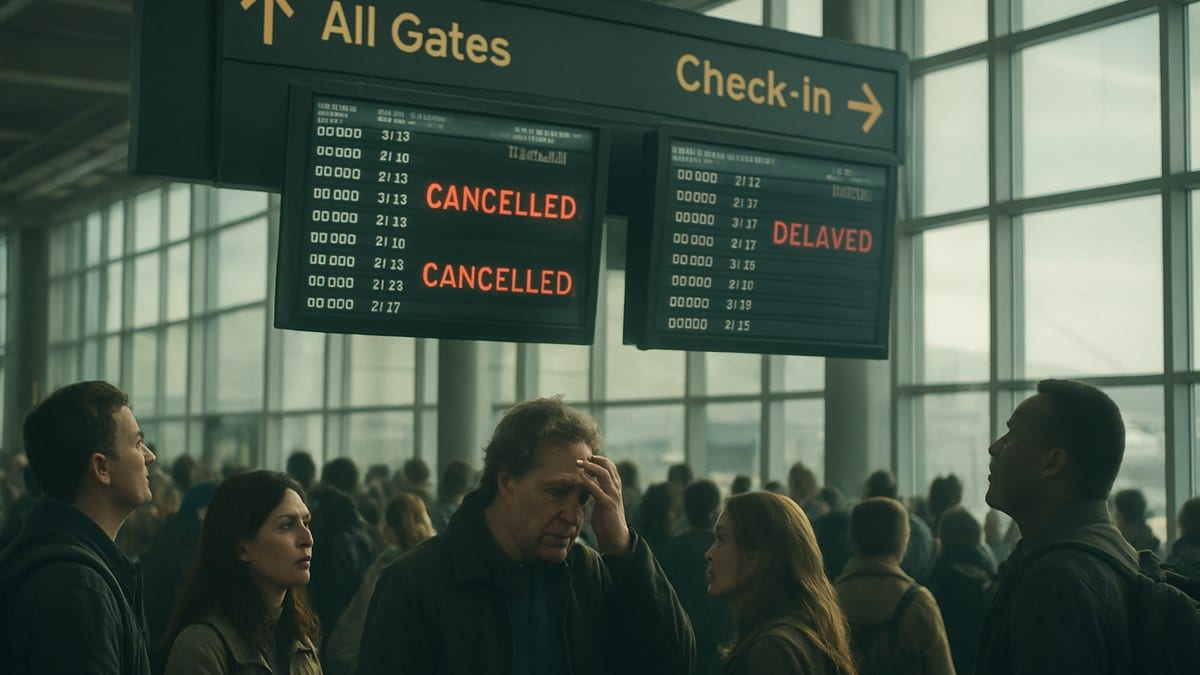
From Weather Chaos to Network Gridlock
Publicly available tracking data and industry reporting indicate that the first quarter of 2026 has brought an unusually dense series of disruptions across global air networks. In North and South America, March operations alone have seen more than 31,000 combined delays and cancellations as storm systems repeatedly hit major hubs, from Atlanta and Dallas to New York and Toronto. For travelers heading into Mexico, the Caribbean and South America, tightened schedules and full flights have left little spare capacity when weather events ripple through already busy corridors.
Across the Asia Pacific region, March 11 saw more than 2,300 cancellations and over 18,000 delays worldwide, with 774 cancellations concentrated in Asia Pacific alone. Reports describe a “crisis day” in which thunderstorms, operational strain and knock-on effects from Middle East airspace restrictions converged, overwhelming airline and airport recovery plans. While bad weather is a regular feature of aviation, the scale and duration of these disruptions suggest that contingency buffers in crew, aircraft and airport resources are stretched thin.
European traffic data for late February and early March show the same pattern of fragility. Eurocontrol’s weekly overviews record a sharp drop in flights between Europe and the Middle East at the end of February, with flows down by about a quarter compared with the prior week after key corridors were shut or rerouted. Even a modest reduction in capacity on such heavily used routes has generated significant scheduling complexity for airlines already operating at historically high load factors.
For passengers, the result is a growing sense that any disturbance, whether a snowstorm at a hub or a thunderstorm over a control sector, can trigger a cascade of missed connections, overnight stays and last-minute rebookings that are far out of proportion to the original trigger event.
Middle East Flashpoint Reveals Dependence on Gulf Corridor
The late February outbreak of hostilities involving Iran, Israel and the United States has provided one of the clearest examples in years of how concentrated global aviation has become around a few strategic chokepoints. After Iranian strikes on Qatar and the temporary closure of Qatari airspace on February 28, published accounts detail days of significant disruption at Doha’s Hamad International Airport before limited emergency operations resumed in early March. Standard commercial flights remained largely suspended while airspace authorities managed evacuation and cargo movements under special procedures.
At the same time, reports from regional travel media indicate that several Middle Eastern states either fully or partially closed their airspace, forcing airlines to suspend or radically reroute services. Major Gulf hubs in Doha, Dubai and Abu Dhabi, which normally handle close to 300,000 passengers per day across their combined networks, saw waves of cancellations and diversions. Aircraft en route to or from Europe, Asia and Africa were recalled mid-flight or sent on lengthy detours to avoid closed corridors.
The disruption has had global consequences because of how central the Gulf “super-connector” model has become. For many long-haul travelers from Asia and Africa, a single missed connection at a Gulf hub can mean losing access to the only daily service onward to Europe or the Americas. March’s turmoil revealed the degree to which decades of investment in a small number of mega-hubs, while efficient in normal times, leaves the world’s air network vulnerable when those hubs are suddenly constrained.
European data underscore the impact. Network overviews for the final week of February show flows between Europe and the Middle East falling by roughly two thirds on the worst days compared with the same period a year earlier. Airlines have responded with temporary schedule cuts and equipment swaps, but travelers continue to face longer routings, reduced frequencies and heightened uncertainty about onward connections.
System Outages Turn Local Glitches into Global Events
Alongside geopolitical shocks and weather, a string of recent technology failures is drawing attention to the aviation system’s growing dependence on complex digital infrastructure that was often built decades ago. In January, a radio communications failure in Greece forced authorities to shut the country’s airspace for several hours after interference spread across both primary and backup channels. Roughly 120 flights were grounded at Athens and Thessaloniki on a single day, with diversions and delays rippling into neighboring countries and lingering into the next morning as schedules were rebuilt.
In the United States, a brief but disruptive outage in March led to a nationwide ground stop for JetBlue flights while the carrier addressed internal system problems. The stoppage lasted less than an hour, but subsequent reporting emphasized how quickly even a short interruption can snarl operations when fleets are tightly scheduled and airports are operating near capacity. Travelers reported residual delays and missed connections well after the technical issue was resolved.
These 2026 incidents follow a series of major IT events in recent years. A 2025 glitch in United Airlines weight-and-balance system led to a temporary halt of mainline departures across the United States, while a 2024 global outage tied to security software updates triggered thousands of cancellations and widespread congestion at Delta Air Lines and other major carriers. In Europe, a cyberattack on a key aviation technology supplier in 2025 disrupted check-in and boarding systems at several major airports, contributing to weeks of elevated cancellation rates.
Industry analyses published in early 2026 argue that the issue is less about the promise of new tools such as artificial intelligence and more about foundational weaknesses in aging core systems. Many airline and airport platforms for crew tracking, scheduling, baggage handling and passenger processing remain heavily customized, difficult to update and highly interdependent. When one piece fails, there is often no simple fallback, and manual workarounds cannot scale to the volumes seen in modern hub operations.
Aircraft Software and Regulatory Responses Add New Strains
Beyond networks and IT backbones, the aircraft themselves have also become a focal point for disruption. In late 2025, a critical software malfunction identified on certain Airbus A320-family jets prompted emergency inspections and updates across thousands of aircraft worldwide. Regulators prioritized safety, leading airlines to ground affected jets on short notice and reshuffle fleets during peak travel periods. The resulting cuts and delays rippled through domestic and international schedules as carriers struggled to find spare capacity.
Some operators reported having to pull more than 100 aircraft from service in the space of days, exacerbating already tight fleet utilization. Immigration specialists noted that such rapid capacity reductions can carry outsized consequences for travelers whose legal status depends on meeting strict appointment or entry deadlines, including visa holders and new immigrants. Even short disruptions left limited alternatives in markets where only a handful of long-haul services operate each day.
Regulatory interpretations have also sparked debate over passenger protections. Guidance issued in late 2025 by United States authorities clarified that airlines would generally not be required to cover expenses such as meals or hotels when cancellations stem from mandatory aircraft recalls and safety-related software fixes. Consumer advocates argue that this leaves travelers exposed during technical crises, while carriers maintain that absorbing those costs would be unsustainable when they stem from manufacturer or supplier issues beyond airline control.
These developments arrive as airlines operate with thin margins and historically high load factors. Industry outlooks for 2026 project average net margins below 4 percent, limiting financial room to hold large reserves of spare aircraft or crews. The result is a system where safety-driven decisions, though non-negotiable, almost inevitably translate into sudden capacity shocks and crowded rebooking queues.
Calls for Resilience, Redundancy and Smarter Investment
Recent crises are prompting renewed scrutiny of how governments, airports and airlines plan for resilience in an era of climate volatility, geopolitical tension and accelerating digitalization. Analyses from global airline associations highlight a convergence of risks in 2026, with increasing dependence on interconnected infrastructure, expanding cyber exposure and a dense web of cross-border airspace arrangements that can change overnight.
Security and technology briefings stress that aviation infrastructure cannot rely on fragmented or purely reactive measures. Industry standards initiatives, including efforts to modernize digital data exchange in cargo and passenger operations, are being promoted as ways to improve situational awareness and recovery speed when problems arise. Digital identity trials at select airports, designed to streamline passenger flows, are also framed as tools that could free up staff and physical space during irregular operations.
At the same time, labor groups and air traffic control associations in several regions continue to warn about aging equipment and underinvestment. Greek controllers, for example, have pointed to the January communications failure as evidence that legacy systems need urgent replacement, while European air navigation authorities are investing in more robust routing tools to cope with sudden airspace closures. Similar debates are unfolding in North America and Asia over funding models for airport expansion, control tower upgrades and backup power and communications.
For travelers, the emerging picture is a global air transport system that remains remarkably capable in routine conditions but increasingly vulnerable at the margins. Early 2026 has shown that a single snowstorm, a software patch, an airspace closure or a radio glitch can, under the wrong circumstances, cascade into a multinational crisis. The question now facing policymakers and industry leaders is whether incremental fixes will be enough, or whether the scale and frequency of recent disruptions demand a more fundamental rethinking of how aviation infrastructure is built, governed and paid for.