

More news on this day
Explosive tensions linked to the 2026 Iran war are rippling across global aviation networks, with thousands of flights canceled or rerouted as Gulf airspace closures and missile strikes force airlines to suspend services and travelers to scramble for alternative routes.
Get the latest news straight to your inbox!
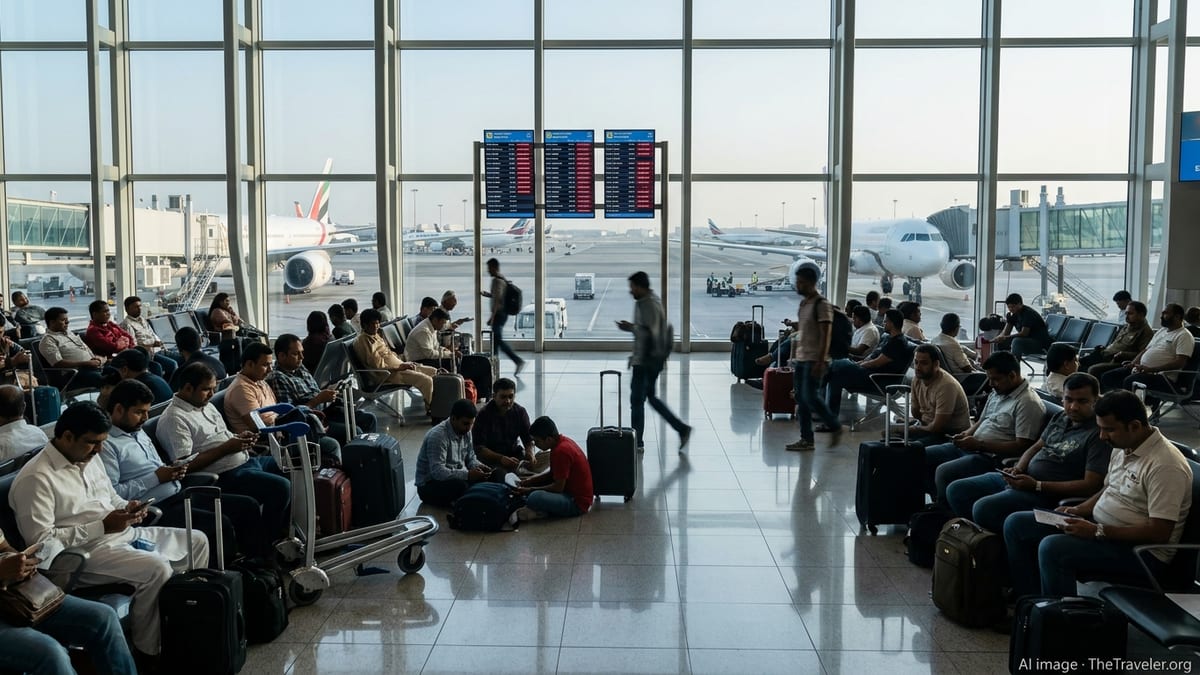
Gulf Airspace Closures Trigger Worldwide Flight Cancellations
Publicly available air traffic data and aviation advisories indicate that airspace closures across parts of the Middle East are driving an unprecedented wave of global flight disruptions. Following Iranian strikes on Qatar and the United Arab Emirates, multiple Gulf states have sharply curtailed civil aviation, severing some of the world’s busiest east west travel corridors between Europe, Asia, and Africa.
Analysts tracking the economic impact of the 2026 Iran war report that closures and capacity reductions in the United Arab Emirates, Qatar, Kuwait, Bahrain, and neighboring states have resulted in thousands of daily flight cancellations. Major transit hubs such as Dubai International Airport and Hamad International Airport in Doha have faced intermittent shutdowns and damage-related constraints, forcing airlines to ground aircraft, consolidate schedules, or cancel operations entirely.
Long haul routes between Europe and South or Southeast Asia are among the hardest hit, as traditional paths over Iran, Iraq, and the Gulf must be replaced with lengthy detours via southern corridors over Oman, Saudi Arabia, or North Africa where possible. Where rerouting is not viable or insurable, airlines are withdrawing service. Industry briefings describe a steep spike in war risk premiums for flights entering the broader Gulf region, complicating efforts to maintain even skeleton schedules.
While some airports in Saudi Arabia and Oman continue to operate with limited capacity, the patchwork of closures and restrictions has created a cascading effect worldwide. Passengers with no direct connection to the Middle East are finding their journeys disrupted as aircraft and crews are stranded out of position, cargo flows are interrupted, and carriers undertake wholesale timetable overhauls.
PIA Suspends UAE Routes as Pakistan Tightens Security Posture
Within this volatile environment, Pakistan International Airlines has moved to halt key routes to the United Arab Emirates and parts of the wider Gulf, citing the need to safeguard passengers and crews amid rapidly shifting security conditions. According to published coverage from regional outlets, the flag carrier has progressively suspended selected services linking major Pakistani cities with Dubai, Abu Dhabi, Sharjah, and other Emirati gateways.
These suspensions affect travelers departing from primary hubs such as Karachi, Lahore, and Islamabad, as well as secondary cities that rely heavily on Gulf links for labor migration and family visits. Local aviation reporting describes a pattern of cancellations and extended delays on Pakistan to Gulf sectors, as PIA and other regional airlines assess missile and drone threats, air defense activity, and the availability of safe approach routes into Gulf airports.
Pakistan’s broader security stance has shifted in tandem with the conflict’s escalation. Maritime initiatives such as Operation Muhafiz ul Bahr reflect efforts to shield vital energy and trade routes in the Arabian Sea, a priority that underscores the stakes for a country heavily dependent on Gulf oil and remittances. In this context, curbing civilian flight exposure to conflict-adjacent airspace is emerging as a key plank in Pakistan’s risk management strategy.
Travel industry observers say the PIA suspensions are particularly disruptive for Pakistani expatriate workers in the UAE and neighboring states, many of whom now face complex multi stop journeys via alternative hubs, or indefinite delays while waiting for routes to reopen. Charter operators and foreign airlines are seeing a surge in demand on remaining corridors, driving up fares and reducing flexibility for stranded passengers.
Saudi Arabia, Qatar, Bahrain, Kuwait and the Gulf Grapple With Patchwork Operations
Across the Gulf Cooperation Council, civil aviation authorities and airlines are navigating a difficult balance between maintaining connectivity and minimizing exposure to ongoing strikes and air defense operations. Recent logistics and risk advisories describe Bahrain and Kuwait as effectively closed to normal passenger traffic, with airports and airspace largely suspended and only limited emergency or humanitarian movements permitted.
Qatar has gradually reopened segments of its air navigation services under heavily restricted conditions following missile barrages that previously shut its airspace and disrupted operations at Hamad International Airport. Publicly available statements from Qatari aviation bodies indicate that while limited evacuation and cargo flights are moving, standard commercial schedules remain far from normal, with many airlines keeping services suspended until the security trajectory becomes clearer.
In Saudi Arabia, key gateways such as Riyadh, Jeddah, and Dammam have continued to function in a constrained mode, operating reduced schedules and accommodating substantial rerouting from neighboring states. However, travel advisories point to persistent delays, cancellations, and capacity cuts, reflecting both direct risk considerations and the knock on effects of neighboring closures. Kuwait and Bahrain, with smaller but strategically located hubs, remain under stringent restrictions that sharply limit their role as transit points.
The United Arab Emirates illustrates the volatility of the situation. Following Iranian strikes that hit targets in and around major cities, Dubai International Airport and other UAE facilities have experienced temporary shutdowns and partial restarts. Public reports note periods where only a limited number of flights, largely operated by local carriers, have been permitted to depart or arrive under enhanced security procedures, leaving foreign airlines with little choice but to suspend most operations.
Global Carriers Cut Middle East Services and Reroute Long Haul Flights
International airlines across Europe, Asia, and beyond are rapidly rewriting schedules in response to the deteriorating risk environment around Iran and the Gulf. Publicly available tracking of airline announcements shows that carriers including British Airways, Lufthansa, Air France KLM group airlines, and several major Asian operators have temporarily suspended most or all passenger services to key Gulf destinations such as Dubai, Abu Dhabi, Doha, Bahrain, and Kuwait City.
For some airlines, outright cancellation of Middle East routes is only part of the challenge. Long haul flights that previously transited Gulf or Iranian airspace en route between Europe and South Asia, East Asia, or Australia are being forced into longer routings via southern or northern arcs. Industry commentary indicates that the resulting increases in flight time, fuel burn, and crew duty complexity are straining capacity, while elevated insurance premiums for segments that still approach the broader conflict zone are testing route economics.
Air cargo is under similar strain. Supply chain updates from logistics firms point to capacity shortages as freighter operations through Bahrain, Kuwait, and parts of the UAE remain constrained, redirecting flows through alternative hubs in Turkey, Egypt, and farther afield. This shift is already creating bottlenecks and higher transport costs for time sensitive goods ranging from pharmaceuticals to electronics, with downstream implications for global manufacturing and retail.
Passengers booked on affected airlines are being advised, through public communications, to check flight status frequently and consider rebooking via secondary hubs where space allows. However, as disruptions ripple through multiple continents, options are narrowing. With aircraft and crew displaced and schedules rewritten on short notice, even travelers not flying to or from the Middle East are encountering missed connections and unplanned stopovers.
Travelers Face Uncertainty as Airlines and Regulators Monitor the Conflict
For individual travelers, the net effect of these developments is a climate of deep uncertainty. Reports from passenger forums and travel advisory services describe people stranded at airports across Europe, Asia, and the Middle East after last minute cancellations, as well as families and migrant workers struggling to secure alternate routes home from Gulf countries. Some governments are coordinating special flights where feasible, but these efforts are constrained by the same airspace and security limitations facing commercial carriers.
Regulators and aviation safety bodies are closely tracking the trajectory of the conflict and the associated missile and drone activity that poses a threat to high altitude civil aviation. Public guidance stresses that decisions to close airspace or suspend routes are precautionary measures designed to avoid aircraft exposure to active conflict zones, a lesson sharpened by previous incidents in other regions where civilian jets were caught near military engagements.
Looking ahead, the pace at which flights can resume depends heavily on whether Iranian strikes on Gulf states subside and whether regional governments gain confidence in the robustness of air defense and deconfliction arrangements. Industry analysts caution that even if hostilities ease, a phased return of services is likely, with airlines first restoring critical trunk routes while continuing to avoid the most sensitive airspace corridors.
Until then, the Middle East will remain the epicenter of an aviation crisis radiating across continents, and carriers like Pakistan International Airlines, regional Gulf airlines, and global network operators will continue to adjust schedules day by day. For travelers planning journeys that would normally pass through the region, flexibility, contingency planning, and close monitoring of airline advisories have become essential parts of any itinerary.