

More news on this day
Greece has launched an unprecedented effort to repatriate citizens and their pets from the United Arab Emirates to Athens, with a special Aegean Airlines evacuation flight from Abu Dhabi marking a new chapter in how governments respond to travelers caught in conflict zones.
Get the latest news straight to your inbox!
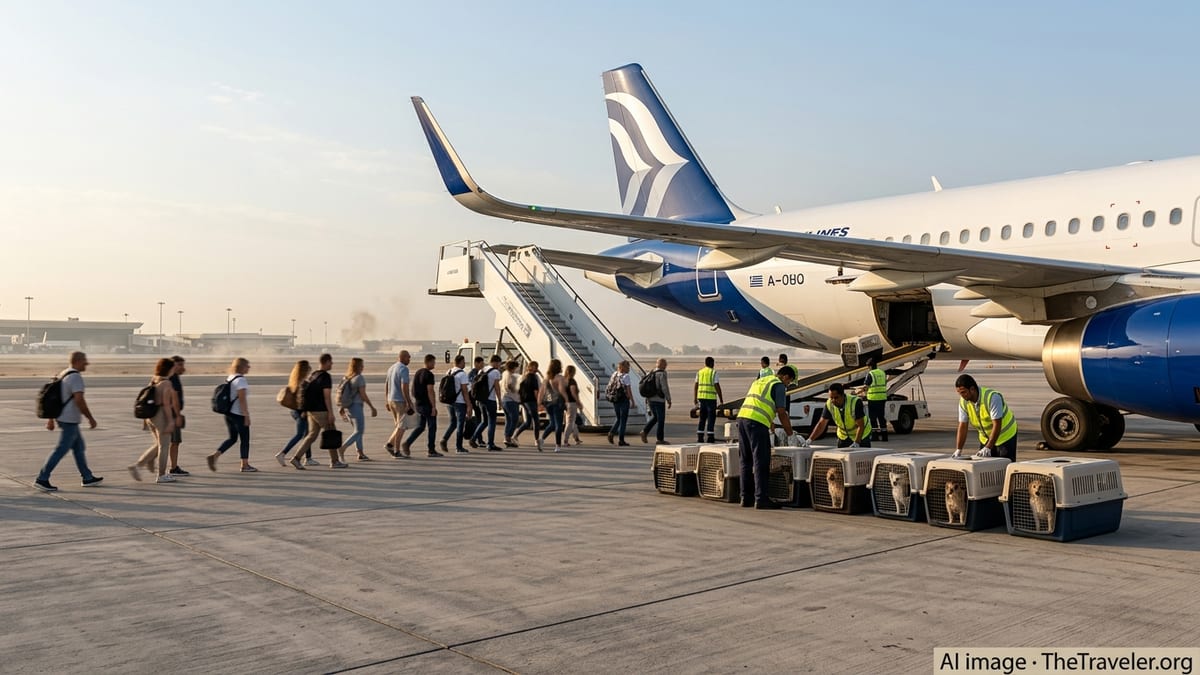
A Historic Animal-Inclusive Airlift From Abu Dhabi
The most visible milestone in Greece’s operation came on March 18, 2026, when a government-organized Aegean Airlines flight departed Abu Dhabi carrying 101 passengers and 45 pets to Athens. Publicly available coverage describes emotional reunions at Athens International Airport as dogs and cats emerged from travel carriers to greet their owners after days of uncertainty.
The flight followed wide disruption to air travel across the Middle East after strikes on Iran and subsequent retaliatory attacks that repeatedly closed regional airspace. Reports indicate that many commercial carriers serving the Gulf region had curtailed services, leaving travelers scrambling for alternatives and making it particularly difficult to find options that would accept animals in the cabin or cargo hold.
According to published accounts, the Abu Dhabi to Athens service was specifically configured to accommodate companion animals alongside their guardians, reflecting a growing recognition that many evacuees are unwilling to leave pets behind. The aircraft, operated by Greece’s flag carrier Aegean Airlines, became a symbol of a broader shift toward more humane evacuation planning that considers entire households rather than just human passengers.
The operation has drawn attention across Europe and the Gulf not only because of the number of animals involved, but also because it contrasts sharply with reports from the UAE of pets being abandoned as residents rushed to leave during the conflict. Against that backdrop, Greece’s animal-inclusive airlift has been framed in international coverage as a rare piece of positive news emerging from a volatile region.
How Greece Coordinated Repatriation From the UAE
Greece’s wider response fits into a pattern of government-organized evacuations seen across the Middle East since late February, when the current Iran war severely disrupted commercial aviation. Publicly available information shows that multiple countries have deployed charter flights and military aircraft to move their citizens out of high-risk areas as air corridors shift from day to day.
For Greece, the UAE has been a focal point, as Abu Dhabi and Dubai serve as major transit hubs for Greek nationals working or vacationing across the Gulf and Asia. Reports from regional media and international outlets indicate that Greek authorities first concentrated on repatriating citizens from immediate conflict zones, then extended their efforts to those stranded in secondary hubs once it became clear that normal air schedules would not quickly resume.
The Abu Dhabi flight is described as part of this second wave, assembled in response to mounting difficulties faced by pet owners in securing commercial tickets. Forum posts and local coverage from the UAE describe a patchwork of airline rules, with some carriers suspending pet transport entirely and others limiting animals to checked cargo, which many owners viewed as too risky given the instability and frequent rerouting of flights.
Within this complex environment, Greece’s decision to organize a tailored evacuation service from the UAE, rather than only from states directly under fire, underscores how far-reaching the disruption to global travel has become. It also highlights the logistical challenge of coordinating departure clearances, aircraft availability, and passenger manifests in a region where flight paths can change with little warning.
Aegean Airlines’ Role and Operational Capabilities
Aegean Airlines, Greece’s largest carrier and a Star Alliance member, has emerged as a central player in the repatriation effort. Company disclosures from recent years show that Aegean has steadily expanded its fleet of Airbus A320 and A321 neo aircraft and broadened its network across Europe and the Middle East, leaving it well positioned to operate ad hoc flights during crises.
In the current conflict, Aegean has had to balance its role as a commercial airline with the demands of emergency operations. Public information indicates that the airline, like many of its regional peers, temporarily suspended flights to certain Middle Eastern destinations earlier in March due to security concerns and airspace closures. At the same time, it has been called upon to support government-organized missions such as the Abu Dhabi to Athens airlift.
Operating an evacuation that includes pets adds another layer of complexity to an already challenging mission profile. Aegean’s standard policies allow a limited number of animals in the cabin and additional pets in the cargo hold, subject to weight and carrier-size restrictions. In an evacuation scenario, capacity planning must account for larger-than-normal numbers of animal passengers, specialized containers, and coordination between ground handlers, veterinary checkpoints, and airport authorities.
Despite these hurdles, reports from the March 18 flight suggest that the operation proceeded smoothly, with both human and animal passengers arriving safely in Athens. Industry observers note that Aegean’s growing fleet and experience on Middle Eastern routes likely helped the airline adapt quickly, even amid wider regional disruptions and rerouted flight corridors.
What Stranded Travelers With Pets Need to Know
For Greek nationals and other travelers in the UAE still hoping to return home with pets, the situation remains fluid. Travel advisories and aviation megathreads covering the conflict emphasize that flight schedules can change at short notice and that airlines may adjust pet transport policies in response to shifting security assessments or operational constraints.
Publicly available guidance for pet travel on Aegean and other carriers highlights several consistent requirements. Animals generally need up-to-date vaccinations, especially against rabies, and documentation such as an EU pet passport or equivalent health certificates. Carriers must comply with international aviation standards for ventilation, size, and construction, whether the pet is traveling in the cabin or in the hold.
Travelers in the UAE also need to be aware of local export procedures, including veterinary checks and exit permits, which can take several days to arrange under normal circumstances. During a conflict, processing times may be longer as government offices and veterinary services respond to higher demand and intermittent disruptions. Prospective passengers are advised in publicly available resources to prepare documentation as early as possible and to keep backup plans in mind in case specific flights or corridors close.
Those hoping to join future organized repatriation flights should pay close attention to official announcements from their home governments and to verified updates from airlines about special services. Past evacuations during the 2026 Iran war show that once flights are announced, seats can fill quickly, particularly on routes that permit pets. Flexibility on dates, routes, and even departure airports within the UAE may be essential for travelers trying to leave with animals.
Broader Implications for Travel and Animal Welfare
Greece’s pet-inclusive repatriation from the UAE is part of a larger story about how modern conflicts are reshaping expectations around travel and animal welfare. Coverage of the 2026 Iran war has documented not only stranded travelers, but also a surge in abandoned animals across affected cities as residents flee without the means or permission to take pets along.
By contrast, the Athens-bound flight from Abu Dhabi demonstrates that it is possible to structure evacuations that keep families and companion animals together, provided that governments, airlines, and airports coordinate requirements in advance. Observers of previous crises note that such coordination can reduce the burden on local shelters and veterinary services, which are often overwhelmed when pets are left behind.
The operation may also influence how airlines approach pet transport in volatile regions. The high-profile nature of the Greek airlift, amplified by images and testimonies shared through international media and social platforms, has drawn public attention to the limitations of existing pet policies during emergencies. That scrutiny could accelerate discussions within the industry about more flexible evacuation protocols for animals.
For now, the Abu Dhabi to Athens flight stands as one of the clearest examples of a coordinated animal airlift during the current conflict. As repatriation efforts continue and additional flights are considered, travel watchers will be looking to see whether Greece and Aegean Airlines expand similar operations and whether other countries adopt comparable models to reunite citizens and their pets with homes far from the front lines.