

More news on this day
Ground stops affecting major Washington DC area airports were lifted early Saturday after an air traffic control facility issue, but travelers at Ronald Reagan Washington National Airport are still facing a formal ground delay program and lingering disruptions.
Get the latest news straight to your inbox!
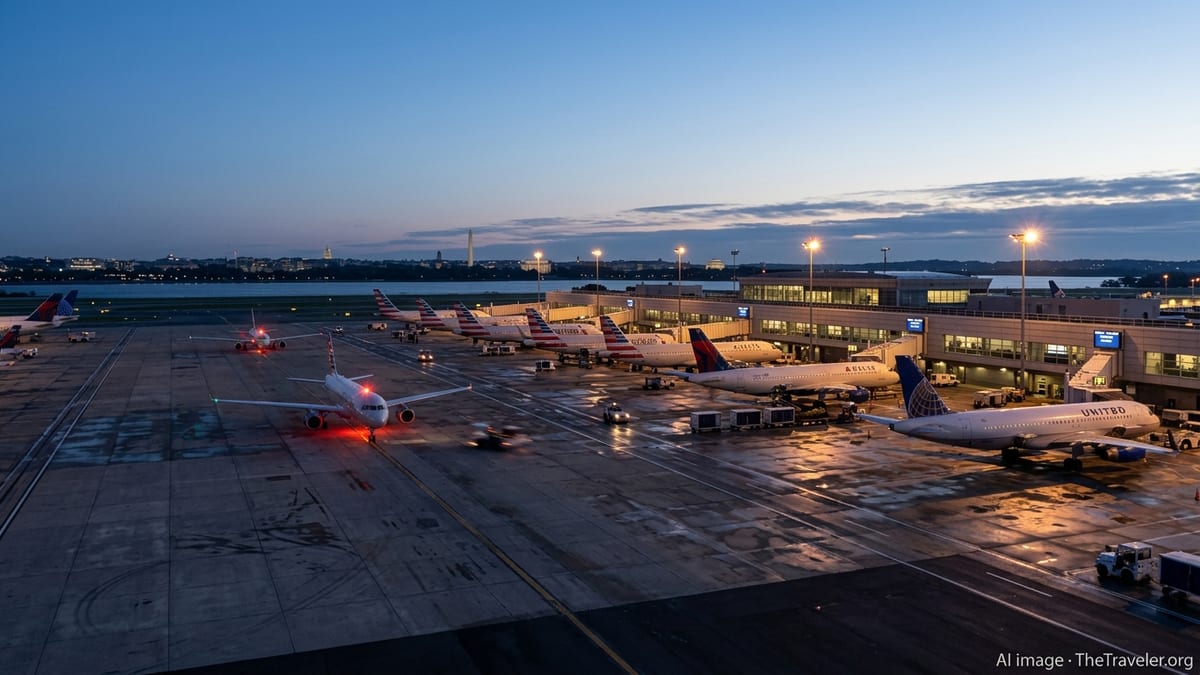
Air Traffic Issue Triggers Widespread Ground Stops
Flights into and out of the Washington region were significantly disrupted Friday evening after an operational problem at the Potomac Terminal Radar Approach Control facility, a key air traffic hub located in Warrenton, Virginia. Publicly available information indicates the facility, which manages approach and departure traffic for Ronald Reagan Washington National, Washington Dulles International, Baltimore/Washington International Thurgood Marshall, Richmond International and Charlottesville-Albemarle, was partially evacuated due to an environmental or equipment issue.
Data from flight tracking platforms and airline advisories show that the Federal Aviation Administration implemented ground stops that temporarily halted many departures bound for the DC region, while arrivals were sharply limited. Social media posts from passengers stranded on the tarmac at multiple airports across the country described pilots attributing the disruption to an issue at the Washington area control facility.
By late evening, updates from airports and carriers indicated that the broad ground stops had been lifted and controllers were gradually returning to their workstations. However, with aircraft and crews out of position across the network, the impact continued to ripple well into the overnight hours.
Reagan National Shifts From Ground Stop to Ground Delay
With the initial stoppage ended, traffic management in the Washington area transitioned into a more controlled recovery phase. According to FAA planning data and airline operations notices, a formal ground delay program was put in place for Ronald Reagan Washington National Airport early Saturday.
Under a ground delay program, flights destined for a particular airport are assigned specific departure times from their origin points, spacing arrivals to match reduced capacity at the destination. This differs from a full ground stop, in which departures to that airport may be barred altogether. The move at Reagan is intended to meter inbound traffic while air traffic control staffing and airspace capacity are restored.
Passengers booked into or out of Reagan early Saturday have reported revised departure and arrival times, with some flights pushed back by an hour or more. Airlines are updating schedules throughout the morning as the delay program is adjusted and additional arrival slots become available.
Travelers Face Residual Delays Across the DC Region
Even after the formal ground stops ended, the Washington region’s three main commercial airports continued to see residual delays. Flight status boards at Reagan National, Dulles and Baltimore/Washington show a mix of late departures, rolling delays and scattered cancellations as carriers work to reposition aircraft and crews.
Publicly available information from airline advisories emphasizes that recovery from such a disruption typically takes several hours, especially during busy evening and morning bank periods. Some long-haul and transcontinental flights were diverted to alternate airports during the stoppage, creating additional complexity for Saturday’s schedule.
Reports from passengers arriving at Reagan overnight described relatively quiet terminals but limited late-night options for onward travel. Others connecting through Dulles and Baltimore have noted missed connections and rebookings onto later services, with some travelers forced to overnight away from their original destination.
Recurring Strain on Potomac TRACON Raises Questions
The latest interruption follows a series of recent incidents linked to the Potomac TRACON facility, including a similar event earlier in March that also led to temporary ground stops at DC area airports. Published coverage at the time cited equipment issues and strong odors inside the building, prompting safety checks and temporary reductions in air traffic services.
Aviation analysts note that the facility is critical to the functioning of one of the country’s most complex airspace regions, handling dense traffic flows into multiple major airports and numerous smaller fields, along with military and governmental operations around the nation’s capital. Any outage or evacuation can have an immediate, outsized effect on national air traffic, particularly during peak travel windows.
Recent federal documents and policy discussions have highlighted ongoing efforts to modernize air traffic infrastructure and strengthen contingency planning for high-demand regions such as Washington. The latest disruption is likely to renew scrutiny of redundancy, maintenance and staffing levels at key control centers, especially where repeated issues have been reported within a short span of time.
What Passengers Should Expect in the Coming Hours
As of early Saturday, operational data suggests that flights into the Washington region are gradually resuming more typical patterns, with the most severe restrictions lifted but measured controls still in place at Reagan National. Travelers heading to or from the DC area are being advised by airlines to monitor their flight status frequently and allow additional time for check-in and security.
Industry guidance indicates that morning and midday departures are most likely to experience residual delays, as aircraft and crews cycle back into position. Short-haul routes that rely on aircraft making multiple turns in a day could see knock-on effects into the afternoon, while some early-morning departures may be subject to adjusted times under the ground delay program at Reagan.
Passengers already at the airport are encouraged, in public travel advisories, to stay close to their departure gate for real-time updates, as boarding times may shift rapidly when new arrival slots open. Those with flexible plans may find that rebooking to later flights or alternate DC area airports improves their chances of a smoother journey as the system stabilizes.