

More news on this day
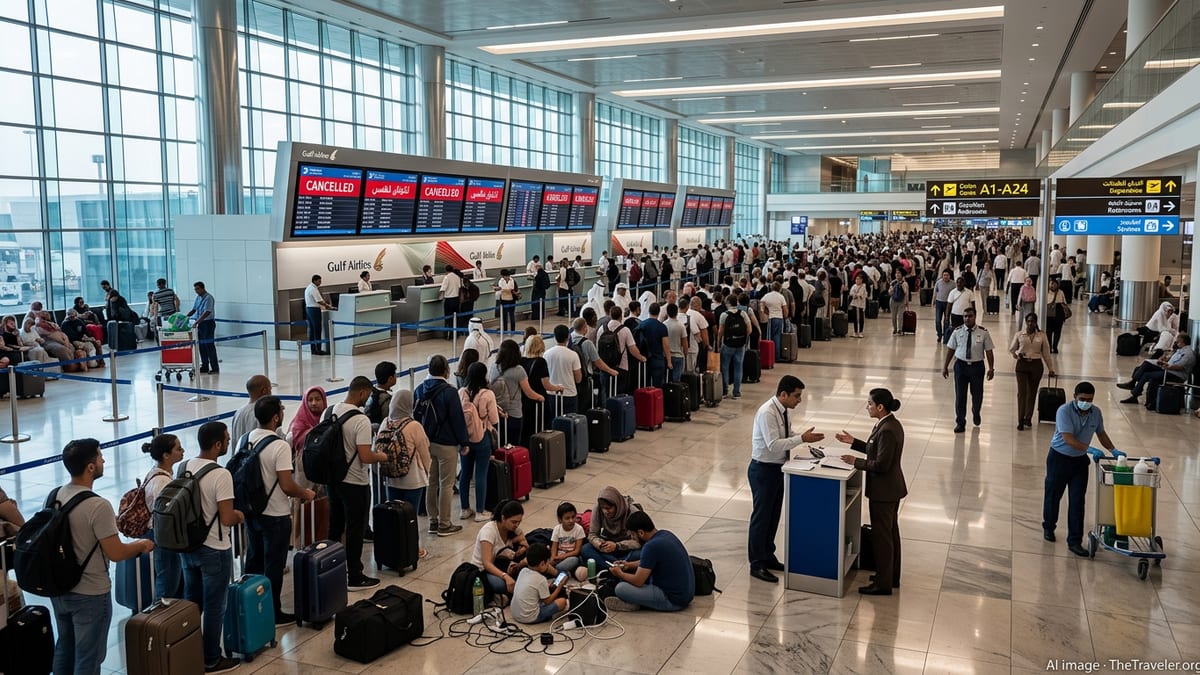
A sweeping airspace crisis across the Gulf is rippling through global aviation, as partial closures and severe flight restrictions in the United Arab Emirates, Qatar, Saudi Arabia and Oman trigger mass cancellations, diversions and days of uncertainty for travelers worldwide.
How the Gulf Airspace Shutdown Unfolded
The disruption escalated at the end of February, when US and Israeli strikes on Iran were followed by retaliatory attacks across the Gulf. Authorities in multiple states responded by shutting or restricting key sections of their airspace, including corridors that sit above some of the world’s busiest long haul routes linking Europe, Asia, Africa and Australasia. Within days, thousands of flights were cancelled or rerouted as safety regulators and militaries imposed tight controls on civilian traffic.
In the United Arab Emirates, the General Civil Aviation Authority announced a temporary and partial closure of airspace on February 28. Dubai International and Abu Dhabi International, two of the world’s most important transfer hubs, sharply reduced movements as airlines suspended or consolidated services. While limited operations have resumed, schedules remain volatile and many passengers are still facing last minute changes.
Qatar has been hit even harder. Following missile and drone threats in early March, Qatari airspace was effectively closed to regular commercial traffic, severing Doha’s Hamad International Airport from its usual global flows. Qatar Airways, normally one of the world’s largest long haul carriers, has grounded most of its network and is operating only a handful of repatriation and relief flights via special corridors approved by regulators.
Saudi Arabia and Oman, whose skies are often used as alternatives when central Gulf routes are disrupted, have faced their own pressures. Parts of Saudi airspace, particularly in the east and northeast, have been subject to heightened risk advisories and route restrictions. Oman’s airspace remains officially open, but its airports and air traffic systems are under intense strain as airlines divert flights through Muscat and Salalah to skirt closure zones.
Major Gulf Airlines Slash Schedules and Reroute
Flag carriers based in the Gulf, which rely on open skies and smooth hub operations, have been forced into emergency mode. Emirates and Etihad Airways significantly cut schedules to and from Dubai and Abu Dhabi during the height of the closures, cancelling hundreds of departures and consolidating passengers onto the small number of flights that could safely operate. Low cost carrier flydubai and regional player Air Arabia have been similarly affected, with many routes temporarily suspended or diverted to secondary airports.
Qatar Airways has issued some of the starkest updates. With Qatari airspace formally closed, the airline has temporarily suspended most scheduled passenger services through at least mid March and halted sales of many ancillary products such as lounge access and prepaid seat selections. Only limited repatriation flights to key European hubs are moving, using tightly controlled routes that exit Qatari airspace as quickly as possible before joining longer detours over safer sectors.
Saudi carriers, including Saudia and flynas, have kept more of their domestic and religious traffic moving, particularly around Jeddah and Madinah for Umrah pilgrimages. Yet even they have had to adjust routings and timings, especially for flights that would normally cross conflict affected airspace to reach destinations in Europe or the Indian subcontinent. Longer paths and intermediate fuel stops are reducing aircraft availability and complicating crew planning.
For Oman, the crisis has turned Muscat into a key relief hub. Oman Airports has stressed that major gateways remain fully operational, and a growing number of airlines from Asia and Europe are now threading flights through Omani airspace to bypass closed sectors above the central Gulf and parts of Iraq and Iran. While this has allowed some long haul services to continue, the extra flows are placing heavy demands on ground handling, air traffic control and hotel capacity for disrupted passengers.
Global Route Maps Redrawn Overnight
The closures have forced airlines around the world to redraw their route maps overnight. Long haul services linking Europe and North America to India, Southeast Asia and Australasia, which often rely on efficient great circle paths over the Gulf, are now detouring hundreds of miles to the south or north. Some carriers are avoiding the wider region entirely, suspending flights to destinations such as Dubai and Doha and instead feeding passengers through alternate hubs in Turkey, Egypt or Central Asia.
These diversions carry major operational and financial consequences. Extra fuel burn on elongated routes pushes operating costs higher at a time when jet fuel prices are already elevated. In many cases, airlines are imposing payload restrictions, leaving some seats unsold or offloading cargo to keep aircraft within safe performance limits on the longer legs. That in turn reduces available capacity and makes it harder to accommodate rebooked passengers.
Airports far from the Gulf are feeling the shock. Major hubs in Europe and Asia report waves of stranded travelers whose connecting flights through the Middle East have vanished from departure boards. Some carriers have been running ad hoc “rescue flights” to pick up those stuck in Dubai, Abu Dhabi or third country airports after their onward services via Qatar or Saudi Arabia were cancelled. Travel patterns that have underpinned global tourism and business trips for more than a decade are, at least temporarily, being reshaped.
Industry analysts note that Gulf airports handle large volumes of transfer traffic that never actually enters the region, especially for trips between secondary cities. The closure of these efficient one stop links is forcing many travelers onto two or even three stop itineraries, adding complexity, cost and time to journeys that had become routine.
What Travelers Need to Know Right Now
For passengers with upcoming trips involving the UAE, Qatar, Saudi Arabia or Oman, the most important message from airlines and regulators is to avoid heading to the airport until a flight has been explicitly confirmed. Schedules are changing by the hour as authorities adjust airspace restrictions and carriers secure or lose access to specific corridors. Even flights that appear on time one day may be cancelled the next if security conditions deteriorate or military activity intensifies.
Most major airlines are offering flexible rebooking, refunds or travel vouchers for itineraries that touch the affected airspace between late February and at least mid March. However, policies differ by carrier and by ticket type, particularly for journeys issued through codeshares or online travel agencies. Passengers are being urged to manage their bookings directly through airline websites or apps, where possible, and to be prepared for long waits if they need to reach call centers.
Travelers already stranded in the Gulf are seeing a patchwork of solutions. Some governments, including those in Europe and Asia, are chartering special flights or reserving blocks of seats on the limited services still operating to evacuate citizens. Others are advising people to shelter in place until commercial flights resume in greater numbers. Hotel availability is tightening in key hubs, and daily expenses for food and accommodation are becoming a pressing concern for those whose trips have stretched from days into weeks.
For those planning future travel, experts suggest building in extra buffers for important trips, avoiding tight connections, and considering alternative routings that do not depend on Gulf hubs, at least until there is a clear and sustained reopening of the main airspace corridors. Travelers should also pay close attention to travel advisories issued by their own governments, which may affect insurance coverage and the ability to claim compensation for disruption.
Outlook for the Region’s Aviation and Tourism Sectors
The Gulf states have spent decades positioning themselves as indispensable crossroads of global aviation. Dubai, Doha and Abu Dhabi in particular have built business models on funneling millions of passengers a year through their airports en route to far flung destinations. The current crisis underscores both the strength and vulnerability of that strategy: while the hubs can normally adapt quickly to localized shocks, widespread regional airspace closures expose them to risks largely beyond their control.
Short term, the focus for airlines and airports is on safety and controlled resumption. Limited flights are gradually returning to UAE airports under tight security protocols, and there are early signs of coordinated efforts to reopen at least some corridors for humanitarian and essential travel. Yet any escalation in the wider conflict, or fresh strikes near key aviation infrastructure, could reverse that progress and prolong the disruption well beyond March.
Tourism and business travel flows into the Gulf are likely to remain subdued even after restrictions ease, as travelers reassess their appetite for transiting or staying in a region under heightened alert. Conference organizers, cruise operators and tour companies are revisiting itineraries and, in some cases, shifting events to alternative destinations. The longer the uncertainty persists, the greater the risk of lasting damage to the perception of the Gulf as a reliably open, convenient gateway.
For now, the message from industry leaders is one of cautious realism. Airlines and regulators insist that they will only restore full schedules when they are confident that flight paths are secure. Until then, passengers should expect a choppy recovery, with sporadic resumptions, sudden cancellations and evolving restrictions that will continue to reshape global travel patterns in and far beyond the Middle East.