

More news on this day
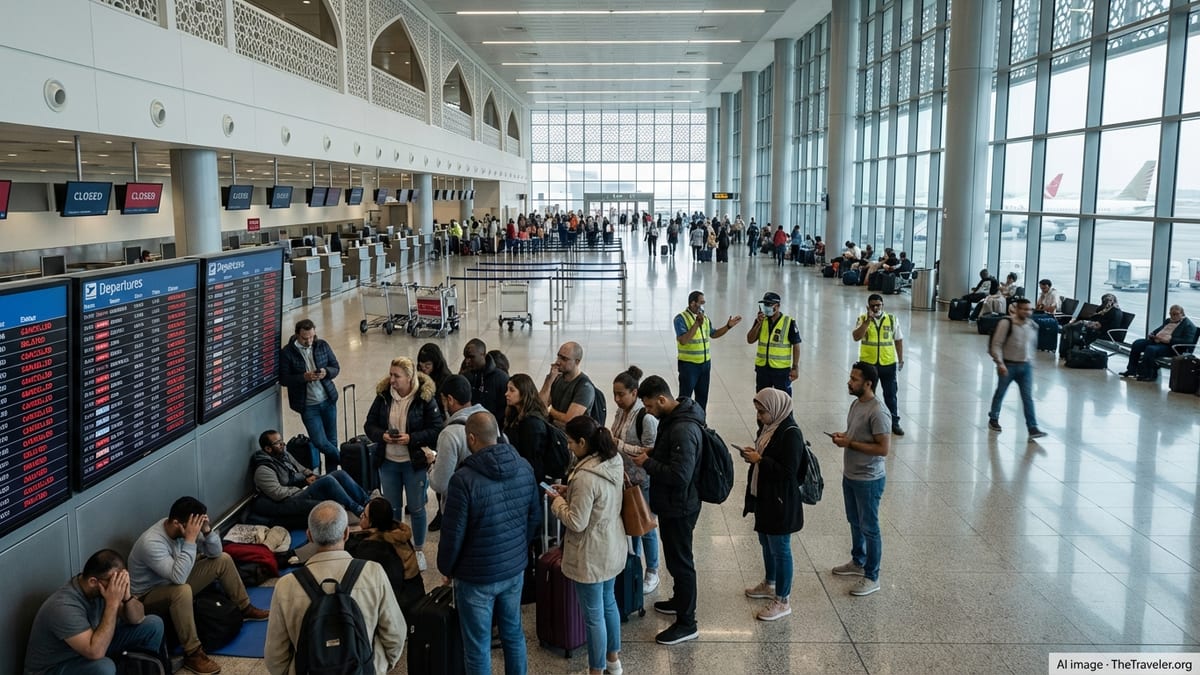
Thousands of travelers across the Gulf region have been left in limbo as continuing airspace disruptions force Saudia, Gulf Air, Air Arabia, Kuwait Airways and other carriers to cancel or severely curtail flights at major hubs in Riyadh, Kuwait City, Manama and Dubai.
Get the latest news straight to your inbox!
Regional Airspace Still Volatile After Weeks of Shutdowns
Travel across the Gulf remains fragile after weeks of rolling airspace closures and missile and drone incidents linked to the wider regional conflict. Publicly available information shows that Saudi Arabia, Kuwait, Bahrain and the United Arab Emirates have all imposed temporary restrictions at various points since late February, triggering large-scale cancellations and diversions on some of the world’s busiest routes.
Safety advisories issued by aviation regulators in Europe and the Gulf highlight ongoing concerns about the risk of miscalculation and debris near busy corridors, even as some countries begin reopening their skies. Reports indicate that thousands of flights have been canceled or rerouted since the crisis began, forcing airlines to improvise with ad hoc routings, emergency stopovers and truncated networks.
While some long-haul services are now skirting the region entirely, regional carriers such as Saudia, Gulf Air, Air Arabia and Kuwait Airways are contending with a more immediate problem: hubs that are either operating in a limited fashion or, in some cases, effectively shut to routine commercial traffic. The result has been mounting backlogs of passengers at key Gulf airports and an increasingly complex rebooking puzzle.
The wider economic context is stark. Analysts tracking the impact of the conflict note that Gulf airports collectively handle a significant share of global air traffic, so each day of reduced capacity multiplies the disruption across Europe, Asia and Africa. Airlines have warned that the combination of lost revenue, longer routings and higher insurance and fuel costs is likely to be felt for months after airspace fully reopens.
Saudia and Air Arabia Edge Back While Riyadh and Dubai Struggle
In Saudi Arabia, Saudia is cautiously rebuilding parts of its schedule after earlier suspensions on key regional routes. Travel trade updates show that from 11 April the airline has begun restoring selected flights from Jeddah and Riyadh to Dubai, Abu Dhabi and Amman following a prolonged period in which many services to neighboring hubs were halted or sharply reduced.
For passengers in Riyadh, this limited restart offers some relief but far from a full return to normal. Airlines are prioritizing core regional and domestic links, and publicly available schedules indicate that frequencies remain below pre-crisis levels. Travelers report crowded departure halls, long queues at ticket counters and difficulty in finding open seats on near-term departures, particularly for those with onward connections beyond the Gulf.
In the United Arab Emirates, Air Arabia is also reintroducing services into and out of the country after earlier cancellations tied to airspace and airport incidents. Coverage in regional business media notes that the low-cost carrier is rebuilding its network from Sharjah and other UAE airports, reconnecting markets across the Middle East, North Africa and South Asia, although with fewer frequencies and shorter booking horizons than usual.
Dubai International Airport, one of the world’s largest transit hubs, remains under particular scrutiny after damage and fires linked to earlier missile and drone activity. Travel advisories and aviation analysis sites describe a patchwork of limited operations, waivers and schedule changes, with some foreign airlines still suspending services into Dubai while regional carriers gradually resume. These conditions have contributed to clusters of stranded passengers waiting for seats out of the city or new routings via alternative hubs.
Kuwait City and Manama Face Prolonged Closures and Diversions
If Riyadh and Dubai are inching toward partial recovery, Kuwait City and Manama remain among the most severely affected Gulf hubs. According to recent regional reporting, Kuwait International Airport has stayed closed to routine commercial traffic on 11 April, with flight boards showing no regular departures or arrivals amid repeated drone and missile alerts in the vicinity of the facility.
The closure has forced Kuwait Airways to cancel large portions of its schedule and left travelers in Kuwait facing a shortage of options. Guidance published for passengers suggests using alternate gateways such as Dammam in Saudi Arabia or Bahrain when possible, but tight capacity and land border constraints have limited the practicality of such workarounds for many stranded travelers.
Bahrain’s capital Manama has also experienced a multi-day halt to normal operations at Bahrain International Airport, which serves as Gulf Air’s primary hub. News coverage in regional outlets describes a full suspension of airspace during the height of the crisis, followed by a phased reopening as security conditions allow. During the shutdown, aircraft were diverted or held on the ground, leaving many passengers unable to depart and others stuck in transit with limited information about onward travel.
For Gulf Air, the sudden loss of its home hub has prompted temporary measures such as operating via Saudi airports along the Gulf coast and prioritizing repatriation-style flights when permitted. However, the return to regular scheduling is expected to be gradual, with rolling cancellations still likely as airspace and airport conditions change with little warning.
Knock-on Effects for Global Connections and Transit Passengers
The turmoil at Riyadh, Kuwait City, Manama and Dubai is reverberating well beyond the region. Gulf hubs sit at the crossroads of Europe, Asia and Africa, and published analyses of the conflict’s economic impact estimate that closures and restrictions across the Middle East have led to thousands of daily flight cancellations worldwide.
Long-haul travelers who would normally connect through Dubai, Abu Dhabi or other Gulf hubs are facing multi-leg reroutings, overnight stays in secondary airports and, in some cases, forced returns to their point of origin. Airlines in Europe and Asia have reworked schedules to avoid restricted airspace, resulting in longer flight times and higher operational costs that may ultimately filter through to ticket prices.
Transit passengers already in the region have been particularly hard hit. With visas, hotel arrangements and travel insurance often tied to specific itineraries, many find themselves in “nowhere land” at closed or partially operating hubs. Travel risk advisories emphasize that hotel capacity near major Gulf airports is under strain, with stranded travelers competing for limited rooms and struggling to navigate changing immigration and transit rules.
The cargo sector is also feeling the strain. Logistics updates from global freight companies describe suspended services at some Gulf airports and delayed shipments as operators pivot to alternative routings, including longer sea-air and ground-air combinations. For time-sensitive industries such as pharmaceuticals and high-tech manufacturing, these detours are adding days to delivery windows.
What Stranded Passengers Are Being Advised to Do Now
As airlines and governments work to stabilize the situation, public guidance for affected travelers has grown more specific. Many carriers, including Saudia, Air Arabia, Gulf Air and Kuwait Airways, are publishing rolling updates on their websites and apps, urging passengers not to proceed to the airport until they have verified that their flight is confirmed to operate.
Industry notices show that flexible change and refund policies remain in place across much of the region. Some airlines are waiving date-change fees and fare differences for trips scheduled during the peak disruption window, while others are allowing full refunds even on nonrefundable tickets when flights are canceled or rerouted due to airspace restrictions.
Travel risk consultants and aviation analysts recommend that passengers stranded in Riyadh, Kuwait City, Manama or Dubai keep multiple options open, including alternative routings via less-affected hubs such as Muscat or Jeddah when available. They also advise monitoring both airline communications and local airport announcements closely, as reopenings can be partial and subject to rapid reversal if security conditions deteriorate.
For now, the picture across the Gulf remains mixed. With some carriers cautiously resuming selected services while others still face full airport closures, travelers can expect continued cancellations and last-minute changes in the coming days. The pace at which Saudia, Gulf Air, Air Arabia, Kuwait Airways and their counterparts can rebuild stable schedules at Riyadh, Kuwait City, Manama and Dubai will depend not only on airline planning, but on how quickly the region’s airspace stabilizes.