

More news on this day
Flight disruptions tied to the latest Middle East unrest are now rippling through Thailand, with around 20 services operated by El Al, Gulf Air, Kuwait Airways and other carriers reportedly cancelled across Bangkok and Phuket, unsettling travel plans on busy routes to Tel Aviv, Bahrain, Kuwait, Kuala Lumpur and beyond.
Get the latest news straight to your inbox!
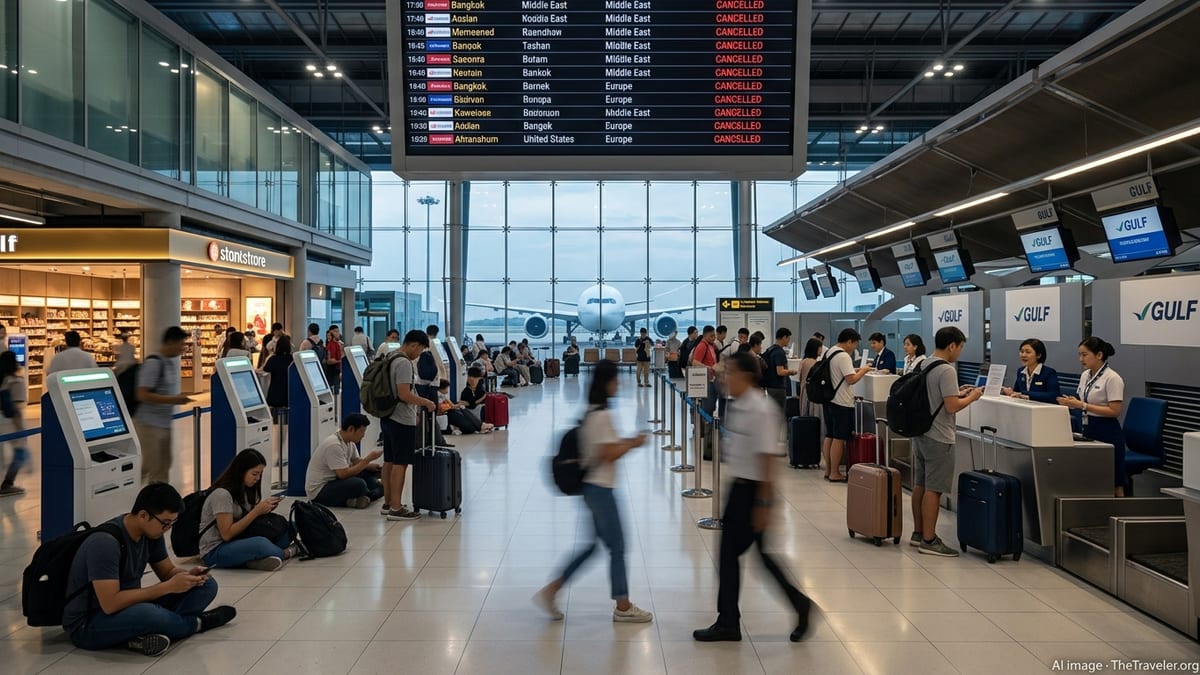
Thailand Becomes a Pressure Point in a Wider Airspace Crisis
Thailand’s main holiday gateways at Bangkok Suvarnabhumi and Phuket International have emerged as unexpected pressure points in a fast‑moving air travel crisis linked to escalating tensions in the Middle East. Publicly available flight‑tracking data and airline notices indicate that multiple departures and arrivals connecting Thailand with Israel and Gulf hubs have been withdrawn or consolidated in recent days, with roughly 20 cancellations affecting services over a short window.
Routes between Bangkok and Phuket and key transit hubs such as Tel Aviv, Bahrain, Kuwait City and Kuala Lumpur have been hit, reflecting the importance of Thailand as both a leisure destination and a convenient waypoint between Asia and Europe. Many of the affected flights were used by travelers connecting onward to Western Europe, North America or other parts of Asia, amplifying the knock‑on impact of each individual cancellation.
The disruptions follow significant airspace restrictions and schedule cuts across Israel and several Gulf states since late February, as carriers reassess overflight permissions, crew safety and operational risk. Thailand is not directly involved in the regional tensions, but its role in long‑haul networks means changes made thousands of kilometers away can cascade quickly into its airports.
While domestic services and most regional routes within Southeast Asia are continuing to operate broadly as normal, planners at international airlines are prioritizing aircraft and crew for corridors that avoid sensitive skies, leaving some Thailand–Middle East city pairs temporarily exposed.
El Al, Gulf Air and Kuwait Airways Pull Back Services
El Al’s network between Tel Aviv and Southeast Asia has been under particular pressure since Israeli airspace was partially curtailed and capacity from Ben Gurion Airport reduced. According to published schedules and tracking platforms, non‑stop services linking Tel Aviv with Bangkok have seen repeated cancellations and substitutions, with some rotations scrubbed entirely and others operating with altered timings as the airline juggles aircraft across its long‑haul portfolio.
Gulf Air, the national carrier of Bahrain, has also adjusted its Thailand flying. Its typical pattern of flights between Bahrain and Bangkok, including services that previously extended to Phuket during peak travel periods, has been thinned out as the airline copes with constrained routings over conflict‑adjacent areas. Some rotations that would ordinarily provide convenient overnight connections from Europe through Bahrain to Thailand have been withdrawn, leaving travelers to search for alternative one‑stop options.
Kuwait Airways, which positions Kuwait City as a transfer point between Europe, the Middle East and Asia, is facing a similar squeeze. Publicly available information points to cancellations on Kuwait–Bangkok sectors, and travelers on social platforms are reporting disrupted itineraries where Kuwait was scheduled as the only stop between Thailand and their final destination. The loss of even a handful of frequencies can significantly reduce flexibility for passengers given the limited number of daily wide‑body flights on these routes.
Secondary and codeshare arrangements are affected as well. Some itineraries sold under the brands of European or Asian partners but operated by Gulf carriers have been caught up in the cancellations, meaning that passengers who did not realize they were booked onto El Al, Gulf Air or Kuwait Airways metal are discovering changes only at the check‑in stage or through last‑minute notifications.
Bangkok and Phuket Travelers Face Rerouting and Higher Fares
For travelers currently in Bangkok and Phuket, the most immediate impact is a scramble for replacement seats. Reports from passengers on travel forums describe multiple rounds of cancellations on itineraries routed via Gulf hubs, forcing last‑minute switches to European or East Asian carriers that operate direct or one‑stop services back to Europe without crossing the Middle East.
With demand still strong at the end of Thailand’s high season and capacity abruptly curtailed on popular Middle East corridors, replacement fares are climbing. Travelers seeking to return to cities such as London, Frankfurt, Paris or Rome are gravitating toward airlines operating via cities like Singapore, Hong Kong, Seoul, Beijing and various European hubs, creating bottlenecks on those alternatives. Some passengers indicate that lower‑priced options vanish at payment, suggesting dynamic repricing as limited inventory sells out.
Phuket in particular, which relies heavily on connecting traffic through Gulf hubs in normal times, is experiencing a sharper shock. Travelers report needing to position themselves first to Bangkok before securing long‑haul seats, or opting to wait out the disruption and extend their stay in Thailand. The result is a patchwork of individual workarounds rather than a single coordinated solution, adding stress and uncertainty to journeys that were planned months in advance.
Travel advisories from risk‑monitoring firms and major international airlines emphasize that schedules remain fluid. Many carriers are offering fee waivers or allowing one‑time changes for tickets touching affected hubs, but rebooking windows and conditions vary, and seats on alternative routings are far from guaranteed.
Knock‑On Effects for Kuala Lumpur and Regional Hubs
The fallout is not confined to direct links between Thailand and the Middle East. Kuala Lumpur and other Southeast Asian hubs are also feeling the effects as passengers divert around compromised routes. Kuala Lumpur’s role as a connector between Southeast Asia, South Asia and the wider Muslim world means that any sustained cutback in Gulf capacity can quickly alter traffic flows through the Malaysian capital.
Regional carriers that link Thailand to Kuala Lumpur, Singapore and other nearby gateways are seeing a mix of higher demand from travelers seeking to reroute and occasional schedule tweaks as they adjust aircraft deployment. Flights from Bangkok and Phuket into Kuala Lumpur that feed onward services to the Gulf or to Europe via Middle Eastern hubs are particularly exposed to rapid changes in booking patterns.
In practice, this means that a Thailand‑based traveler bound for Europe via Bahrain, Kuwait or Tel Aviv might now be advised to route through Kuala Lumpur, Singapore or a North Asian hub instead. As more passengers adopt these workarounds, pressure builds on regional networks, potentially affecting travelers who have no original connection to the Middle East but happen to be using the same flights within Southeast Asia.
Travel planners note that the situation highlights how deeply interconnected Asia–Middle East–Europe air corridors have become over the past decade. A missile strike, airspace closure or capacity restriction in one part of the system can reverberate quickly through airports hundreds or thousands of kilometers away, as Thailand is now experiencing.
What Travelers Should Watch in the Coming Days
With tensions in the Middle East still evolving, industry observers expect more near‑term volatility rather than a rapid return to normal operations. Airlines are reviewing schedules in short cycles, sometimes adjusting day by day as overflight permissions, insurance conditions and security assessments shift. This makes it difficult for travelers to rely on timetables published weeks in advance.
Publicly available guidance from major carriers and travel risk consultancies suggests that passengers booked on itineraries touching Tel Aviv, Bahrain, Kuwait or other Gulf hubs should monitor their bookings closely, use airline apps where possible, and be prepared for rerouting through different regions. Travelers in Thailand are being encouraged by travel agents to allow extra time for connections, keep accommodation flexible and maintain contingency funds in case overnight stays or new tickets become necessary.
For Thailand’s tourism sector, the cancellations are an unwelcome complication at a time when international arrivals have been recovering strongly. Industry analysts note, however, that the country’s diverse mix of inbound markets and its strong links to East Asian and European carriers may cushion the blow if disruptions through the Middle East persist. The pace at which El Al, Gulf Air, Kuwait Airways and their peers can safely restore regular operations will be a key factor shaping long‑haul travel to and from Thailand in the weeks ahead.