

More news on this day
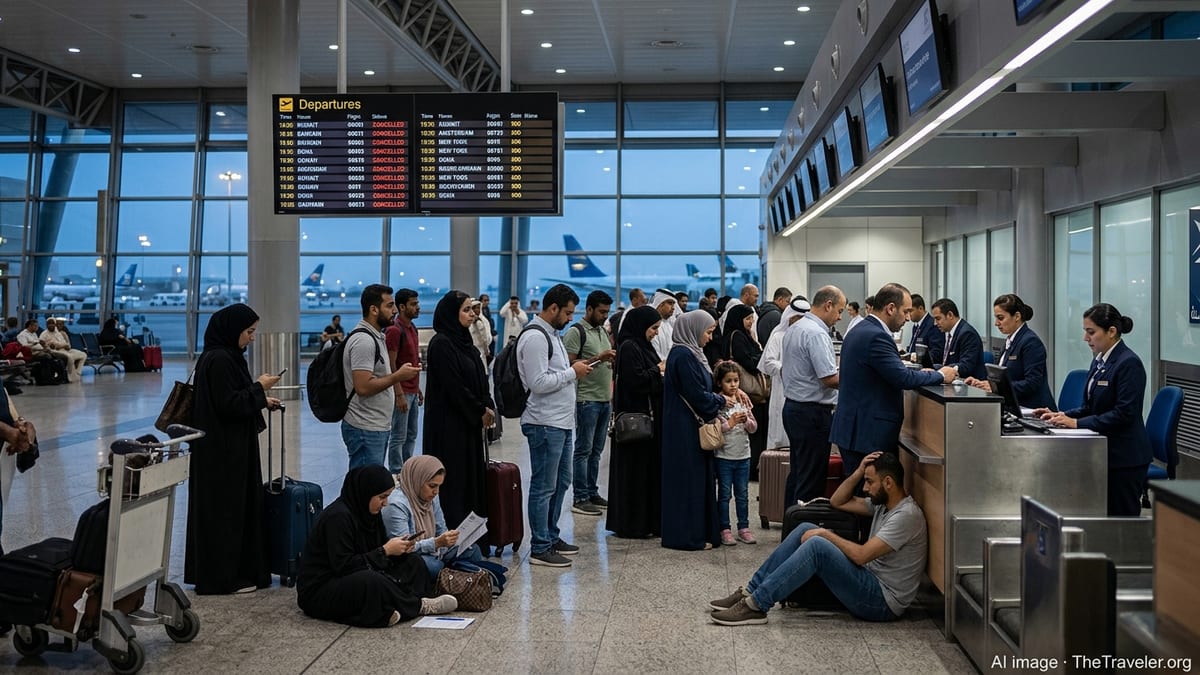
Hundreds of passengers transiting through Kuwait were left in limbo this week after Gulf Air, Kuwait Airways and Qatar Airways scrubbed more than a dozen services, as rolling airspace closures and schedule changes rippled across key routes linking Bahrain, New York, Amsterdam, Doha and other major hubs.
Get the latest news straight to your inbox!
Wave of Cancellations Hits Kuwait Transit Hub
Publicly available flight tracking data and regional media coverage show that the latest wave of cancellations followed renewed restrictions on airspace over several Gulf states, interrupting normal operations at Kuwait International Airport and neighboring hubs. Gulf Air, Kuwait Airways and Qatar Airways all adjusted schedules, with multiple departures and arrivals involving Kuwait removed at short notice.
Reports from affected travelers indicate that flights connecting Kuwait with Bahrain, Doha and key long haul destinations in Europe and North America were among those most heavily impacted. Services routed via Bahrain and Doha to cities such as Amsterdam and New York saw last minute cancellations or extended delays, leaving passengers unable to complete onward journeys.
The disruptions come on top of weeks of reduced capacity across the region as airlines navigate evolving security assessments and temporary airspace closures. Industry advisories describe a highly fluid situation in which carriers are frequently forced to replan or suspend flights only hours before scheduled departure times.
For Kuwait, which serves both as an origin and a connection point for South Asia, Europe and the Americas, the sudden loss of multiple services in a single day created an acute bottleneck. Travelers who had already started multi leg journeys through the Gulf found themselves stranded with limited rebooking options as nearby hubs also grappled with curtailed operations.
Stranded Passengers Face Long Waits and Patchwork Support
Accounts shared on social platforms and traveler forums describe crowded service desks, long queues at airline counters and overnight stays in airport terminals as passengers sought information and alternative routes. Some Kuwait bound travelers reported being unable to leave transit zones while they waited for news on replacement flights.
Gulf Air passengers connecting through Bahrain to or from Kuwait reported cancellations on short notice as Bahrain’s own airspace and airport operations were restricted. With Gulf Air’s Bahrain hub handling the bulk of its network, even a limited suspension quickly cascaded into missed onward connections and complex rebooking challenges for travelers heading toward Europe or North America.
Qatar Airways customers described similar difficulties as the carrier continued to operate a reduced schedule from Doha after earlier blanket suspensions. While the airline introduced limited relief and repatriation flights on select dates, these were primarily focused on major European capitals and did not immediately address all disrupted itineraries involving Kuwait or Amsterdam.
Kuwait Airways passengers, including those booked on services between Kuwait City and long haul destinations such as New York, have reported receiving cancellation notices by email without immediate clarity on rebooking windows or processing times for refunds. Some travelers recounted multiple schedule changes over several days, making it difficult to plan accommodation and onward transport.
Key Routes to New York, Amsterdam, Doha and Bahrain Affected
Network maps and airline advisories highlight that the disruption has not been limited to point to point traffic in the Gulf, but has instead affected a broad corridor of long haul travel. Kuwait based passengers traditionally reach New York via Kuwait Airways nonstops or one stop itineraries on Gulf Air and Qatar Airways through Bahrain and Doha, while Amsterdam is typically served through Doha or other regional hubs.
In the latest round of schedule changes, multiple Doha and Bahrain bound flights linked to Kuwait were removed, which in turn severed onward connections to Amsterdam, New York and additional transatlantic and European destinations. Flight tracking snapshots show periods where few, if any, commercial passenger services were operating on these corridors, underscoring the scale of the interruption.
The situation has been complicated by longer routings required to circumnavigate closed or restricted airspace. Carriers operating from the Gulf to Europe, for example, have in some cases been forced to adopt northerly detours that add significant flight time and cost. This has reduced the number of daily rotations airlines can sustain and has contributed to the decision to consolidate or cancel certain services altogether.
For travelers, this translates into missed business engagements, disrupted family visits and extended stays in expensive transit cities. Travel management firms and corporate travel departments have signaled that they are scrambling to identify alternative routings that avoid the most heavily affected hubs, sometimes involving two or three stops in place of a single Gulf connection.
Airlines Adjust Policies as Disruption Drags On
In response to continuing instability, Qatar Airways has published updated passenger guidelines that expand options for date changes and refunds for tickets due to travel during the period of airspace closures, according to information shared by travelers and summarized in public advisories. The carrier has also outlined conditions under which passengers may be rebooked on partner airlines or redirected via different transit points when Doha remains constrained.
Kuwait Airways has communicated refund windows for flights canceled during the most intense phase of the disruption, including specific dates in late February and March. Passengers have been advised through published notices and customer communications to submit formal refund requests with booking details, though some travelers report that processing times remain uncertain and may extend for several weeks.
Gulf Air, operating from Bahrain, has likewise indicated that its scheduled services remain subject to temporary suspension while Bahrain’s airspace is restricted. Public travel alerts note that the airline is prioritizing rebooking on later dates where possible, but capacity remains limited as long as operations at Bahrain International Airport are curtailed.
Consumer advocates observing the situation note that while many airlines have introduced more flexible change and cancellation policies, the patchwork nature of these measures and the speed of operational changes can leave individual travelers confused about their rights. Passengers who purchased tickets through third party agents, in particular, may face additional steps before they can secure refunds or alternative travel.
Travelers Urged to Monitor Routes and Build in Flexibility
Travel risk consultants tracking the Gulf region advise that itineraries touching Kuwait, Bahrain or Doha are likely to remain vulnerable to short notice disruptions as long as airspace restrictions and regional tensions persist. Broader analysis of the situation suggests that even as some corridors reopen, sudden closures or precautionary suspensions may continue to affect selected days and routes.
Publicly available guidance from airlines and travel associations recommends that passengers with imminent departures regularly check their booking status, mobile applications and airport departure boards rather than relying solely on original e ticket confirmations. Same day changes have been common, with some flights reinstated or retimed even after earlier cancelation notices.
For future bookings, industry advisors suggest building in longer connection times, selecting itineraries that offer more than one possible routing, and considering carriers whose hubs fall outside the most affected airspace. Travelers departing from or transiting through Kuwait are also being encouraged to confirm visa and entry requirements in case an unplanned overnight stay in a third country becomes necessary.
As airlines and aviation authorities across the Gulf work to stabilize schedules, the experience of passengers stranded in Kuwait and neighboring hubs illustrates how quickly a regional airspace issue can send shockwaves through global travel. With long haul links to New York, Amsterdam and other key destinations still recovering, flexibility and up to date information remain essential for anyone planning to cross the region in the coming days.