

More news on this day
Passengers traveling between Türkiye and key Gulf and European hubs are facing fresh disruption after Qatar Airways, Gulf Air, Lufthansa and Turkish Airlines cancelled more than a dozen flights, affecting connections to Doha’s Hamad International Airport, Bahrain, Frankfurt, Brussels, Dubai, Sharjah and other major transit points.
Get the latest news straight to your inbox!
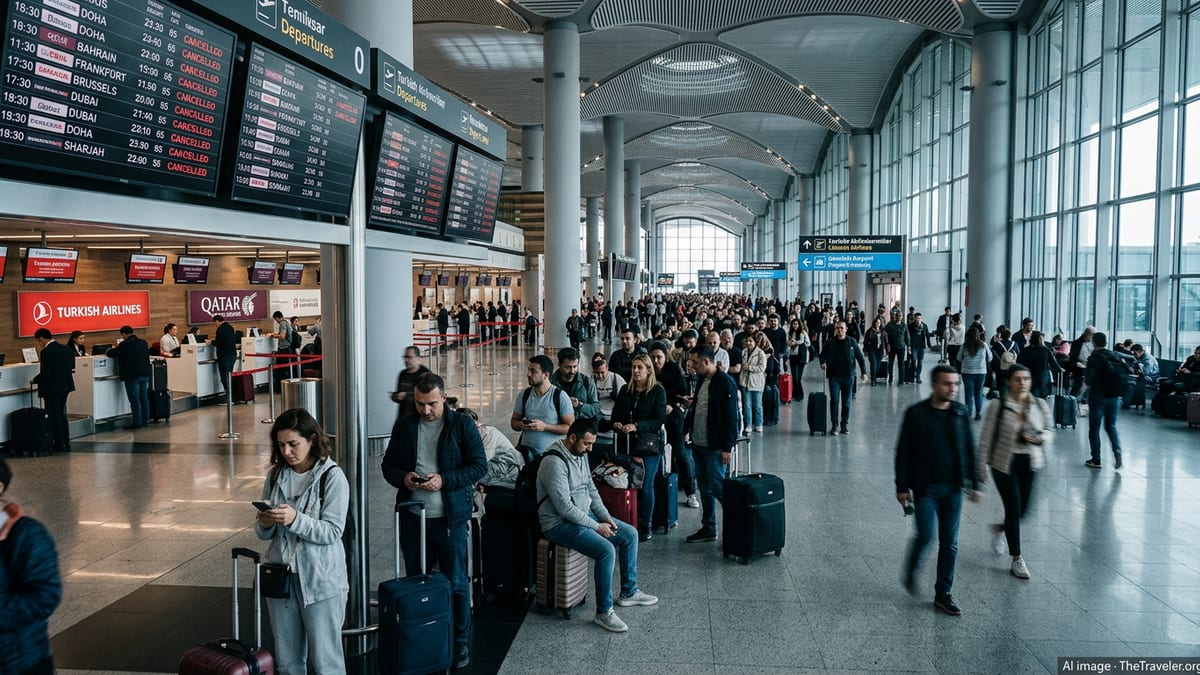
Wave of Cancellations Follows Ongoing Gulf Airspace Turmoil
The latest round of cancellations came as carriers continued to grapple with heavily restricted airspace and tight capacity across Qatar, Bahrain and the wider Gulf, forcing airlines to pare back schedules and consolidate routes at short notice. Turkish aviation authorities confirmed that several departures and arrivals involving Doha, Manama, Dubai and Sharjah were pulled from Friday’s boards at Istanbul and other Turkish airports, while related onward sectors to major European hubs were also affected.
Qatar Airways has been running a significantly reduced operation through Doha since early March, with services from Türkiye subject to day-by-day review as the airline prioritises repatriation flights and essential links to Europe and Asia. Gulf Air, whose Manama hub is a key bridge between Türkiye and the wider Middle East, has also trimmed frequencies, leading to gaps in connectivity for passengers booked via Bahrain to destinations in the Indian subcontinent and Southeast Asia.
Lufthansa and Turkish Airlines, both major players on Europe–Türkiye–Gulf corridors, have meanwhile cancelled selected rotations to and from Frankfurt and Brussels, particularly where these flights rely on feeds from disrupted Gulf services. In practice, this has meant same-day cancellations, rolling delays and last-minute aircraft swaps, creating knock-on effects for passengers across multiple continents.
Although some flights continue to operate on contingency routings around closed or restricted skies, the combination of longer flight times, crew duty limits and slot constraints has limited the scope for quick recovery, pushing airlines toward pre-emptive cancellations rather than risking extended delays.
Key Routes Hit: Doha, Bahrain, Frankfurt, Brussels and UAE Gateways
According to airport departure boards and airline schedule updates on Friday, the most heavily affected links from Türkiye include flights to Doha’s Hamad International Airport, Bahrain International Airport, Frankfurt, Brussels, Dubai and Sharjah. These airports function as vital transit hubs for Turkish travellers heading onward to North America, Africa and Asia, magnifying the impact beyond simple point-to-point journeys.
In the Gulf, Qatar Airways’ Doha hub has seen multiple Türkiye-bound flights removed from sale or marked as cancelled within 24 to 48 hours of departure, with remaining services often operating at or near full capacity. This has left many travellers struggling to secure alternative connections, particularly those with imminent long-haul segments planned from Doha to Australia or East and Southeast Asia.
Gulf Air’s Manama operation has also been constrained, reducing options for passengers who typically use Bahrain as a quieter alternative to Doha or Dubai. In parallel, carriers serving the United Arab Emirates, including flights from Türkiye to Dubai and Sharjah, have adjusted timings and dropped selected rotations in response to airspace bottlenecks, resulting in patchier schedules than usual between Istanbul and Gulf gateways.
On the European side, Lufthansa’s Frankfurt hub is experiencing elevated disruption as cancellations on feeder routes from the Gulf and Türkiye ripple into transatlantic and intra-Europe networks. Turkish Airlines, using Istanbul as its own global hub, has been forced to cancel or retime certain departures to Brussels and other European cities when inbound Gulf traffic fails to materialise, leaving some aircraft and crews out of position.
What Affected Passengers in Türkiye Should Expect at the Airport
Travellers in Türkiye with tickets on Qatar Airways, Gulf Air, Lufthansa or Turkish Airlines are being advised to check their flight status repeatedly in the 24 hours before departure and again on the day of travel, as schedules remain fluid and subject to rapid change. Airlines have, in many cases, been updating systems in waves, meaning a flight that appears confirmed in the morning can show as cancelled by afternoon once network planners finalise revisions.
At Istanbul Airport and Sabiha Gökçen, long queues have formed at airline transfer and ticketing desks as passengers seek rebooking, refunds or alternative routings. Ground staff report that same-day solutions are often limited, especially for those travelling in economy cabins during peak hours, and that travellers may be offered departures several days later or via circuitous itineraries through less congested hubs.
Some carriers are encouraging customers to use digital channels such as mobile apps and call centres to manage changes rather than waiting at airport desks, though call volumes remain high and hold times lengthy. Where cancellations are confirmed well in advance, airlines are more likely to offer proactive re-accommodation onto partner airlines or different routings, while last-minute disruptions can result in overnight stays and airport hotel vouchers, subject to availability and each carrier’s policy.
Families, elderly travellers and those without flexible visas for intermediate countries are urged to pay particular attention to any rebooked routings, ensuring that transit requirements are met and that minimum connection times are realistic given ongoing congestion at major hubs.
Rebooking, Refunds and Passenger Rights on the Affected Routes
The wave of cancellations has thrown a spotlight on passenger rights frameworks that vary by jurisdiction and ticket type. Travellers whose journeys start in the European Union or involve EU carriers such as Lufthansa may be covered by European compensation rules for cancellations and long delays, depending on the cause of disruption and the amount of notice given. Those flying from Türkiye or the Gulf with non-EU airlines, including Qatar Airways, Gulf Air and Turkish Airlines on certain routes, may fall under different national regulations or airline-specific policies.
In practice, most affected passengers are being offered a choice between free rebooking on a later date, re-routing via an alternative hub where seats are available, or a full refund of the unused portion of their ticket. However, the exact options and any additional cash compensation depend on the airline, the origin and destination, and whether the cancellation is legally considered within the carrier’s control.
Travel industry advisers in Istanbul report that some passengers have achieved faster solutions by working through reputable travel agencies, which can search across multiple airlines and fare classes to secure rare remaining seats. Others have opted to purchase entirely new tickets on carriers less impacted by the Gulf airspace constraints, planning to pursue refunds or claims from their original airline afterward.
Travel insurance policies that include disruption cover may provide an extra layer of protection, particularly for those facing non-refundable hotel bookings, missed cruises or prepaid tours. Policyholders are being urged to retain all documentation, including cancellation notices, boarding passes and receipts for meals and accommodation, to support any future claims.
Advice for Travellers Planning Upcoming Trips via the Gulf
With conditions in the Gulf still evolving, aviation analysts suggest that passengers planning new journeys from Türkiye in the coming weeks consider building in additional flexibility. This could include choosing fully refundable or changeable fares where budgets allow, allowing longer connection times at intermediate hubs, and avoiding tight same-day onward connections from Doha, Bahrain, Dubai or Sharjah where possible.
Experts also recommend keeping booking details consolidated in one place and downloading airline apps that provide push notifications for gate changes and cancellations. Where itineraries involve multiple separate tickets on different airlines, there is a higher risk that one cancelled segment will not automatically trigger protection or rebooking on the others, leaving travellers to coordinate their own fixes at short notice.
For those who must travel urgently, non-stop services between Türkiye and final destinations in Europe or Asia, or routings through less affected hubs, may offer more reliability in the short term than multi-stop connections via the Gulf. However, capacity on these alternatives is already tight, and fares have begun to rise as demand shifts away from disrupted corridors.
Airlines and airport authorities in Türkiye stress that they are working to stabilise operations as quickly as conditions permit, but warn that further short-notice changes remain possible. Passengers are urged to remain vigilant, check their flights frequently and be prepared for continued volatility on routes linking Türkiye with Doha, Bahrain, Frankfurt, Brussels and the United Arab Emirates.