

More news on this day
Japan’s fast-evolving air mobility sector is drawing fresh attention as helicopter charter specialist AirX deepens its role in connecting international airline passengers with resorts, cities, and tourism hubs across the country, signaling a shift in how premium travelers experience the destination from the moment they land.
Get the latest news straight to your inbox!
A New Layer in Japan’s Premium Travel Ecosystem
Japan’s hospitality and tourism sectors are increasingly looking to the skies as helicopter charters move from niche novelty to strategic infrastructure. Tokyo-based AirX operates booking platforms such as AIROS that aggregate helicopters from multiple operators nationwide, allowing travelers to arrange point-to-point flights between airports, heliports, and high-end resorts without navigating individual charter companies.
Publicly available company material describes AirX as a travel and air transport agency that focuses on air mobility and low-altitude tourism, working with dozens of partner helicopter firms across Japan. Routes commonly link major urban heliports with destinations such as Mount Fuji, Hakone, Karuizawa, and hot spring regions, compressing multi-hour ground journeys into flights that often last under an hour.
The model mirrors a wider global trend in premium travel, where airlines, airports, and mobility platforms collaborate to turn helicopter legs into extensions of long-haul itineraries. In Japan, this is beginning to influence how inbound passengers flying with global carriers such as Emirates, Air Canada, and Qatar Airways think about time, convenience, and access once they arrive.
For Japan’s tourism authorities and local governments, these services offer a way to disperse high-spending visitors beyond established city centers, while hotels and ryokan operators see a tool to differentiate their offerings and draw guests deeper into regional landscapes.
How AirX Connects Airports, Cities, and Luxury Resorts
AirX’s charter platforms position helicopters as a practical bridge between international gateways and remote leisure destinations. The company promotes approximately 200-kilometer-per-hour cruising speeds and the ability to bypass road congestion, particularly on routes radiating from Tokyo toward popular nature and hot spring areas.
On its booking sites, AirX highlights sample products such as transfers from Tokyo to Fuji-Oshino near Mount Fuji, Hakone Sengokuhara, and upscale properties including Amanemu in Ise-Shima. In some cases, helicopter access can cut a five-hour ground journey to around 50 to 110 minutes of flight time, effectively turning distant coastal or island resorts into viable weekend or short-stay options for international visitors.
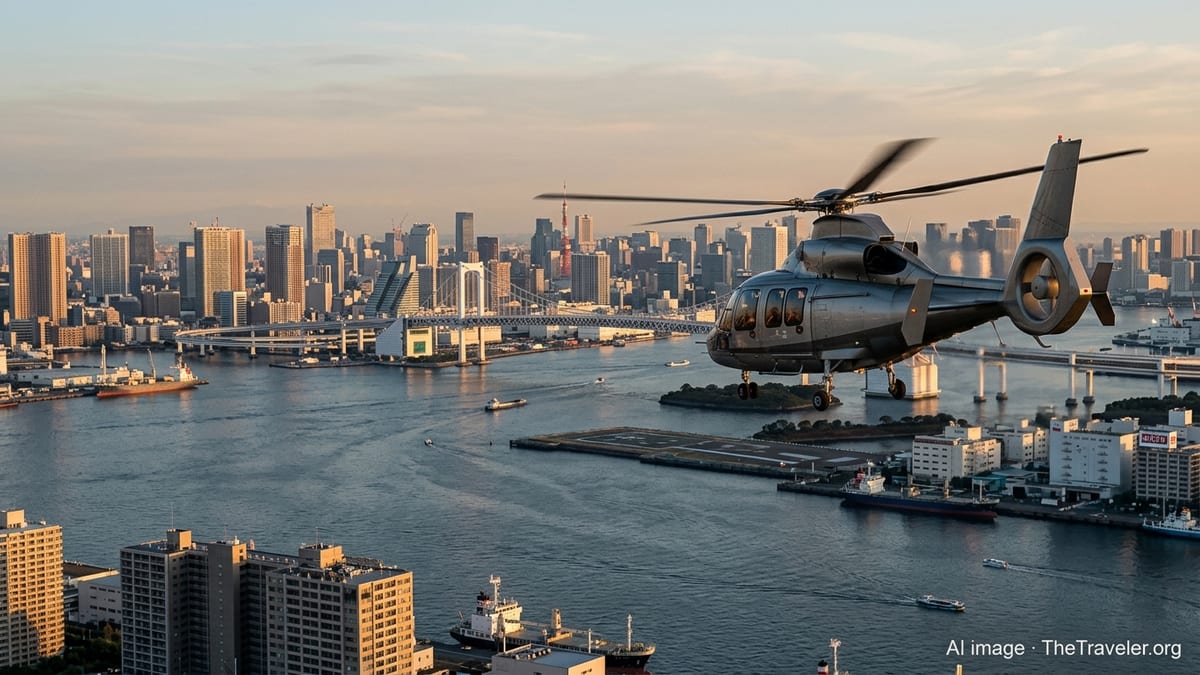
AirX also operates sightseeing flights over Tokyo and other urban areas, positioning helicopter cruising as an experience in itself. Evening flights over the capital’s skyline, or scenic circuits around Mount Fuji, are marketed to couples, families, and small groups seeking special-occasion travel moments that complement longer itineraries.
The company’s broader strategy includes work on urban air mobility and so-called flying vehicles, according to its corporate information and recent press releases. Demonstration flights and vertiport planning suggest that today’s helicopter tourism and transfer network could evolve into a more extensive low-altitude mobility grid serving both domestic and international travelers in the coming years.
Global Airlines Look to Seamless Surface-to-Sky Journeys
As Japan strengthens its position as a long-haul destination, global carriers are increasingly focused on what happens after passengers clear customs. Emirates, Air Canada, and Qatar Airways all target premium travelers who value speed, privacy, and comfort, and industry watchers note growing interest in integrating helicopter links into broader travel ecosystems in markets worldwide.
Emirates, for example, already showcases helicopter transfer options with partners in other regions, positioning short rotary flights as add-ons to its long-haul services. While its published travel-partner lists emphasize arrangements such as helicopter transfers to Monaco via BLADE in Europe, the same concept is closely watched in Asia, where dense cities and resort geographies are well suited to vertical mobility.
Air Canada and Qatar Airways similarly court high-yield passengers with upgraded cabins, dedicated business-class products, and tailored ground services. In Japan, the presence of a maturing helicopter charter market gives such airlines a ready-made layer of connectivity that can be paired with their long-haul networks through airport hotels, tour operators, and concierge services, even where no formal joint product is yet marketed.
Travel industry analysis suggests that as Japan continues to relax entry rules, expand airport capacity, and promote regional tourism, the opportunity for deeper coordination between airlines and helicopter platforms will grow. Packaged itineraries that combine long-haul flights with pre-arranged low-altitude transfers to golf resorts, ski areas, or island ryokan are seen as a logical next step for carriers seeking to differentiate their Japan offerings.
Reshaping High-End Hospitality and Regional Tourism
The expansion of helicopter charter services is already influencing how Japanese hotels and tourism operators design their products. AirX’s listings prominently feature “stay and fly” style packages in which luxury inns and resort hotels bundle helicopter access with accommodation, dining, and on-the-ground experiences.
For remote hot spring properties, coastal retreats, and art islands, the ability to advertise direct helicopter access from Tokyo or other major cities provides a new marketing hook aimed at affluent domestic and international guests. It also encourages visitors with limited time to consider destinations that previously required complex rail and road transfers.
Regional tourism organizations view low-altitude air mobility as a way to capture demand beyond well-known circuits like Tokyo–Kyoto–Osaka. Scenic flights over national parks, coastal routes across the Seto Inland Sea, and connections to ski resorts offer opportunities to distribute visitor spending more evenly and extend stays in rural areas.
At the same time, operators are conscious of the need to balance exclusivity with environmental and community considerations. Discussions within Japan’s advanced air mobility community include questions about noise footprints, vertiport placement, and integration with public transport, all of which will shape how widely helicopter and future eVTOL services can scale.
From Helicopters to Flying Cars: What Comes Next
AirX is positioning today’s helicopter network as a stepping stone toward a broader ecosystem of urban air mobility in Japan. Corporate materials and trade show participation indicate that the company is engaged in projects involving next-generation aircraft, demonstration flights, and consulting on vertiports and related infrastructure.
For airlines like Emirates, Air Canada, and Qatar Airways, which have spent the past decade refining premium cabins and hub operations, these developments offer a glimpse of what future end-to-end journeys into Japan might look like. In a scenario where eVTOL aircraft join or replace helicopters on certain routes, long-haul passengers could one day step from a widebody jet directly into a low-emission air taxi bound for a city-center rooftop or seaside resort.
Industry observers note that progress will depend on regulation, safety frameworks, public acceptance, and investment in physical infrastructure. However, the presence of active helicopter charter networks and early-stage flying vehicle projects suggests that Japan is laying practical groundwork rather than treating urban air mobility as a distant concept.
For now, helicopter charters remain a premium product, but their growing visibility in tourism marketing and travel planning tools is changing expectations among high-end visitors. As AirX and its partners refine routes and products, and as global carriers explore closer integration, Japan’s travel landscape is gradually being reshaped from above, redefining what it means to arrive, connect, and explore.