

More news on this day
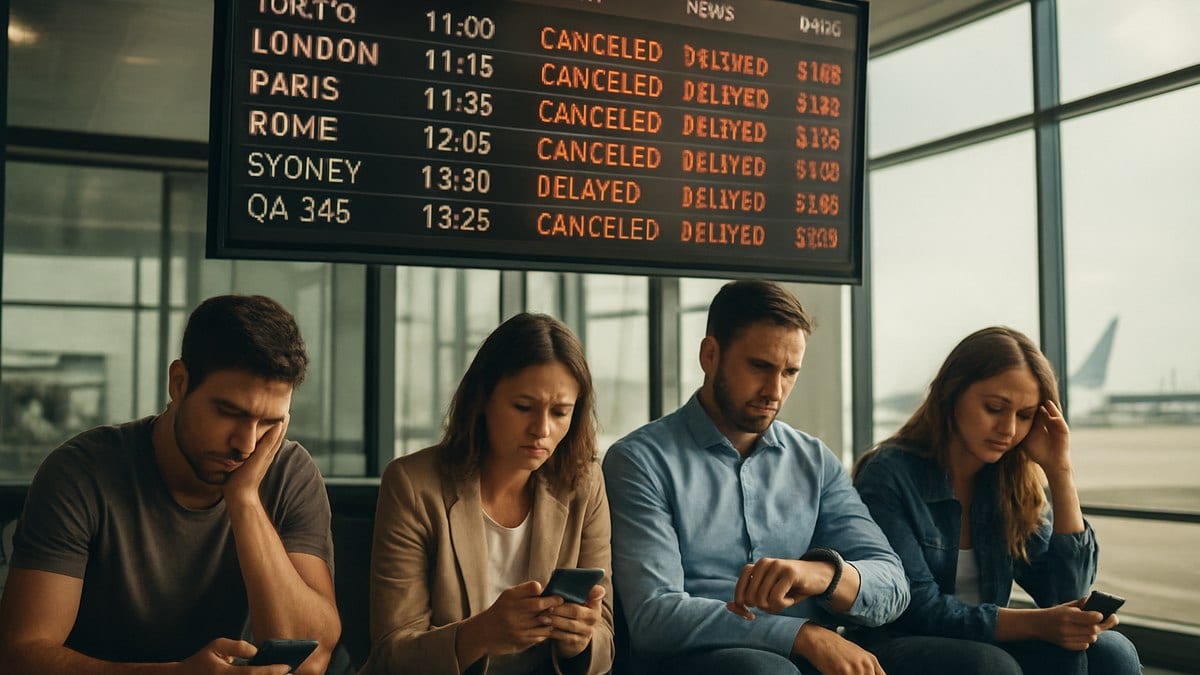
A record wave of air travel bookings for 2026 is building on the back of strong demand and falling real airfares, even as analysts warn that widespread flight delays are quietly imposing an annual cost estimated at around 18 billion dollars on travelers and the broader economy.
Get the latest news straight to your inbox!
Record Demand Sets Up Another Year of Crowded Skies
Global aviation forecasts indicate that passenger demand will continue to climb through 2025 and into 2026, extending the industry’s post‑pandemic rebound. Recent outlooks from major industry bodies project close to 10 billion air passengers worldwide by 2025, with further growth expected the following year as capacity expands and booking volumes rise.
Financial projections compiled from airline and industry reports suggest that passenger numbers in 2026 will be supported by robust leisure and business travel, particularly across North America, Europe and fast‑growing Asia Pacific markets. Carriers are planning higher seat capacity and reporting strong advance sales into the northern summer of 2026, indicating that travelers are locking in trips earlier despite economic uncertainty.
Average airfares, adjusted for inflation, are expected to moderate or edge lower in many markets, reinforcing the perception that flying is becoming more affordable. Analysts note that this combination of softer prices and pent‑up demand is helping push global gross travel bookings to new highs, with 2026 shaping up as another potentially record year for ticket sales.
Behind the headline growth, however, capacity constraints, staffing gaps and infrastructure bottlenecks remain unresolved in several major hubs. That imbalance between strong demand and limited resilience is setting the stage for a fresh round of congestion and schedule disruptions as the next peak travel seasons approach.
Delay Statistics Reveal a Persistent Structural Problem
Recent compilations of U.S. and global delay data show that chronic schedule disruptions have become a structural feature of modern air travel rather than a temporary legacy of the pandemic years. Publicly available statistics for the United States indicate that roughly one in five domestic flights arrived late in 2023, with similar patterns persisting into 2024.
Economic analyses of those disruptions place the total cost of U.S. flight delays in the tens of billions of dollars annually, once aircraft operating costs and passenger time are taken into account. One widely cited estimate puts the impact at roughly 33 billion dollars a year for the U.S. system, combining airline expenses, missed connections, crew overtime, and lost productivity for travelers.
Extrapolated across major aviation markets, that burden translates into a global drag that analysts and transport economists often benchmark in the high‑single‑digit to tens‑of‑billions range. Within that wider figure, an 18 billion dollar estimate for the portion borne directly by travelers through wasted time, additional accommodation and rebooking costs is increasingly used by industry observers as a conservative reference point.
Academic work on the propagation of delays within complex air networks underscores how small disruptions at a few large hubs can ripple through schedules for days. Studies of air traffic control bottlenecks, security slowdowns and weather‑related congestion show that once operations reach high utilization, recovery windows shrink, making extended chains of missed slots and connections more likely.
The Invisible Price Paid by Travelers and the Economy
For passengers, the most visible impact of disruption is time lost to hours spent in terminals or overnight stays far from home. Economists quantify that loss by assigning a monetary value to each hour of a traveler’s time and multiplying it by the millions of people affected each year. Using standard valuation methods, passenger time alone accounts for billions of dollars in hidden costs that do not appear on airline balance sheets.
There are also knock‑on expenses that travelers shoulder directly. When weather or air traffic control constraints trigger mass delays, hotel rooms near major airports quickly sell out, ride‑share prices surge and travelers often face out‑of‑pocket costs for food, ground transport and emergency purchases. Even when airlines provide vouchers, they rarely cover the full disruption, particularly for missed business meetings, events or nonrefundable arrangements at the destination.
Beyond individual inconvenience, prolonged or repeated episodes of disruption can dampen productivity and regional competitiveness. Business travelers missing client meetings, crews timing out and cargo shipments arriving late can all contribute to a broader drag on economic activity. Studies of past large‑scale outages have shown that multi‑day disruptions can erase hundreds of millions of dollars in revenue for airlines and their corporate customers.
Consumer behavior research suggests that repeated disruption is starting to influence how some travelers plan trips. Longer connection times, buffer days before key events and a growing reluctance to book tight itineraries reflect a widespread expectation that schedules may not hold. Those private adjustments come with their own cost in flexibility and time, even when flights ultimately depart on schedule.
Why Delays Are So Hard to Fix
Despite years of investment in technology and infrastructure, the drivers of disruption remain deeply embedded in how the global air transport system operates. Staffing shortfalls in air traffic control and ground handling, aircraft and parts shortages, and the slow pace of airport expansion all limit the system’s ability to absorb shocks. When demand spikes, as it is expected to do again in 2026, that limited slack quickly disappears.
Operational data show that a significant share of delays originates with carrier operations and late‑arriving aircraft, then cascades through the day. Weather remains a major contributor, but analysts point out that schedule design, tight aircraft rotations and aggressive utilization targets amplify the impact of storms or infrastructure glitches. High load factors mean that rebooking options are often scarce, stretching disruptions over multiple days.
Industry and government strategies to address delays have focused on modernizing air traffic management, using data and automation to improve routing and sequencing of flights. Experimental systems that apply machine learning to landing and departure scheduling have demonstrated measurable reductions in cumulative delay in simulations and pilot projects. However, rolling out such tools across entire national or regional networks is a complex, multi‑year undertaking.
At the same time, decarbonization efforts are adding new layers of complexity. The gradual introduction of sustainable aviation fuels, new aircraft types and revised airspace procedures can bring long‑term efficiency gains but may also require transitional adjustments that temporarily constrain capacity. Balancing those goals with the immediate need to stabilize on‑time performance remains a central challenge for regulators and airlines.
2026 Bookings Rise Faster Than Resilience
Forward‑looking data from travel research firms and booking platforms indicate that reservations for 2026 are currently tracking ahead of comparable periods in 2024 and 2025. Strong demand from Asia Pacific outbound travelers, resilient U.S. leisure spending and a steady recovery in corporate travel are all contributing to the uplift.
Airline financial outlooks for 2026 anticipate higher passenger revenues and solid profit margins, underpinned by greater aircraft utilization and sustained high load factors. Yet those same forecasts acknowledge ongoing supply chain issues and infrastructure constraints, suggesting that operational resilience may not be improving at the same pace as demand.
For travelers, the contrast between buoyant marketing messages and the realities of crowded airports and strained schedules creates a widening expectations gap. While headline fares may appear competitive, the true cost of a trip increasingly includes the probability of disruption, the value of backup plans and the potential need to purchase additional services such as flexible tickets or travel insurance.
Analysts describe the emerging picture as an “on‑time recovery lag,” in which the financial and demand rebound in aviation has outpaced investments in capacity and modernization. As 2026 bookings surge, the unpriced 18 billion dollar burden associated with delays is likely to become more visible, reshaping traveler expectations and adding pressure on the sector to convert record demand into more reliable journeys.