

More news on this day
Across Asia, a historic wave of airport construction is accelerating, with Ho Chi Minh City moving in lockstep with Bangkok, Taipei, Hong Kong and other regional hubs in a multibillion-dollar push to capture the next generation of global air travel.
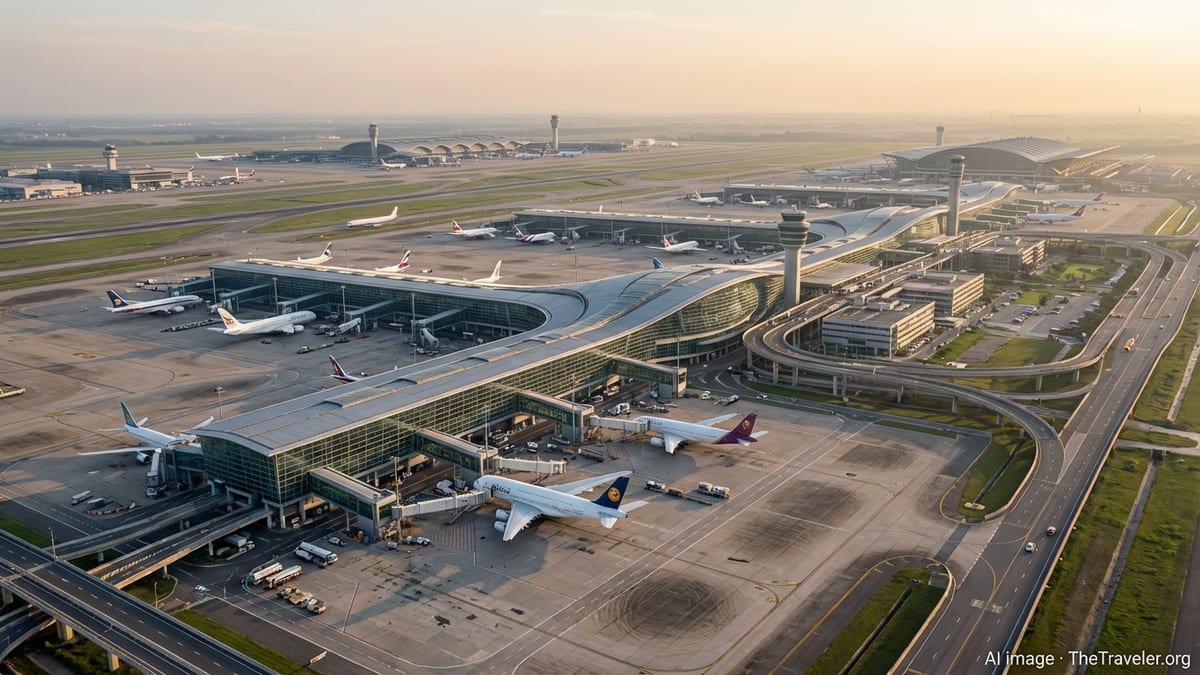
Ho Chi Minh City’s New Mega-Gateway Takes Shape
Vietnam’s commercial capital is at the heart of the region’s airport expansion race. Long Thanh International Airport, rising about 40 kilometers east of Ho Chi Minh City, is designed to become the country’s primary international gateway and one of Southeast Asia’s largest aviation hubs. The greenfield site will eventually replace most long-haul traffic now funneled through Tan Son Nhat International Airport, which has long operated near or above its intended capacity.
The first phase of Long Thanh is under construction with a target capacity in the tens of millions of passengers per year, positioning it to quickly join the ranks of Asia’s top airports once operations begin. Planned subsequent phases, stretching toward mid-century, would progressively scale the airport to handle upwards of 100 million passengers annually, placing Ho Chi Minh City in direct competition with the region’s most established hubs for intercontinental traffic and cargo flows.
Authorities in Vietnam see Long Thanh as a strategic project that will underpin the country’s export-led growth, tourism ambitions and push to become a regional logistics powerhouse. The airport is being closely linked to expressways and, in later phases, planned high-speed and urban rail, reflecting a broader trend across Asia of treating aviation infrastructure as the backbone of multimodal transport corridors.
At the same time, Tan Son Nhat is being upgraded with additional taxiways, new aprons and terminal enhancements to ease congestion until Long Thanh is fully on line. Together, the two airports are expected to give the Ho Chi Minh City metropolitan area a step change in overall capacity and resilience, anchoring Vietnam’s role in the wider aviation network being built from Bangkok to Hong Kong.
Bangkok Builds a Multi-Airport Powerhouse
In Thailand, Bangkok is pressing ahead with a multi-node airport strategy centered on Suvarnabhumi Airport, Don Mueang International Airport and the redevelopment of U-Tapao Airport in the Eastern Economic Corridor. Suvarnabhumi, the country’s main gateway, is undergoing a major expansion that includes a new satellite terminal and a third runway intended to increase both passenger throughput and hourly aircraft movements.
Authorities have framed Suvarnabhumi’s build-out as essential to maintaining Thailand’s status as a tourism and transit hub, with pre-pandemic demand already straining the original layout. The new satellite terminal is designed to add tens of millions of passengers in capacity each year, while the third runway project will give the airport more flexibility to handle peak waves of long-haul and regional flights.
Meanwhile, Don Mueang, historically Bangkok’s primary airport and now a major base for low-cost carriers, is undergoing phased upgrades to terminals and airside infrastructure to better manage surging budget traffic. South of the capital, U-Tapao is being transformed from a relatively modest facility into a key component of an integrated high-speed rail and industrial corridor, signaling Bangkok’s ambition to spread aviation growth across a wider metropolitan and coastal region.
Taken together, these projects place greater Bangkok at the forefront of capacity expansion in Southeast Asia. Officials are betting that improved connectivity, new tourism products and growing cargo volumes will justify the enormous capital outlays that are reshaping the country’s aviation landscape.
Taipei’s Taoyuan Airport Accelerates into the Big Leagues
Taipei’s Taoyuan International Airport, already a critical transpacific and regional hub, is in the midst of one of its most ambitious upgrades since opening. The centerpiece is Terminal 3, a vast new complex under construction between the existing terminals. Once fully completed later this decade, it is intended to lift the airport’s annual passenger handling capacity from roughly the high 30-million range to more than 80 million travelers.
The Terminal 3 project, which includes a main processor building, multiple concourses, aprons and associated taxiways, has faced delays and cost escalations but has continued to advance, with structural milestones marked in 2023 and 2024. Airport officials have indicated that parts of the north concourse are due to enter service ahead of the full opening, adding extra gates and easing pressure on crowded peak-time operations.
Alongside the terminal itself, Taoyuan is being reimagined as a smart gateway, with investments in automated border control, upgraded baggage systems and an extended airport MRT line that will connect directly into the new facilities. Plans for a third runway and expanded logistics zones highlight Taiwan’s ambition to reinforce its position in the Asia Pacific as both a technology and trade hub, leveraging its strong aviation links with North America and Southeast Asia.
Traffic at Taoyuan has rebounded sharply since borders reopened, with transit passengers again using Taipei as a bridge between the Americas and Southeast Asia. If current forecasts hold, the expanded airport will be operating near its enhanced design capacity in the 2030s, putting Taipei firmly alongside the region’s largest hubs in terms of scale.
Hong Kong’s Three-Runway System Comes Online
Hong Kong International Airport, long one of the world’s busiest hubs, is entering a new era with the commissioning of its three-runway system. The project, years in the making and one of the largest infrastructure investments in the city’s history, adds a new north runway built on reclaimed land and reconfigures the original airfield to allow three runways to operate in parallel.
With the full three-runway system now in service, Hong Kong’s airport authority is targeting the ability to handle around 120 million passengers a year and roughly 10 million tonnes of cargo within the next decade. The expansion is supported by a new passenger concourse with more than 100 aircraft stands and a major enlargement of Terminal 2, which is being redeveloped as a full-service departures and arrivals facility connected to the new airfield via an automated people mover.
The airport’s leadership has argued that the project is critical to maintaining Hong Kong’s position as a leading international aviation hub, particularly as rival airports around the Pearl River Delta and across Asia undertake their own expansions. The three-runway system is expected to increase the maximum number of aircraft movements per hour and give the hub greater operational resilience in adverse weather or peak demand conditions.
The upgraded Hong Kong gateway also reinforces the city’s role as a top global cargo center, especially for high-value goods and e-commerce shipments that depend on fast turnaround times. As the three-runway system ramps up, airlines are gradually restoring and adding services, banking on renewed demand for both passenger and freight connectivity through the city.
Ho Chi Minh City and Regional Peers Drive a Global Capacity Surge
Analysts note that the simultaneous expansion of airports in Ho Chi Minh City, Bangkok, Taipei and Hong Kong is part of a much wider capacity surge stretching from Northeast Asia through Southeast Asia and into the Middle East. Population growth, rising middle-class incomes and the return of international travel are driving governments and airport operators to pursue projects that would have seemed bold even a decade ago.
In Southeast Asia, Vietnam and Thailand are not alone. Major works are underway or planned at airports in Singapore, Kuala Lumpur, Manila and Jakarta, among others. However, the clustering of mega-projects around Ho Chi Minh City, Bangkok, Taipei and Hong Kong is particularly striking, as each aims to serve not just local markets but also large transfer flows that link North America, Europe and Oceania with Asia.
The combined effect is a race to secure airline partnerships, route networks and cargo contracts while ensuring that infrastructure does not again become a bottleneck as it did at several regional airports prior to the pandemic. Governments are weighing the long-term benefits of connectivity and economic spillovers against the financial and environmental costs associated with land reclamation, large-scale concrete works and increased aircraft movements.
For travelers, the impact will be felt in more routes, better schedules and upgraded terminal experiences. For cities like Ho Chi Minh City, the stakes go even higher, as a new airport such as Long Thanh has the potential to reshape urban development, industrial clusters and the balance of power between regional hubs for a generation.
Infrastructure, Investment and Environmental Trade-offs
The current wave of expansion is also a test of how countries manage environmental and social concerns alongside their economic ambitions. Projects such as Hong Kong’s three-runway system have drawn scrutiny over marine ecosystem impacts and carbon emissions associated with land reclamation and construction, while proposals for new runways and terminals in other cities have faced local opposition over noise and land use.
In Vietnam, planners have stressed that Long Thanh International Airport incorporates provisions for modern, energy-efficient building systems and space for future adoption of lower-carbon aviation technologies. Thailand, Taiwan and Hong Kong have similarly emphasized more efficient air traffic management, public transport links and terminal designs that reduce energy consumption, although critics argue that any large expansion of capacity inevitably increases absolute emissions from aviation.
Financing is another area under focus. The cost of these mega-projects runs into the tens of billions of dollars across the region, involving complex funding structures that mix state budgets, airport revenues, bond issuances and, in some cases, private investors. Ensuring that debt levels remain sustainable, particularly after the shock of the pandemic, is an ongoing challenge for airport operators and national treasuries.
Yet despite the risks, governments are largely pushing ahead, convinced that delaying or scaling back projects would leave their economies at a disadvantage as trade routes evolve and airlines redeploy capacity. The result is a historically large building cycle that is redefining the competitive landscape for global hubs.
New Connectivity Corridors and the Future of Asian Hubs
Beyond headline passenger numbers, the expansions in Ho Chi Minh City, Bangkok, Taipei and Hong Kong are about creating new connectivity corridors. Long Thanh is being positioned as a bridge linking secondary cities in Vietnam and the Mekong region to long-haul markets, while Bangkok’s multi-airport system aims to connect tourism hotspots and industrial zones through a web of domestic and international routes.
Taipei’s Taoyuan expansion is geared toward capturing higher volumes of transfer traffic between North America and Southeast Asia, supported by its home carriers and a growing focus on high-value cargo tied to the island’s technology sector. Hong Kong, with its expanded three-runway system, is banking on deep integration with the Greater Bay Area, leveraging cross-border infrastructure to feed passenger and freight flows into its enlarged hub.
These strategies are unfolding at a time when airlines are rethinking network design, balancing large connecting hubs with more point-to-point flying on efficient new aircraft. If the current building boom succeeds, Asia could end up with several superhubs within a few hours’ flight of each other, each offering dense networks and high service levels but competing intensely for the same pools of travelers and shipments.
For now, Ho Chi Minh City’s Long Thanh, together with the expansions in Bangkok, Taipei and Hong Kong, symbolizes the scale of Asia’s aviation ambitions. The projects underscore a broader bet that, despite cyclical risks and growing climate concerns, demand for air travel in and around the region will continue to grow for decades to come.