

More news on this day
Across the global hotel sector, food waste has moved from a hidden cost of doing business to a central test of environmental credibility, driving rapid adoption of new technology, tighter kitchen practices and ambitious corporate targets.
Get the latest news straight to your inbox!
A Growing Cost to Climate and the Bottom Line
Food waste has become one of the largest and most scrutinized environmental impacts linked to hotel operations. Recent industry analysis indicates that discarded food accounts for up to 40 percent of a typical full service hotel’s carbon footprint, reflecting both the emissions embedded in ingredients and the methane released when organics reach landfill. At the same time, the financial implications are substantial, with global hospitality reports pointing to billions of dollars in annual losses when uneaten buffet items, banquet overproduction and plate scraps are tallied.
Publicly available data from food waste technology providers suggests the scale of the opportunity as well as the problem. Industry coverage of AI-powered tracking systems reports that hotel and foodservice operators using these tools are now saving more than 100 million dollars a year by cutting waste, largely through better portioning and production planning. The figures are increasingly cited by investors and sustainability analysts who view waste reduction as a straightforward route to higher margins and lower emissions.
Against this backdrop, hotel companies are positioning food waste management as a core part of their climate strategies. Corporate sustainability reports from major global brands outline medium term goals to halve food waste, often aligned with international targets for 2025 and 2030. These documents highlight the link between food waste and scope 3 emissions, signalling that what happens in kitchens and banquet halls is becoming as important to climate performance as energy efficiency and renewable power procurement.
Growing guest expectations are reinforcing this shift. Consumer surveys referenced in trade coverage show that travelers are increasingly aware of food waste and are factoring visible sustainability measures into their booking decisions. For hotels competing in crowded urban and resort markets, credible food waste programs are now promoted alongside rooftop solar, refillable amenities and plastic reduction as differentiators for environmentally minded guests.
From Buffets to Banquets: Where Hotels Are Cutting Waste
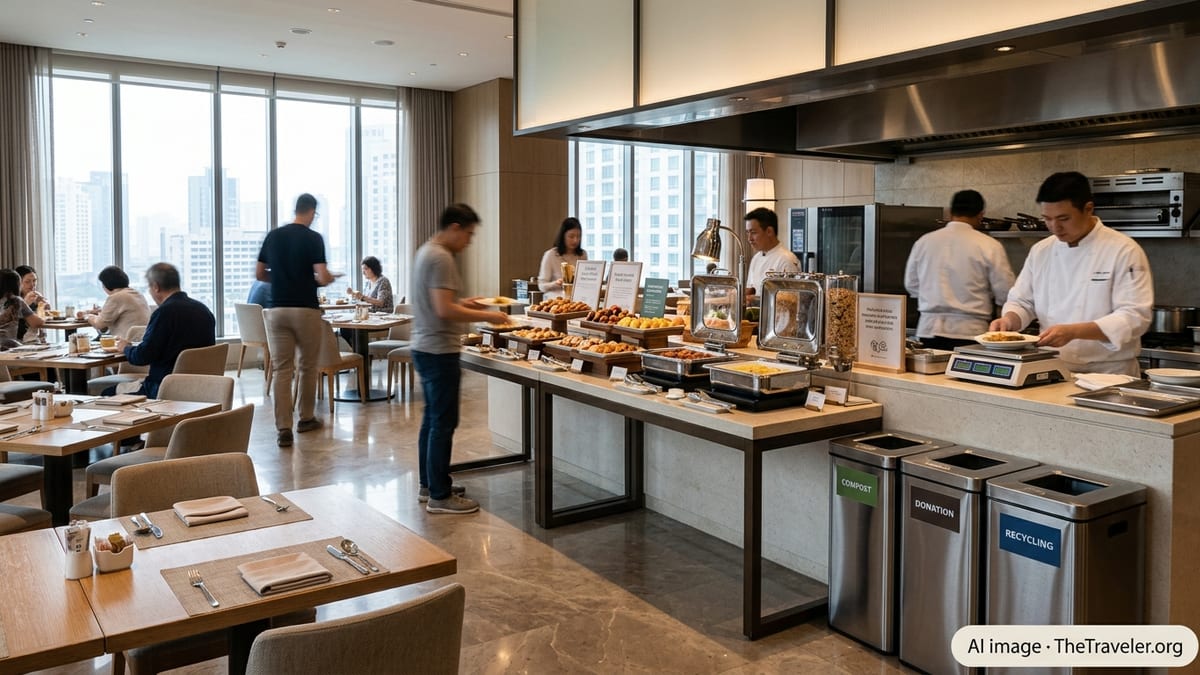
Operationally, the biggest gains are being reported in buffet and banquet operations, long viewed as the most waste intensive parts of hotel food and beverage. Case studies shared in hospitality media describe properties that have redesigned breakfast and conference buffets by shrinking oversized platters, refreshing food more often in smaller batches and dialing back production toward the end of service. One European city hotel cited in recent coverage cut overproduction by more than 60 percent while maintaining guest satisfaction scores, largely through these adjustments.
Banquet kitchens are also rethinking traditional “just in case” production models. Corporate responsibility reports from major real estate investment trusts and management groups describe pilots in which event menus are planned using historic consumption data, with capped overproduction margins and closer collaboration between sales teams and chefs. In one example highlighted in a 2025 sustainability report, two large convention hotels in the United States diverted more than 30 tons of food from landfill in a year by combining menu redesign with expanded composting services.
The all inclusive and resort segment is facing particular pressure to demonstrate progress, given historically high levels of surplus food at buffets and themed restaurants. Regional reporting from destinations in the Middle East and Caribbean notes that resort operators are trialing reservations only breakfast services, made to order stations and dynamic menu planning tied to occupancy forecasts. These approaches are designed to reduce the need for large, continuously replenished displays while still offering variety perceived as essential to the guest experience.
At the property level, smaller boutique hotels are experimenting with more localized solutions. Public information from independent brands in Europe and island destinations points to closer coordination with nearby farms and food banks, as well as the use of on site composters that convert kitchen scraps into soil for hotel gardens. While the absolute tonnage may be lower than in large convention properties, these initiatives are often promoted as part of a broader narrative of place based, circular hospitality.
AI, Data and Smart Kitchens Redefine Food Waste Tracking
Technology is emerging as one of the most significant drivers of change in hotel food waste management. Reports from hospitality technology outlets describe rapid uptake of AI enabled waste tracking systems, in which cameras and connected scales identify and quantify items thrown away in real time. The resulting data is processed into dashboards that show chefs exactly which dishes, stations and time periods generate the most waste.
Vendors and hotel case studies highlighted in recent coverage indicate that this level of insight is altering how kitchens are run. Chefs are adjusting recipes and portions based on actual plate returns, cutting back on consistently uneaten garnishes and rebalancing buffets away from low demand items that regularly end up in the bin. Some properties are using the data to justify reconfiguring their menus entirely, replacing labor and waste intensive dishes with options that travel better across long service windows.
Beyond front line kitchens, AI tools are being linked to inventory and procurement systems. Trade publications focused on smart waste management report that hotels in regions such as the Gulf Cooperation Council and Southeast Asia are piloting platforms that connect occupancy forecasts, past consumption patterns and supplier lead times. The aim is to minimize surplus ordering while still protecting against stockouts during peak periods, a balance that has historically driven conservative, and often wasteful, purchasing habits.
Technology is also reshaping back of house processes such as composting and anaerobic digestion. Industry features describe properties integrating on site digesters that can process organic waste into nutrient rich effluent or biogas, sometimes in partnership with local utilities. While up front capital costs remain a barrier for smaller hotels, larger portfolios are reporting positive returns when these systems are combined with avoided landfill fees and lower purchasing tied to upstream waste reductions.
Policy Pressure and Regional Initiatives Shape Hotel Responses
Public policy is adding momentum to hotel food waste efforts, particularly in urban destinations that have introduced mandatory organic waste separation. Municipal regulations in cities such as New York, highlighted in recent waste management summaries, now require many commercial buildings to separate food scraps, with escalating fines for noncompliance. Hotels, as major generators of organic waste, are restructuring back of house workflows to meet these rules, often adding dedicated bins, staff training and new collection contracts.
In the Gulf region, national sustainability campaigns are influencing hospitality practices. Coverage from regional news outlets describes initiatives such as pledges to cut food loss and waste by up to 50 percent by 2030, with hotels among the key sectors targeted for rapid reductions. Some large resort developments on the Red Sea and in the United Arab Emirates have adopted zero waste to landfill ambitions, which effectively require comprehensive food waste diversion through reduction, donation and treatment technologies.
Asia Pacific tourism hubs are moving in parallel. Reports from Singapore and other destinations note that government backed hotel sustainability roadmaps now explicitly address food waste, setting out expectations for tracking, target setting and certification. Industry events and trade shows in the region increasingly feature sessions on smart waste management, from AI enabled portion control to collaborations with local farmers and anaerobic digestion operators.
Corporate commitments intersect with these policy trends. Publicly available materials from global hotel chains outline timelines to halve food waste in managed and franchised properties, often tied to broader environmental, social and governance frameworks. These documents emphasize harmonized measurement approaches so that data from properties in different jurisdictions can be compared and aggregated, an area where international hotel and tourism associations are playing a coordinating role.
Guests, Staff and the Culture of Hotel Sustainability
Alongside technology and regulation, culture inside hotels is proving critical to sustained food waste reduction. Sustainability reports and academic case studies underline the importance of staff engagement, particularly among kitchen teams, banquet servers and housekeeping. Training programs highlighted in recent publications focus on correct separation of organic waste, the rationale behind portion changes and the environmental benefits of new preparation techniques.
Guest facing communication is also evolving. Hospitality press coverage points to a shift from discreet back of house initiatives to more visible messaging at buffets, in room dining menus and digital platforms. Signs explaining why portions may be slightly smaller but made to order, or how leftovers from events are redirected to community partners where safe and legally permitted, are increasingly common in properties positioning themselves as sustainability leaders.
Academic collaborations are helping hotels test new approaches. University projects in North America and elsewhere have examined the return on investment of different food waste strategies for large urban hotels, comparing options such as expanded donation, composting and on site processing. These partnerships are providing empirical evidence that can be shared across the sector, supporting a move from isolated pilots to standardized practices.
As climate disclosures become more granular and travelers more discerning, food waste management in hotels is moving from a niche operational concern to a core measure of responsible tourism. The latest reporting suggests that properties combining data driven kitchens, clear targets and engaged teams are beginning to demonstrate that luxury hospitality and low waste dining can coexist on a global scale.