

More news on this day
With Kuwait International Airport shut after February drone strikes and no clear reopening date in sight, travelers are quickly rewriting their plans, turning to Saudi Arabia’s highways and regional airports to keep business, family visits, and evacuation efforts moving.
Get the latest news straight to your inbox!
A Sudden Shutdown That Grounded a Nation
Kuwait fully closed its airspace to civilian traffic on February 28, 2026, after Iranian drone strikes damaged parts of Kuwait International Airport and nearby military facilities. Commercial flights in and out of the country were halted within hours, leaving thousands of passengers stranded and severing a key node in Gulf aviation just as regional tensions escalated.
Despite rapid repair work on airport infrastructure, security concerns have kept the skies shut. Officials have yet to provide a firm timeline for reopening, and airlines that once relied on Kuwait as a hub have suspended or diverted services. What began as an emergency safety step has now turned into a prolonged disruption that is reshaping how residents, expatriates, and foreign nationals move across the region.
As days stretch into weeks, foreign embassies, corporate travel managers, and ordinary travelers are improvising around the closure. The solution emerging most quickly is on the ground, not in the air, with overland journeys across Saudi Arabia becoming the new bridge between Kuwait and the wider world.
Saudi Arabia’s Border Crossings Become New Gateways
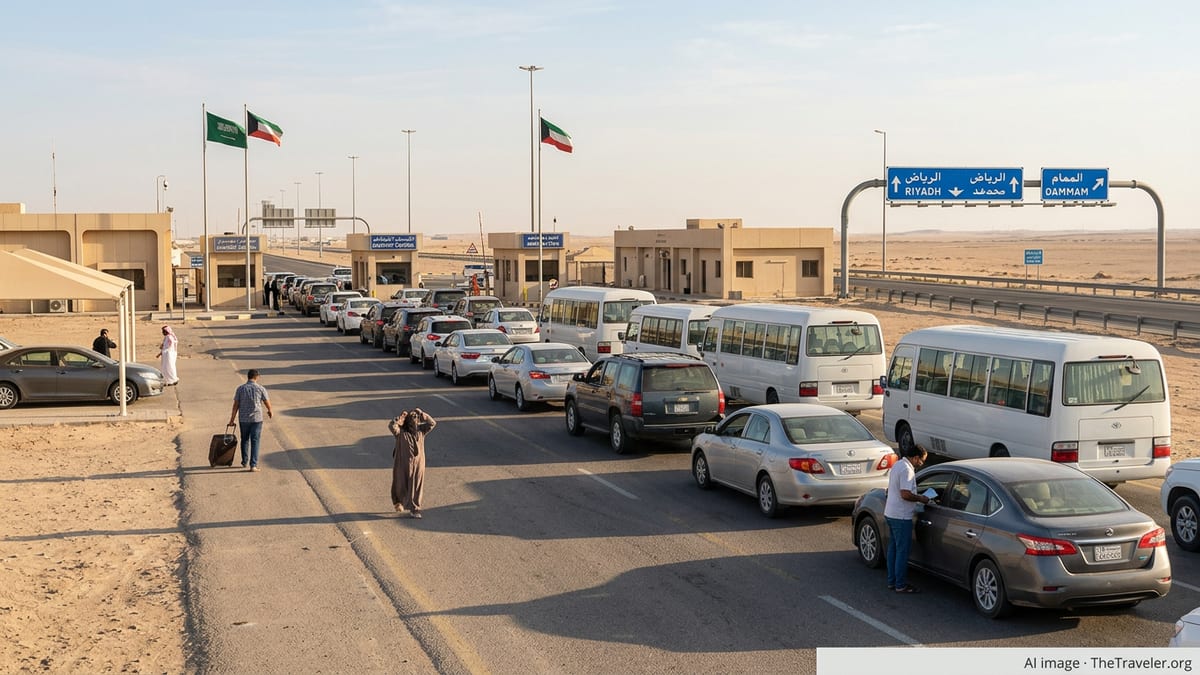
With flights impossible from Kuwait, Saudi Arabia’s eastern and central provinces have become the primary exit and entry points for those who can move by land. Long established crossings such as Salmi on Kuwait’s western flank and the Nuwaiseeb crossing on the coastal highway are seeing surging traffic, from private cars and company buses to chartered coaches organized by travel agents and community groups.
Embassies have begun coordinating convoys for their nationals, arranging transfers from Kuwait across the Saudi border and onward to major airports like Riyadh and Dammam. Some evacuees are traveling in groups under diplomatic supervision, while others are hiring licensed transport operators vetted by consular missions. Travel advisories consistently stress that land movements remain at travelers’ own risk and are highly dependent on local security conditions along the route.
Saudi authorities, facing their own security pressures, continue to process travelers but are enforcing documentation rules strictly. Border checks now typically involve multi‑stage screening, and waits at peak times can stretch for hours as officers verify visas, vehicle documents, and onward travel plans. For many in Kuwait, however, these queues are now the only path toward an operating airport.
From Kuwait City to Qaisumah, Riyadh, and Dammam
The closure has rapidly elevated a handful of Saudi airports into critical lifelines for Kuwait‑linked travel. One of the most striking shifts is the temporary relocation of Kuwait’s Jazeera Airways operations to Qaisumah–Hafar Al‑Batin International Airport in Saudi Arabia’s Eastern Province. The airport, about a two and a half hour drive from Kuwait City under normal conditions, has become an improvised hub, with arriving passengers continuing by road into Kuwait and departing travelers making the same journey in reverse.
Other travelers are heading deeper into Saudi Arabia to reach larger airports. Riyadh’s King Khalid International Airport, though operating a reduced schedule, is handling evacuation flights and long haul services that now substitute for connections that once passed through Kuwait. Dammam’s King Fahd International Airport on the Gulf coast is another alternative, particularly for those able to secure seats on regional flights still serving Gulf and Asian destinations.
This patchwork of rerouting has turned what used to be a short hop into a complex, multi segment journey. A resident trying to reach Europe, for example, might now travel by road from Kuwait City to the Saudi border, continue on to Dammam or Riyadh, and only then board a long haul flight. For some, especially families with children or those with limited mobility, the added time and uncertainty are daunting, but in many cases there is simply no other option.
Paperwork, Visas, and Practical Realities on the Road
The rapid pivot to land routes has also thrown a spotlight on the practicalities of crossing Saudi Arabia by road. Travelers must hold a valid Saudi entry visa, whether an e‑visa obtained before departure or a permit issued at the border where eligible. Those driving their own vehicles need registration papers in their name, as well as cross‑border insurance, which can typically be purchased near the crossing points. Rental cars usually require explicit authorization from the company to leave Kuwait and enter Saudi territory.
Embassies and local authorities are urging travelers to prepare thoroughly before setting off, warning that incomplete paperwork can mean being turned back at the frontier. Transport operators advertised on community channels and in embassy guidance are offering “end‑to‑end” services that include not just the border crossing itself, but also the onward drive to a Saudi airport and coordination with flight schedules. Demand for such services has surged, with reports of buses and minibuses filling up days in advance.
On the ground, travelers are also adjusting to longer travel times, increased checkpoints, and fluctuating fuel and accommodation availability along main corridors. Security conditions can change rapidly, prompting some routes to be favored over others from one day to the next. Many companies now instruct staff to travel only in daylight hours, avoid isolated rest stops, and stay in close contact with their employers or consular officials while en route.
A New Map for Gulf Mobility
While the Kuwait airport closure is officially described as temporary, its impact is already feeding broader debates about resilience and redundancy in Gulf transport networks. Airlines that had expanded in Kuwait in recent years are now looking at how quickly they can pivot to neighboring hubs when crisis hits, while logistics firms are reassessing their reliance on a single airport for cargo flows into northern Gulf markets.
For travelers, the crisis is offering a crash course in the geography of the region, from the desert highways leading toward Hafar Al‑Batin and Dammam to the bureaucratic realities of multi‑country travel in a conflict affected environment. What was once a straightforward departure from Kuwait City has turned into an exercise in route planning, risk assessment, and cross‑border coordination.
How long these improvised overland corridors will remain essential depends on both security developments and political decisions about when to reopen Kuwaiti airspace. For now, however, Saudi Arabia’s land borders and regional airports have taken on an outsized role, quietly keeping people and essential traffic moving at a time when the usual path into and out of Kuwait is firmly closed.