

More news on this day
As geopolitical tensions, cyberattacks and sophisticated criminal networks reshape global risk, airports in 2026 are racing to deploy smarter security technologies that can spot threats faster while keeping passenger journeys as seamless as possible.
Biometrics Go Mainstream at Borders and Boarding Gates
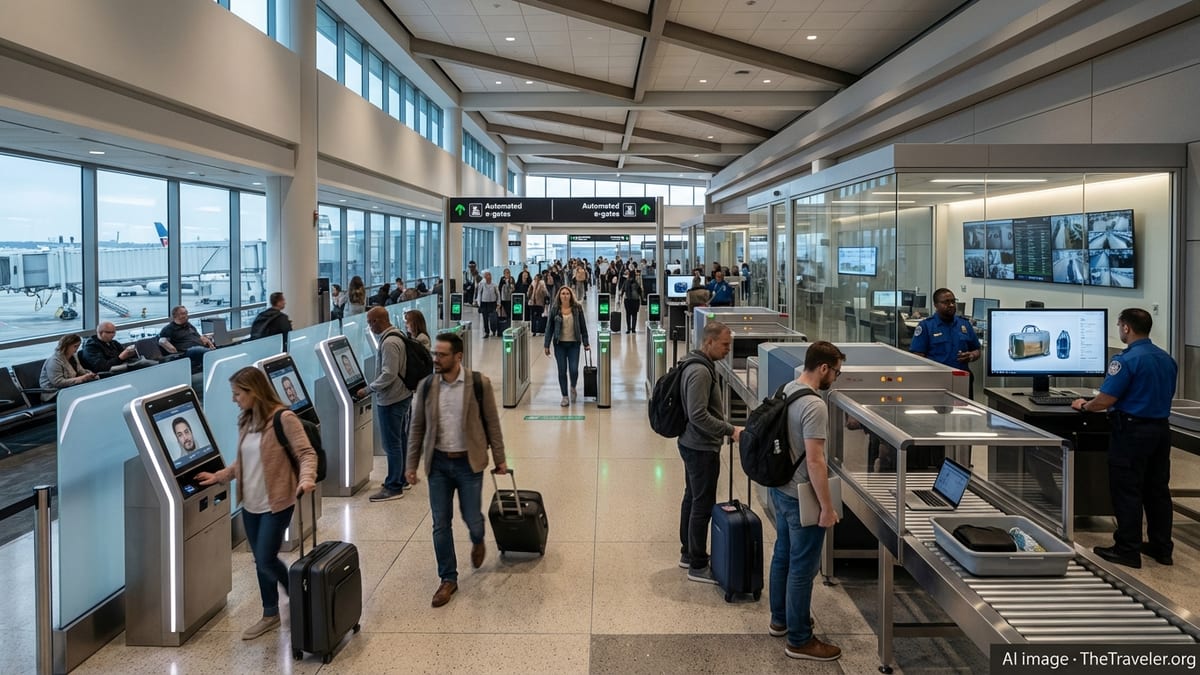
Biometric identity checks that once felt experimental are rapidly becoming standard at major hubs this year, from U.S. gateways to European transfer airports. Facial recognition, fingerprint scanning and digital identity tokens are replacing manual document checks, promising faster processing times at peak travel periods while tightening controls on who actually boards a flight.
In Europe, the new Entry/Exit System, which began rolling out across the Schengen Area in October 2025, is transforming how non-EU travelers are processed at external borders. By April 10, 2026, the system is scheduled to be fully operational at all external border crossing points, with kiosks capturing passport data alongside facial images and fingerprints instead of relying on traditional passport stamps. Border authorities say the digital records will make it easier to spot overstays and identity fraud, while allowing a growing share of passengers to pass through automated lanes.
Airports and operators are investing heavily to make the transition workable in the real world. Eurotunnel, which handles a large share of Channel crossings, has spent tens of millions of pounds on new biometric kiosks and additional staff to manage the new checks, while ports such as Dover and major rail terminals have reconfigured passenger flows to reduce the risk of logjams as travelers acclimate to the new routines.
Inside terminals, airlines and airports are extending biometrics beyond border control to create “face-as-boarding-pass” experiences. Travelers who opt in can link a live face scan to their reservation and passport data, then move through bag drop, security and boarding with minimal document handling. Industry groups say the systems are designed to meet strict privacy rules, including limits on data retention, but civil liberties advocates continue to press for clearer safeguards and transparency.
Next-Generation Checkpoints: CT Scanners and AI-Assisted Screening
At security checkpoints, the era of unpacking laptops and liquids is slowly giving way to smarter, layered screening built around computed tomography scanners, advanced algorithms and risk-based screening concepts. Three-dimensional CT scanners, already in use at airports in the United States, Europe and parts of Asia, are being deployed more widely in 2026, allowing security officers to rotate and inspect bags virtually while passengers keep electronics and liquids inside.
Security agencies are layering machine learning tools on top of this imaging hardware. These systems are trained to flag suspicious shapes and materials inside baggage, helping officers focus on anomalies rather than scanning every image from scratch. Officials say early deployments have reduced false alarms and secondary bag checks, cutting down queue times during busy morning and holiday peaks. The technology is also being refined to better detect homemade explosives and non-metallic weapons that may escape traditional X-ray systems.
Airports are also experimenting with more personalized, risk-based screening inspired by programs like TSA PreCheck in the United States. Instead of treating every traveler identically, security systems increasingly blend watchlist checks, travel history and randomization to determine who requires more intensive screening. The long-term ambition is a checkpoint that feels less like a bottleneck and more like a continuously updated risk filter that can adapt when intelligence agencies flag a new class of threat.
Behind the scenes, data fusion centers at some major airports are integrating feeds from CCTV cameras, access-control systems, baggage screening and even open-source intelligence into unified dashboards. Security managers say this “whole airport” view helps them spot patterns, such as suspicious movements in airside zones or coordinated probing of security perimeters, that would be easy to miss if each system operated in isolation.
Digital Borders, New Frictions and Traveler Experience Risks
Even as governments tout digital borders as a way to reduce queues in the long run, the transition period is already revealing points of friction that could shape traveler perceptions in 2026. Airports Council International Europe has warned that, during early phases of the Schengen Entry/Exit System, some airports have seen border processing times increase by as much as 70 percent at peak hours, with queues stretching beyond three hours in isolated cases.
National authorities retain the option to slow or temporarily suspend the new system if congestion or technical issues threaten safety or operations. Portugal has already paused Entry/Exit enrollment at Lisbon’s main airport for several months to relieve bottlenecks in the arrivals hall, while it upgrades equipment and staffing. The flexibility is built into European rules precisely to prevent new technology from triggering cascading delays across already stretched aviation networks.
For travelers, the impact will vary significantly by route and timing. At some hubs, newly installed biometric kiosks and clear signage are enabling first-time users to complete fingerprint and photo capture within minutes. At others, undersized waiting areas, staffing gaps and unfamiliarity with the new steps are producing longer lines. Airlines and travel advisors are urging passengers headed to or through the Schengen Area to build in extra connection time throughout 2026, particularly when transiting busy gateways in France, Germany, Italy, Spain and Portugal.
Industry groups say communication will be critical. Airport operators are adding multi-language explainer videos in check-in zones, push notifications in airline apps and pre-travel briefings through travel agents and tour operators. The aim is to turn what could feel like a sudden clampdown into a predictable, if more data-intensive, step in the journey that passengers can prepare for in advance.
Confronting Evolving Threats: From Drones to Cyberattacks
The drive toward smarter, more seamless travel is unfolding against a backdrop of threats that are growing in both sophistication and variety. Aviation security officials increasingly talk about a shift from purely physical risks, such as weapons or explosives in baggage, to a broader spectrum that includes drones near runways, cyberattacks on airport systems and attempts to exploit insider access at airlines and ground-handling firms.
Near runways, airports are deploying more capable counter-drone systems that combine radio-frequency detection, radar and optical tracking to identify unauthorized drones and, where permitted by law, disrupt their signals. The goal is to prevent runway incursions or airspace closures that can ripple across entire networks. Regulators are also tightening rules on drone registration and geofencing, seeking to balance innovation in urban air mobility with the safety of commercial air traffic.
Cybersecurity has moved from the back room to the boardroom as airports digitize everything from baggage sorting and flight information displays to biometric gates and mobile boarding passes. Incidents targeting reservation systems, airport websites or ground-handling software can now cause as much disruption as a winter storm. In response, many airports are adopting zero-trust architectures, segmenting operational technology from public-facing networks and running regular “red team” exercises to uncover vulnerabilities before attackers do.
Security planners warn that these domains are increasingly intertwined. A cyberattack that disables access-control systems, for example, can open opportunities for physical breaches of secure zones, while a coordinated misinformation campaign could send crowds surging toward certain checkpoints or exits. This convergence is driving closer coordination between traditional aviation security units and national cyber defense agencies, as well as information-sharing partnerships with airlines and technology providers.
Balancing Privacy, Trust and the Promise of Seamless Travel
As biometric gates, algorithmic screening and digital travel authorizations spread, privacy and civil liberties concerns are moving to the center of public debate. In Europe, regulators emphasize that systems like the Entry/Exit database are governed by strict data protection rules that limit how long biometric data is stored and which authorities can access it. Supervisory bodies are tasked with ensuring travelers can request information about their records and seek corrections or deletion under defined conditions.
Elsewhere, advocacy groups are pressing for clear guardrails on facial recognition in public spaces, including at airports. They argue that the convenience of “walk-through” boarding must not come at the cost of opaque watchlists or unchecked data sharing. Some airports are responding by making biometric programs voluntary where regulations permit, promising no penalty in processing time for travelers who opt to use traditional documents instead.
For the aviation industry, the challenge in 2026 is to prove that smarter security can genuinely feel seamless: shorter lines, fewer intrusive manual checks and a consistent experience from one airport to the next. Executives say that will require not only better technology but also rigorous testing, transparent communication with passengers and fallback plans when systems fail.
Travelers, for their part, are being asked to adapt to a new normal of digital checkpoints, biometric scans and evolving pre-travel requirements. As the year unfolds, whether these measures are perceived as an enabler of hassle-free global mobility or as another layer of red tape will depend on how effectively airports, airlines and border agencies manage the complex transition now underway.