

More news on this day
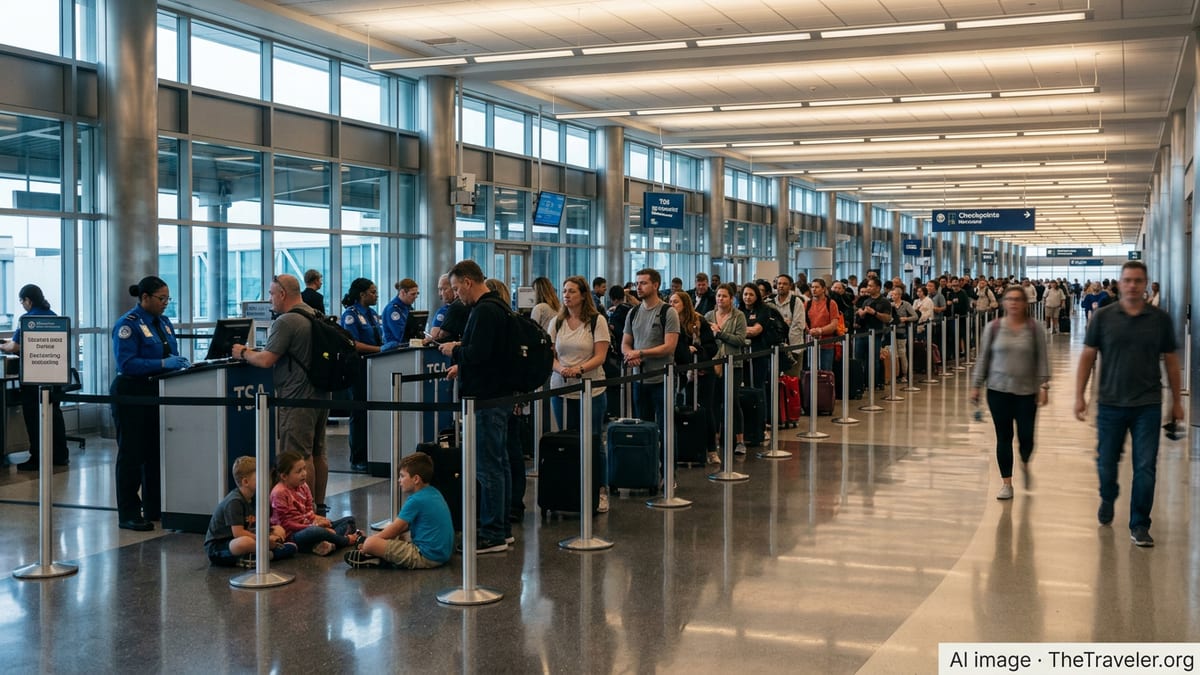
As the Department of Homeland Security shutdown stretches into a seventh week, U.S. travelers are confronting hours-long security lines, sporadely closed checkpoints and mounting uncertainty about how stable the nation’s airport security system really is.
Get the latest news straight to your inbox!
Why a DHS Shutdown Hits TSA So Hard
The current standoff in Washington has left the Department of Homeland Security without full-year funding since mid-February, triggering a partial shutdown that ripples directly into airport security. Transportation Security Administration officers are classified as essential, which means they must continue working even while regular paychecks are halted or delayed. Contingency plans keep checkpoints open, but they also depend on employees absorbing weeks of financial strain.
Publicly available guidance shows that roughly 95 percent of TSA’s workforce is designated as excepted during shutdowns, required to report or face possible discipline. In practice, that has produced a fragile system in which screening lanes are open, but morale is frayed and staffing is unpredictable. Some officers use sick leave, others seek second jobs, and a smaller number resign outright, all of which reduce the agency’s ability to keep every lane at every airport fully staffed.
Recent shutdowns have illustrated how quickly that stress can translate into delays. During past funding lapses, screening delays became a routine feature of air travel, especially at large hubs where absenteeism can mean the difference between ten active lanes and only a handful. Analysts following aviation performance data note that when security becomes a bottleneck, missed flights and knock-on delays ripple through the national network for the rest of the day.
From Three-Hour Queues to Closed Checkpoints
Reports from major hubs in late March describe security lines stretching far beyond their usual footprint, particularly during early morning and late afternoon peaks. At Houston’s George Bush Intercontinental, data cited in recent coverage indicated wait times climbing toward four hours on some days, with only a fraction of checkpoints operating. Travelers have described winding queues that snake into ticketing halls and down concourses, even as airlines urge passengers to arrive much earlier than normal.
Not every airport is affected in the same way. Some facilities with lower traffic or more flexible staffing have reported relatively normal wait times, and online trackers at certain hubs still show average delays measured in minutes, not hours. The uneven picture reflects how local workforce conditions, airline schedules and airport layouts interact with national policy. A modest increase in call-outs at a smaller airport may be manageable, while the same percentage at a sprawling hub can overwhelm security halls.
Where staffing has become particularly thin, airports have begun consolidating operations by shutting some security lanes or entire checkpoints and directing travelers through fewer entry points. In Philadelphia, for example, two checkpoints were temporarily closed earlier in the week even as overall wait times remained manageable at the remaining lanes. Other facilities have roped off lesser-used entrances, concentrating both staff and passengers into more tightly controlled areas.
A growing concern among aviation experts is the possibility of shutting down full terminals or, in extreme cases, entire airports if staffing or law-enforcement coverage falls below minimum thresholds. Recent analytical work underscored that closing even a single commercial airport can disrupt regional connectivity, freight flows and medical flights far beyond the local community. For now, closures have largely been limited to specific checkpoints and limited operating hours, but the scenario of broader shutdowns remains part of contingency planning discussions.
New Stopgap: An Executive Order and Backup Personnel
In an attempt to stabilize the situation, President Donald Trump on March 27 signed an executive action directing that TSA employees be paid despite the broader lapse in Department of Homeland Security funding. According to reporting from national outlets, the move followed weeks of intense pressure as absentee rates climbed and more than 11 percent of scheduled officers missed work on some days. Homeland security leadership has said publicly that workers could begin to see pay as early as Monday, even while the underlying budget dispute remains unresolved.
Policy observers note that the order is an unusual workaround rather than a comprehensive solution. While it may lessen immediate financial pressure on screeners and slow the rate of resignations and call-outs, the broader uncertainty over long-term funding and future shutdown risks remains. Workers who endured weeks without paychecks may still seek more stable employment, and recruiting replacements into a politically volatile environment could prove challenging.
Alongside the pay order, the administration has turned to other federal agencies for temporary reinforcement. In recent days, Immigration and Customs Enforcement officers wearing distinctive tactical vests have been deployed to help at checkpoints in cities including Chicago, Pittsburgh and other airports facing high absentee rates. Coverage from regional outlets and local travelers’ accounts describes these agents supporting existing TSA teams, though they are not a substitute for fully trained screening officers at every lane.
The presence of immigration officers in front-of-house security areas has also generated public debate. Civil liberties groups and immigrant advocacy organizations argue that it may deter some travelers or family members from entering terminals, while supporters view the move as a practical way to keep lines moving. For passengers, the most immediate effect is often a slightly faster queue at a time when every additional staff member counts.
What Travelers Are Experiencing at the Checkpoint
For passengers on the ground, the shutdown’s impact is measured less in policy language and more in minutes spent in line. Travel forums and social platforms have filled with first-hand accounts of three-hour waits at some hubs, especially during the fifth and sixth weeks of the federal funding lapse. Flyers describe joining queues near the entrance doors and slowly inching toward security, worried that even a two-hour buffer may no longer be enough.
Experiences vary widely by location and time of day. At certain airports, travelers report that early morning departures still clear security in under 30 minutes, while midday and evening peaks swell far beyond posted estimates. Some frequent flyers note that trusted traveler lanes, such as PreCheck and CLEAR, remain operational but can themselves become crowded when regular lines overflow or when staffing shortages require reallocating officers away from dedicated lanes.
Publicly available planning guides from travel industry associations advise passengers to treat shutdown conditions as a form of rolling disruption. The recommendations include arriving at the airport earlier than usual, keeping carry-on luggage simple to reduce secondary screenings and building in longer connection times, especially when connecting from international to domestic flights where a second TSA check is required. Travel insurance policies do not consistently cover shutdown-related delays, so travelers are being urged to read fine print carefully before assuming they can recoup costs.
Despite the disruptions, commercial aviation operations have not fully ground to a halt. Airlines continue to operate schedules, and in this shutdown air traffic controllers have continued to receive pay, easing one pressure point seen during past funding crises. Still, the combination of stressed security checkpoints and tight airline schedules leaves little margin for error. A wave of missed connections on a busy day can quickly turn into a cascade of delays across the network.
Could Airports Actually Close, and What Happens Next?
The question looming over many travelers is whether the current pattern of long lines and limited checkpoint closures could escalate into temporary shutdowns of whole terminals or airports. Aviation security specialists point out that federal contingency documents contemplate worst-case scenarios where operations are curtailed if minimum staffing or law-enforcement requirements cannot be met. However, shutting an airport is considered a last resort given the economic and social costs, and recent history suggests that policymakers try multiple stopgaps first.
Recent airspace closures in Texas and New Mexico for unrelated security reasons offer a reminder of how disruptive such moves can be. When airspace restrictions effectively shut down El Paso International Airport for hours in February, airlines diverted flights, medical transports were rerouted and local travelers were left stranded. Analysts say a shutdown-driven closure would look different in cause but similar in effect: a sudden halt to regular passenger service, with wide-ranging knock-on impacts for regional mobility.
On Capitol Hill, new proposals seek to prevent that scenario in future standoffs. Draft legislation introduced in Congress in recent days would guarantee pay for TSA and Federal Aviation Administration workers during government shutdowns, insulating them from the immediate financial impact of political impasses. Lawmakers from both parties have floated versions of these protections before, but the current crisis and the visibility of hours-long airport queues have revived interest in permanent fixes.
For now, the outlook for travelers remains tied to negotiations in Washington and the speed with which recent executive actions translate into actual paychecks. Even if absentee rates begin to fall as workers are paid, travel experts caution that staffing rosters, training schedules and passenger confidence will take time to stabilize. Passengers heading to the airport in the coming days are likely to find a system still operating, but under visible strain, and would be wise to plan as if three-hour queues remain a real possibility at the nation’s busiest hubs.