

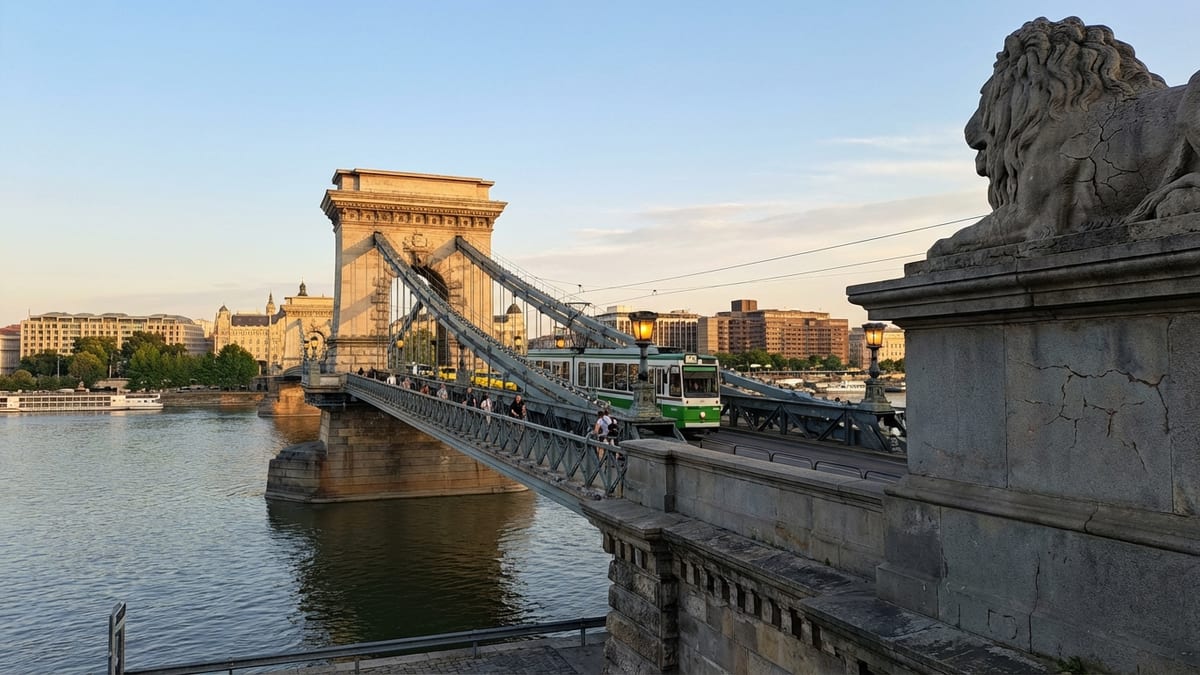
The Széchenyi Chain Bridge is more than a piece of infrastructure across the Danube. Its iron links and stone towers are bound tightly to the story of Hungary’s rise into a modern nation, the unification of Buda and Pest, and the country’s repeated recoveries from war and political upheaval.
Understanding how and why this 19th century suspension bridge was built, destroyed and rebuilt explains not just a postcard view of Budapest, but a turning point that changed Hungary forever.
The Dream of a Modern Hungary
In the early 1800s, Buda and Pest were neighboring towns rather than a unified capital. The Danube between them was a barrier that could be crossed only by ferries or temporary pontoon bridges, both unreliable in winter ice or high water. Travel delays were common. For merchants, officials and ordinary travelers, the crossing was a daily reminder that the kingdom lacked the permanent, modern infrastructure seen elsewhere in Europe.
Count István Széchenyi, an aristocrat and reformer later called “the Greatest Hungarian,” turned that inconvenience into a national project. In the winter of 1820, drifting ice on the Danube made the river impassable for days, and Széchenyi was unable to reach his dying father’s bedside or attend his funeral. The personal blow became a political awakening. A permanent bridge, in his view, was not just a matter of comfort. It was a precondition for economic growth, political reform and for turning Buda and Pest into a real European capital.
Széchenyi used his influence and fortune to push the idea into the mainstream. He pledged a year of his income to the project and lobbied the Hungarian Diet in the 1830s to approve a permanent Danube crossing. He saw infrastructure as the backbone of national renewal: a way to connect regions, stimulate trade, and knit together a multiethnic kingdom that lagged behind more industrialized parts of Europe. The Chain Bridge was his flagship initiative, a physical and symbolic statement that Hungary intended to modernize.
From the outset, the bridge was imagined as something more than a local convenience. In Széchenyi’s speeches and writings it stood for a Hungary that could compete on an equal footing with Western Europe, where technology, capital and national ambition worked together. When the foundation stone was finally laid in the 1840s, the project carried the weight of those expectations.
Engineering Marvel on the Danube
To realize his vision, Széchenyi turned to cutting-edge British engineering. The bridge was designed by English engineer William Tierney Clark, known for pioneering suspension bridges over the Thames, and constructed under the supervision of Scottish engineer Adam Clark (unrelated, despite the shared surname). For its time, the project was on the frontier of civil engineering, adapting British know-how to the challenging conditions of the Danube in the heart of Central Europe.
Construction formally began in 1840 after prolonged political and financial wrangling. Thousands of piles of Croatian pine were driven into the unstable riverbed to support massive stone piers. Iron components and chains were manufactured in Britain and transported in sections to be assembled on-site, a logistical operation that symbolized Hungary’s growing integration into European industrial networks. The main span of 202 meters was among the longest suspension bridge spans in the world when it opened, and the full length of 375 meters placed it among the continent’s most ambitious river crossings.
The bridge’s design combined utilitarian purpose with neoclassical grandeur. The towers rose like gateways on each bank, framing the view of the river and the city. Stone lions by sculptor János Marschalkó were added at each end in 1852, quickly becoming one of Budapest’s most recognizable motifs. Cast-iron decorations and historic lanterns gave the structure a refined silhouette, especially striking at night when illuminated above the water. What began as a feat of engineering quickly took on a monumental presence in the city’s landscape.
When the Chain Bridge opened on 20 November 1849, contemporary observers hailed it as a wonder of modern technology. Beyond local pride, it sent a message that Hungary was ready to stand alongside the great capitals of Europe in both ambition and technical sophistication. For many Hungarians, crossing it for the first time was an encounter with a new era.
From Two Towns to One Capital
Before the bridge, Buda and Pest faced each other across the Danube as loosely linked rivals. Buda, perched on hills, was the historic royal seat and administrative center, while Pest on the eastern bank grew into a bustling commercial town. Travel between them was slow, seasonal and often dangerous. The river, which should have been a unifying axis, functioned instead as a divider in everyday life.
The Chain Bridge changed that balance almost overnight. By providing a permanent, reliable crossing, it redirected trade routes, accelerated the movement of goods, and encouraged businesses to operate across both banks. Merchants no longer had to calculate delays caused by ice or floods. Residents could commute more easily for work, education or political activity. The flow of ideas, newspapers and information quickened along with the flow of traffic.
This new connectivity supported a broader transformation. As Hungary’s reform era advanced and economic activity intensified, Buda and Pest gradually evolved from separate towns into a single urban organism. When the unified city of Budapest was finally created in 1873, combining Buda, Pest and Óbuda, the Chain Bridge had already served for decades as their literal and metaphorical link. In many Hungarian histories, the bridge is described as a precursor to unification, foreshadowing the creation of a true national capital.
In this sense, the bridge helped shift Hungarians’ mental map of their own country. The center of gravity moved more clearly to the Danube and to an emerging metropolis rather than dispersed noble estates. Budapest could now present a coherent urban face to visitors, diplomats and investors. The bridge did not cause all these changes on its own, but it provided the essential infrastructure that made them possible and visible.
Stage for Revolution, Collapse and Rebirth
History did not stand still once the bridge opened. The final stages of construction unfolded against the background of the 1848 Hungarian Revolution and War of Independence against Habsburg rule. The bridge was completed in a subdued atmosphere in late 1849, just months after the revolution’s defeat. Its stark, elegant lines stood as a reminder of both the progress reformers had made and the limits of their political success under imperial pressure.
In the decades that followed, the Chain Bridge became a stage for public life. It formed part of the ceremonial route during the 1867 Austro-Hungarian Compromise and coronation festivities, symbolizing a rebalanced relationship between Vienna and Budapest. Demonstrations, parades and crowds regularly moved across it during moments of national significance. For citizens of the rapidly growing city, the bridge became entwined with their own memories and family histories.
The 20th century brought more violent tests. During the Second World War, as Soviet forces advanced on Budapest, German troops retreating across the Danube systematically destroyed its bridges. On 18 January 1945, they blew up the Chain Bridge, leaving only the stone towers standing amidst the wreckage. Period photographs show the towers isolated in the river, a stark, almost surreal image of a capital cut in two again. The destruction was military strategy, but to many Hungarians it felt like an attack on the nation’s identity.
Rebuilding began soon after the war, initially amid shortages and political turmoil. Engineers drew on earlier reconstruction plans from the 1910s to restore the essential form of the bridge while updating its structure. Remarkably, a substantial portion of the original chains was reused, anchoring the renewed bridge both physically and historically to its 19th century predecessor. On 20 November 1949, exactly one hundred years after the first inauguration, the rebuilt Chain Bridge was reopened. In a country now entering the decades of socialist rule, the reopening served as a public signal that some symbols transcended regimes.
Symbol of Identity, Debate and Memory
From the start, the Chain Bridge carried symbolic weight. The decision to name it officially after István Széchenyi, formalized in the early 20th century, linked the structure directly to the reformer’s legacy. In the public imagination, the bridge came to stand for rational progress, openness to the wider world, and a certain quiet determination to overcome obstacles. Its image appears on coins, postage stamps and in countless pieces of art and literature about Hungary.
As a symbol, the bridge also sparked debate. In the 19th century, its toll system was controversial because it required contributions from all social groups, including nobles who had historically been exempt from many forms of taxation. For Széchenyi, this shared burden was part of the point: a modern nation required equal responsibilities alongside equal benefits. Critics, however, saw it as an affront to traditional privileges. Even in this early moment, the bridge forced a conversation about fairness and modernization.
In the postwar era, the Chain Bridge was incorporated into the visual language of the socialist state, yet remained rooted in an older, broader story. It appears in films, literature and later international media as shorthand for Budapest itself. More recently, debates over its renovation funding and traffic rules highlighted how deeply the bridge still matters to the public. Arguments between the national government and the city over who would pay for restoration costs, and whether private cars should be allowed to cross, were about more than budgets and traffic counts. They reflected competing visions for how the capital should develop in the 21st century.
Despite changing governments and ideologies, one constant has remained: when Hungarians speak about their country’s symbols, the Chain Bridge is almost always near the top of the list. It is a landmark around which personal stories, political narratives and cultural memory continue to cluster.
Renovation, Car-Free Future and Living Legacy
By the early 21st century, nearly eight decades after its postwar reconstruction, the Chain Bridge had begun to show serious signs of wear. Engineers warned that without major renovation, corrosion and structural fatigue could compromise safety. In 2021, the bridge was closed to traffic to begin the most extensive restoration work since the 1940s. For Budapest residents, this was another moment of separation from a familiar daily presence, but also a necessary pause to secure the bridge’s future.
The renovation went far beyond cosmetic repairs. Roadway structures were replaced, key load-bearing elements were renewed or reinforced, and the famous stone lions and historic lanterns were meticulously restored. Modern engineering techniques were quietly inserted beneath the 19th century silhouette, enhancing safety and durability while preserving the bridge’s historic character. Throughout the process, there was close attention to authenticity, with original decorative elements refurbished rather than replaced wherever possible.
The staged reopening began in December 2022, when public transport, taxis and cyclists were allowed back on the bridge. A wider reopening in August 2023 restored pedestrian access, inviting residents and visitors to once again walk between Buda and Pest with uninterrupted river views. At the same time, a decisive policy change took effect. Private cars were no longer allowed, turning the bridge into a corridor prioritized for public transport, non-motorized traffic and people on foot.
This shift marked a new chapter in the bridge’s history. Where the 19th century bridge stood for industrial modernity and connectivity, the 21st century version has become part of a broader move toward a greener, less car-dependent city. Urban planners point out that reducing car traffic not only protects the aging structure from stress, but also enhances the quality of public space and the experience of crossing. For locals, the car-free bridge has quickly become an attractive place to stroll, take photographs and experience the skyline without the constant roar of engines.
Walking the Bridge Today: Experiencing History Firsthand
Crossing the Széchenyi Chain Bridge today is one of the most evocative experiences in Budapest. From the Pest side, the bridge begins near the grand façade of the Hungarian Academy of Sciences and the ornate Gresham Palace. Stepping onto the structure, visitors are immediately framed by the monumental stone portal and the two lions that have watched over the river since the early 1850s. Continuing across, the panorama reveals Parliament up the river, the domes and roofs of Pest behind, and the rising slopes of Buda ahead.
Midway over the Danube, the power of the bridge’s story comes into focus. The gentle sway and the lattice of chains above call back to a time when this was one of the longest suspension spans in the world. The river below carried rafts, steamboats and, later, industrial barges that helped fuel Hungary’s economy. Looking toward Buda Castle, it is easy to imagine 19th century carriages, 20th century trams, and wartime convoys using this route, each generation layering its own history onto the structure.
On the Buda side, the bridge meets a small square named for Adam Clark, the Scottish engineer who oversaw construction. Nearby, the Zero Kilometre Stone marks the origin point from which Hungary’s main roads are measured. This symbolic detail underlines how central the bridge has become to the country’s geography and self-image. From here, a funicular ascends to Buda Castle, and narrow streets climb into the older quarters of the city, where medieval walls and baroque houses coexist with the modern metropolitan skyline.
For travelers, the bridge is not just a scenic walk, but a compressed lesson in Hungary’s last two centuries. Each direction offers a slightly different story. Facing Pest, you see the 19th century commercial town that grew into a grand boulevard-lined capital. Facing Buda, you encounter the older royal seat and its reminders of earlier centuries. The Chain Bridge literally and figuratively holds these narratives together in a single, walkable arc.
The Takeaway
The Széchenyi Chain Bridge changed Hungary forever by turning an inconvenient river crossing into a national project that reshaped the country’s politics, economy and sense of itself. Conceived by a reformer determined to pull Hungary into the modern age, built with some of the most advanced engineering of its time, and repeatedly rebuilt after war and decay, the bridge became far more than a piece of infrastructure.
It helped knit Buda and Pest into a single capital, gave physical form to hopes of equality and shared responsibility, and served as a stage on which Hungary’s triumphs and tragedies played out. From the revolution of 1848 to the devastation of 1945, from socialist reconstruction to 21st century debates over traffic and climate, the bridge has remained a constant reference point in national life.
Today, as a restored, largely car-free landmark, the Chain Bridge continues to evolve. It stands as a reminder that infrastructure can shape identity, that rebuilding is possible after even the worst destruction, and that cities can reinterpret their heritage for new generations. To walk its length is to follow in the footsteps of nearly two centuries of Hungarians who have crossed the Danube not just between two banks, but between eras in their country’s history.
FAQ
Q1: When was the Széchenyi Chain Bridge built and when did it first open?
The main construction of the Chain Bridge took place in the 1840s, and it officially opened to traffic on 20 November 1849, becoming the first permanent bridge between Buda and Pest.
Q2: Why is the bridge named after István Széchenyi?
The bridge is named after Count István Széchenyi because he was the leading political force behind the project. He championed the idea in the Hungarian Diet, pledged a year of his income to support it, and saw the bridge as central to modernizing Hungary.
Q3: Who designed and built the Chain Bridge?
The bridge was designed by English engineer William Tierney Clark, who had experience with suspension bridges in Britain, and it was built under the supervision of Scottish engineer Adam Clark, who managed construction on-site in Budapest.
Q4: How did the Chain Bridge contribute to the unification of Buda and Pest?
By providing a reliable, year-round crossing, the bridge encouraged trade, commuting and social interaction between the two towns. Over time, this daily connectivity helped pave the way for their formal unification with Óbuda into the city of Budapest in 1873.
Q5: What happened to the Chain Bridge during World War II?
In January 1945, as German troops retreated from Budapest, they blew up the Chain Bridge along with other Danube crossings. Only the stone towers remained standing. The bridge was later rebuilt and reopened in 1949.
Q6: How faithful is the current bridge to the original 19th century structure?
The postwar reconstruction and later renovations preserved the overall appearance and key design elements of the original bridge, including its towers and chains. However, internal structural components, road decks and some technical details were modernized for safety and durability.
Q7: Why was the bridge renovated again in the 2020s?
Decades of heavy use, weathering and pollution had taken a toll on the bridge’s structure and surfaces. The renovation launched in 2021 addressed corrosion, replaced aging roadway elements, strengthened key supports and restored historic details such as the lions and lanterns.
Q8: Can cars still drive across the Chain Bridge today?
No. Following the recent renovation and policy decisions by the city, the bridge is now closed to private cars. It is reserved for public transport, taxis, cyclists and pedestrians, reflecting a shift toward more sustainable urban mobility.
Q9: What are the famous lions on the bridge and is it true they have no tongues?
The stone lions at each end of the bridge were sculpted by János Marschalkó and unveiled in the early 1850s. A popular urban legend claims they have no tongues, but in reality the tongues are simply not visible from the usual viewing angles.
Q10: Why is the Chain Bridge considered so important in Hungarian history?
The Chain Bridge is seen as important because it symbolizes Hungary’s 19th century push to modernize, helped transform Budapest into a unified capital, survived wartime destruction, and continues to embody national resilience and identity. Its story mirrors many of the key turning points in Hungary’s modern history.