

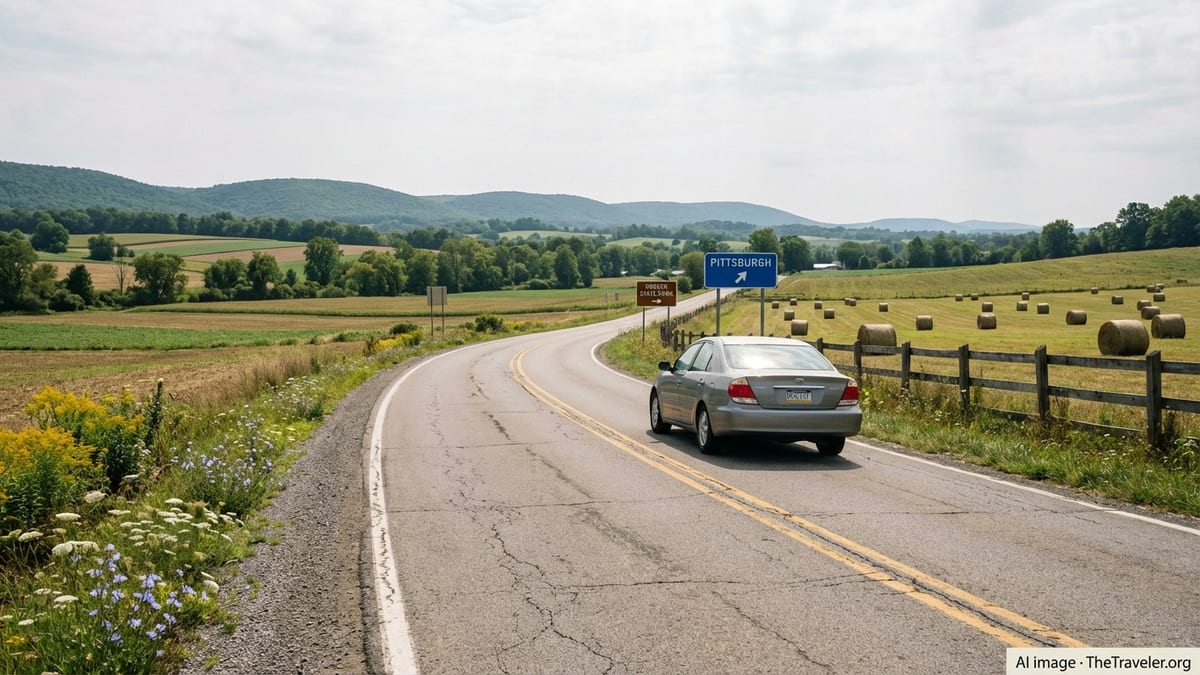
A road trip across Pennsylvania from Philadelphia to the rolling hills and river valleys of the west is one of the most rewarding drives in the Mid-Atlantic. From Amish farmland and Civil War battlefields to rugged state parks and the cultural energy of Pittsburgh, this journey offers an accessible way to see how dramatically the Keystone State changes as you travel from east to west. With some planning around routes, seasons and overnight stops, you can turn a simple drive into a memorable cross-state adventure.
Choosing Your Route From Philadelphia to Western Pennsylvania
The most direct way to cross Pennsylvania by car from Philadelphia is to follow the Pennsylvania Turnpike, Interstate 76, almost the entire way. It runs west from the Philadelphia suburbs toward Harrisburg, then cuts through the Appalachian ridges toward the Laurel Highlands and the Pittsburgh region. The turnpike is a toll road that now uses all electronic tolling, so you will either need an E-ZPass transponder or will receive a bill by mail via license plate recognition. It is usually the fastest option, but you should factor tolls into your budget and watch for ongoing construction zones where widening and bridge replacement projects continue in stages.
For travelers who want to weave in more scenery and small towns, there are slower but more atmospheric alternatives that parallel much of the turnpike. U.S. 30, also known as the historic Lincoln Highway, arcs across the state from the eastern suburbs through Lancaster County farmland, Gettysburg, and the ridges near Chambersburg and Breezewood. Portions of this route hug ridgelines and drop into valleys, with long views that the interstate bypasses. U.S. 22 and U.S. 322, which link Harrisburg with the Juniata River valley and central Pennsylvania, provide additional options for those who prefer river scenery to a straight shot on the turnpike.
For most road trippers, a hybrid strategy works best. Use the turnpike to leave the congestion of metropolitan Philadelphia, then exit for regional loops around Lancaster, Gettysburg, or the Laurel Highlands before rejoining the highway further west. This approach reduces driving stress on your first and last days while still allowing time for quieter back roads, classic diners, and detours through historic districts. Before you go, check Pennsylvania’s 511 travel information service or local traffic reports for any notable closures or long-term work on your chosen route.
It is also worth thinking about how far into Western Pennsylvania you want to go. For many, Pittsburgh serves as a natural endpoint, with its museums, stadiums, and distinctive neighborhoods along the three rivers. Others press on to the college towns and forests around Indiana, the river communities of the Ohio Valley, or the lake and dunes near Erie. Deciding your ultimate turnaround point will help you shape how many nights you need and how many stops feel realistic along the way.
Deciding How Many Days You Need
The driving distance from Philadelphia to Pittsburgh is roughly five to six hours without major stops, assuming normal traffic and staying largely on the turnpike. Technically you could complete the trip in a long day, but that approach leaves little time for exploring the destinations that make the route worthwhile. For a true road trip that balances driving with sightseeing, two to four days in each direction is a more comfortable range.
On the short end, a two-day one-way itinerary might include a half day around Lancaster County or Gettysburg, an overnight in or near Harrisburg or Bedford, and a second day dedicated to reaching Pittsburgh with a break in the Laurel Highlands. This gives you at least one or two meaningful stops rather than just highway rest areas. If you are planning a long weekend, a loop that runs Philadelphia to Pittsburgh, then returns on a different alignment such as U.S. 22 or 30, will require fairly full driving days but is still achievable with careful timing.
With three to four days one way, you have enough flexibility to linger in multiple regions. You might spend a night near Lancaster, another around Gettysburg or Hershey, then continue with an overnight in the Laurel Highlands before rolling into Western Pennsylvania’s cities. Extra days also create room for weather delays, unexpected detours, and unplanned discoveries such as a roadside farm market, a state park overlook, or a small-town festival you stumble upon en route.
How you pace the trip will also depend on your travel party. Families with younger children often prefer shorter daily drives paired with parks, playgrounds, and hotel pools. Couples or friends interested in food, breweries, and museums might concentrate more time in urban hubs like Harrisburg and Pittsburgh. Solo travelers can generally cover more distance but may appreciate breaking up mountain driving during daylight hours, especially in winter when snow and fog can affect visibility in the central and western highlands.
Seasonal Timing and Weather Considerations
Pennsylvania’s seasons are distinct, and they will shape both how you plan and what you see along the way. Spring and fall are generally the most comfortable times for a cross-state drive. In April and May, farmland around Lancaster begins to green, dogwoods and redbuds add color to back roads, and river levels in the Susquehanna and Youghiogheny often create lively conditions for paddling and waterfalls. Crowds are moderate outside of school holidays, and lodging rates can be easier on the budget than in peak summer.
Autumn is especially appealing for those who want to experience foliage along the Appalachian ridges and in state parks like Ohiopyle and Laurel Hill. Color often peaks from late September into mid-October in higher elevations of central and western Pennsylvania, then lingers later in valleys. Temperatures can range from mild to brisk, so layers and a flexible itinerary are useful in case a cold front or rain shifts the best days for scenic drives or short hikes.
Summer brings long daylight hours and a classic road trip atmosphere, but also more congestion near popular destinations. Family-oriented spots such as Hershey, historic Gettysburg, and well-known state parks can feel busy on weekends and holidays, and the Pennsylvania Turnpike sees increased traffic during major travel periods in late June, July, and early September. If you travel at this time of year, plan to drive earlier in the day when temperatures are lower and traffic volumes on the interstate can be lighter, and reserve lodging near the most popular areas well in advance.
Winter road trips across Pennsylvania require a more cautious approach. Snow, ice and sudden squalls can affect higher stretches of the turnpike and the ridges crossing the center of the state. Road crews generally work quickly, but visibility and traction can change within a single valley or mountain pass. If crossing the state between December and early March, keep your daily distances conservative, monitor local forecasts for key mountain segments, and build in leeway for delays. Carry extra warm clothing, a small shovel, and a basic car emergency kit, particularly if you plan to venture onto more remote back roads away from the main highways.
Eastern and Central Highlights: From Lancaster to the Susquehanna
As you leave Philadelphia’s metro area, the first region many travelers explore is Lancaster County, known for its patchwork of farms, covered bridges, and communities where Amish and Mennonite traditions remain visible in daily life. Secondary roads north and south of the main highway pass fields worked by horse-drawn plows, roadside stands selling seasonal produce, and small towns with farmers markets and family-style restaurants. While tourism is well established here, you can still find quieter corners if you drive a few miles off the main commercial strips and allow time to simply follow scenic byways between villages.
Just to the northwest, the state capital of Harrisburg provides a different kind of stop. Its riverfront setting on the Susquehanna offers pleasant walking paths, and the domed capitol building anchors a compact downtown with museums and historic neighborhoods. For those interested in transportation history, the railroad heritage in nearby towns like Hershey and Middletown adds variety to a day that might otherwise be focused on government and civic landmarks. Harrisburg also serves as a practical overnight base, with easy highway access and a range of midscale hotels convenient to the turnpike and I-83 corridors.
Between Lancaster and Harrisburg, you can detour south to the Civil War battlefields and museums at Gettysburg, an area that rewards at least half a day even on a tight schedule. The landscape of ridges, fields, and stone walls is best appreciated at a slower pace, whether via a self-guided driving tour or a walk through key sectors of the battlefield. It is a sobering yet essential stop for many visitors, adding historical depth that contrasts with the lighter diversions in Hershey, where chocolate-themed attractions, gardens, and family entertainment draw crowds during warmer months.
As you press west of Harrisburg, the feel of the drive changes. Ridges rise higher, traffic often thins, and the highway passes through a repeating rhythm of tunnels and valleys. Here, smaller communities like Carlisle, known for its car shows and colleges, and the Juniata River towns accessible from U.S. 22 and 322, offer chances to pause at river overlooks, covered bridges, or modest local museums. Whether you stay on the turnpike or dip onto parallel routes for variety, this stretch introduces the more rural and topographically varied character that will define the central and western parts of your journey.
Exploring the Laurel Highlands and Ohiopyle
One of the most rewarding segments of a road trip from Philadelphia to Western Pennsylvania unfolds in the Laurel Highlands, a highland region southeast of Pittsburgh known for its state parks, scenic overlooks, and a cluster of significant architectural sites. Here the forested slopes, rolling farmland, and winding rivers provide a softer, more intimate mountain landscape than the sharper peaks found further north in the Appalachians. It is a natural place to slow your pace, spend a night or two, and enjoy both outdoor recreation and cultural attractions.
Ohiopyle State Park is a standout stop in this area, drawing hikers, cyclists, and whitewater enthusiasts to its gorges and waterfalls. In recent years the park has gained national attention for its combination of trail networks, river access, and scenic value at relatively modest cost, making it a favorite among travelers seeking an affordable but memorable outdoor experience. Boardwalks and overlooks provide easy access to views of the falls, while more extensive trail systems appeal to experienced hikers and mountain bikers who want to explore deeper into the forest.
In addition to natural attractions, the Laurel Highlands are closely associated with the work of architect Frank Lloyd Wright. The most famous example is a house that cantilevers dramatically over a waterfall, integrated into the forest and stone around it. Nearby, other homes designed in a more modest style demonstrate how his ideas were adapted for different settings and budgets. Touring one or more of these sites requires advance reservations, especially in peak seasons, but offers a memorable contrast to the colonial architecture of eastern Pennsylvania or the industrial-era buildings of Pittsburgh.
Small towns and country roads round out the appeal of the region. Local inns, family-run motels, and cabin rentals provide lodging options that fit a range of budgets. Breweries, farm-to-table restaurants, and seasonal festivals add a contemporary layer to traditional attractions like covered bridges and heritage railways. Whether you approach from the turnpike exit near Donegal or via U.S. 40 and the historic National Road, plan to leave enough time for slow drives along ridge-top routes, short hikes to overlooks, and unhurried evenings under dark skies that reveal more stars than you will typically see near the cities.
Western Pennsylvania and Pittsburgh as a Gateway
As you continue west, hills and valleys gradually give way to the more urbanized landscapes of the greater Pittsburgh region, where rivers, bridges, and steep neighborhoods create one of the most distinctive cityscapes in the country. Many travelers treat Pittsburgh as the western anchor of their cross-state drive, carving out at least two days to explore its museums, parks, and historic districts. The drive into the city is memorable in itself, particularly if you arrive via one of the tunnels that suddenly open onto views of skyscrapers, stadiums, and intersecting rivers.
Within the city, you will find a mix of industrial heritage and modern innovation. Neighborhoods like the Strip District, Lawrenceville, and the South Side have evolved into hubs for dining, shopping, and nightlife, yet you are never far from reminders of the region’s steelmaking past. For a panoramic perspective, riders ascend the steep slopes above the rivers on historic inclines that still carry commuters and visitors between the valley floor and residential plateaus. Museums dedicated to art, science, and local history, along with a renowned botanical garden and zoo, provide an array of indoor options if weather conditions are not ideal for outdoor exploring.
Pittsburgh also works as a springboard for deeper exploration of Western Pennsylvania. To the north and west, smaller river towns and counties bordering Ohio showcase a landscape of rolling farmland, river bluffs, and remnants of canal and rail networks that once tied the region to the Great Lakes and the interior Midwest. To the north, the road continues to the Lake Erie shoreline, where long sandy beaches and wetlands contrast sharply with the mountain and valley environments you have passed through earlier in the trip. These extensions require additional driving time but reward those who want to see how diverse Pennsylvania becomes as you approach its far-flung corners.
Even if you limit yourself to Pittsburgh as the endpoint, you will notice how different the city feels from Philadelphia. Accents, food traditions, and local sports culture all shift as you cross the state. Experiencing both cities on the same trip, with the rural and small-town regions in between, offers a compact introduction to Pennsylvania’s varied identity. When planning your return east, you can either retrace your steps on the turnpike for efficiency or choose a different combination of U.S. highways and state routes to see new terrain and communities on the way back.
Practical Tips for Driving, Lodging, and Safety
A successful road trip across Pennsylvania is as much about logistics as it is about scenery. Before you leave Philadelphia, make sure your vehicle is in good condition, with tires, brakes, and fluids checked, especially if you will be crossing mountain passes in winter or taking on steep back roads in the Laurel Highlands. Keep a paper map or offline navigation app as a backup to phone-based GPS, since cell coverage can be inconsistent in some rural valleys and forested areas, particularly in central and southwestern counties.
Because the Pennsylvania Turnpike uses electronic tolling, it is worth considering an E-ZPass account if you do not already have one, as it typically reduces toll costs compared with pay-by-plate billing. Regardless of how you pay, set aside funds in your budget for tolls, which can add up on a full cross-state journey. Fuel prices can vary between urban and rural areas, so it is sensible to refuel when you pass larger towns rather than waiting until your tank is very low in sparsely populated stretches.
Lodging choices along the route range from chain hotels near highway exits to restored inns in historic towns and cabins in the state parks and forests. In peak seasons such as foliage weekends, summer holidays, and major events in cities like Hershey or Pittsburgh, booking in advance is important to secure your preferred price point and location. At other times of year, you may find more flexibility to adjust your itinerary on the fly, but it is still wise to reserve at least your first and last nights to anchor the schedule. When staying in smaller communities, check operating hours for local restaurants and shops, since midweek evenings can be quiet.
Safety on the road benefits from a conservative approach. Mountain weather can change quickly, deer activity tends to increase near dawn and dusk, and fog pockets are common along rivers and in hollows. Maintain moderate speeds, use pull-offs to let faster traffic pass on two-lane roads, and avoid overly aggressive timetables that leave little room for breaks. Rest areas on the turnpike and welcome centers near state borders offer safe places to stretch, use restrooms, and gather travel information. Having snacks, water, and basic first-aid supplies in the car can make delays more manageable if an accident or construction zone slows your progress.
The Takeaway
Driving from Philadelphia to Western Pennsylvania is more than a point-to-point journey across a map. It is a chance to trace the state’s story from colonial port city through farmland and battlefields, over mountain ridges and river gorges, to the industrial and cultural landscapes of the west. Whether you have a long weekend or a full week to explore, the route can be scaled to match your time, interests, and comfort with winding roads and small towns.
By choosing your route thoughtfully, pacing your days realistically, and tuning your plans to the seasons, you can create a road trip that feels both manageable and memorable. From the quiet of Lancaster’s back roads and the gravity of Gettysburg to the trails and waterfalls of the Laurel Highlands and the skyline of Pittsburgh, each segment adds a different layer to your understanding of Pennsylvania. With a bit of preparation and a willingness to leave the interstate for local detours, you will discover that the space between the state’s two major cities holds some of its most rewarding experiences.
FAQ
Q1. How long does it take to drive from Philadelphia to Pittsburgh without major stops?
In normal conditions and following the Pennsylvania Turnpike for most of the way, the drive typically takes around five to six hours, not counting fuel or meal breaks.
Q2. What is the best time of year to plan a Pennsylvania road trip from east to west?
Spring and fall are often ideal, with milder temperatures, fewer crowds than peak summer, and attractive scenery such as wildflowers in spring and foliage in autumn.
Q3. Do I need an E-ZPass to use the Pennsylvania Turnpike?
You do not need E-ZPass, but having one generally lowers toll costs and speeds up your trip. Without it, cameras record your plate and a bill is mailed to the vehicle owner.
Q4. Is it safe to road trip across Pennsylvania in winter?
It can be safe with proper preparation, but snow, ice, and fog are more likely, especially in central and western mountains. Build extra time into your schedule and monitor local forecasts closely.
Q5. How many days should I plan for a one-way road trip from Philadelphia to Western Pennsylvania?
Allow at least two days one way if you want to include sightseeing. Three to four days gives you time for stops in places like Lancaster, Gettysburg, the Laurel Highlands, and Pittsburgh.
Q6. Are there scenic alternatives to the Pennsylvania Turnpike?
Yes. U.S. 30, the historic Lincoln Highway, and routes like U.S. 22 and U.S. 322 offer more local flavor and scenic views, though they are slower than the turnpike.
Q7. What are some family-friendly stops along the route?
Lancaster’s farm attractions, Gettysburg’s interpretive centers, Hershey’s entertainment venues, Ohiopyle State Park, and Pittsburgh’s museums and zoo all appeal to families.
Q8. Do I need to book accommodations in advance?
Advance bookings are strongly recommended for peak periods such as summer weekends, foliage season, and major events. In quieter seasons you may find more flexibility, but reserving key nights is still wise.
Q9. Is cell phone coverage reliable across rural parts of Pennsylvania?
Cities and major highways are generally well covered, but some rural valleys and forested areas can have weak or inconsistent signals, so offline maps or paper backups are helpful.
Q10. Can I extend the trip beyond Pittsburgh to see more of Western Pennsylvania?
Yes. You can continue north to the Lake Erie shoreline, explore smaller river towns toward Ohio, or head into additional state parks and forests if you have extra days available.