

More news on this day
Wizz Air is quietly reshaping the way Europeans will travel in 2026, with new routes turning Sicily and Bulgaria into some of the most strategic, affordable jumping-off points for summer vacations across the Mediterranean and beyond.
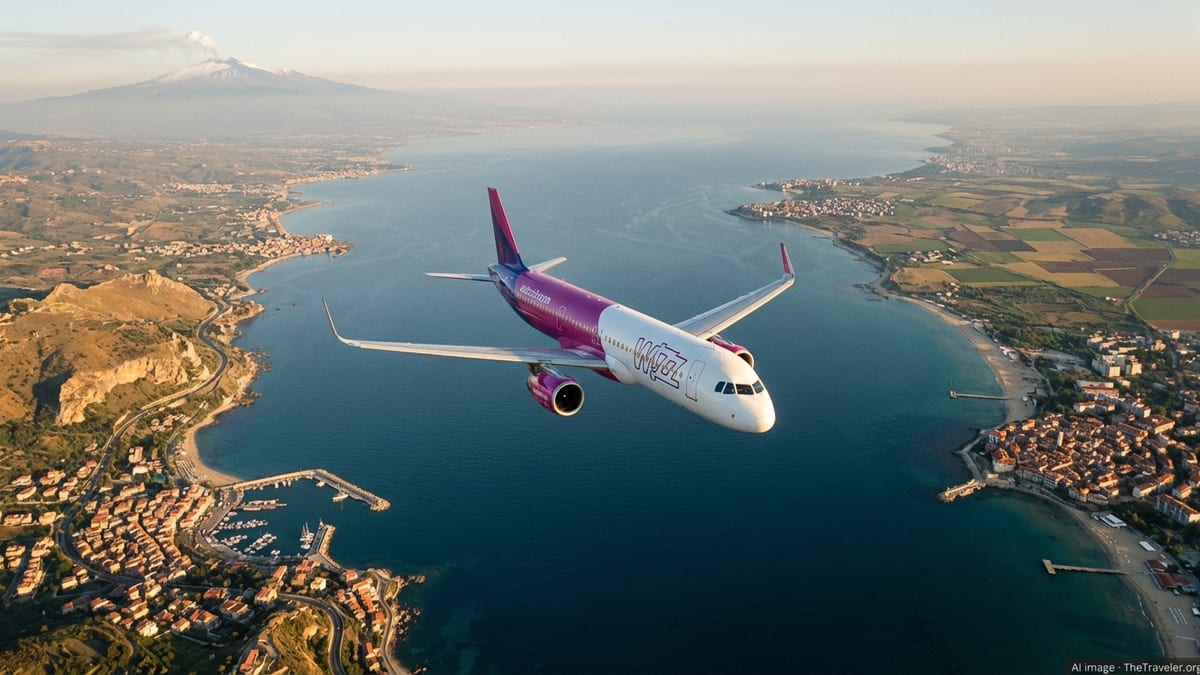
Wizz Air’s 2026 Pivot: Sicily and Bulgaria at the Center
For summer 2026, Wizz Air is concentrating growth on two markets that rarely shared the spotlight in European aviation strategy: Sicily and Bulgaria. The airline’s latest schedule announcements reveal a clear bet that these regions will become high-volume leisure gateways, supported by low fares and dense networks of short- and medium-haul routes.
In Bulgaria, Wizz Air plans to base an eighth aircraft at Sofia Airport from July 2026, a move that enables five new routes from the capital and higher frequencies on some of its most popular services. Across the Black Sea coast, Varna gains additional links and capacity, while new seasonal services to Spain, Greece, Poland, Cyprus and Hungary broaden Bulgaria’s reach into core European tourism corridors.
In parallel, Sicily is being reinforced as a Mediterranean bridge. New connectivity between Palermo and Sofia, additional aircraft based at Catania, and fresh routes linking Catania with Balkan capitals such as Tirana and Podgorica, will allow travelers to use the island as a hub for multi-stop itineraries that combine beaches, heritage cities and lesser-known Eastern European destinations.
The result is a 2026 network where Sicily and Bulgaria are no longer peripheral choices, but central nodes that can anchor entire vacation plans, particularly for price-sensitive travelers seeking to string together two or more countries on a single trip.
New Sofia and Varna Routes That Change the Map
The most visible transformation in Bulgaria comes in Sofia, where Wizz Air’s decision to base an additional Airbus A321neo underpins a major leap in capacity. From summer 2026, the carrier is adding five routes from the capital to Budapest, Palermo, Rhodes, Hurghada and Sharm El Sheikh, while boosting frequencies on established city-break and sun routes such as Prague, Madrid, Rome, Málaga, Valencia, Basel, Alghero, Lamezia Terme, Warsaw and Tel Aviv.
Alongside the base expansion, Wizz Air is rolling out three new seasonal services from Bulgaria for summer 2026: Sofia to Santander in northern Spain, Sofia to Corfu in Greece and Varna to Katowice in Poland. These routes, scheduled to start between March and June 2026, are operated twice weekly and priced as low-cost leisure links, designed to stimulate both outbound tourism from Bulgaria and inbound traffic from Western and Central Europe.
Varna’s role is also shifting from purely seasonal beach gateway to a more diversified regional hub. In addition to the Varna–Katowice connection, Wizz Air is introducing new routes to Larnaca and Budapest and has recently reinforced its base at the airport with a second aircraft. That move has already translated into more frequent flights to existing destinations and the resumption of several suspended routes, indicating confidence in Varna’s year-round demand.
For travelers, this combination of an expanded Sofia base and a stronger Varna operation means more options to mix city breaks, coastal escapes and cultural itineraries, all bookable within the same low-cost platform and aircraft type.
Sicily Turns into a Mediterranean and Balkan Bridge
On the Italian side of the network, Wizz Air is leveraging Sicily to deepen its Mediterranean presence and forge new links into the Balkans. The airline is adding a third aircraft to its base in Catania from May 2026, an upgrade that enables fresh services from Catania to Tirana and Podgorica, alongside other regional growth. These routes position Sicily not only as a destination in its own right, but as a stepping stone between Italy and southeastern Europe.
Palermo, long overshadowed by larger Italian hubs, features prominently in the 2026 expansion as the endpoint of a new Sofia–Palermo connection. This route is expected to attract both Bulgarian holidaymakers drawn to Sicily’s beaches and historical cities, and Italians interested in affordable access to the Bulgarian capital and onward links to Spain, Israel, Central Europe and the Eastern Mediterranean via Wizz Air’s broader Sofia network.
These additions build on a wider trend of growing capacity into Sicily from across Europe and North America. While full-service carriers have recently launched new nonstop services from the United States to Palermo and Catania, Wizz Air’s low-cost strategy focuses on stitching Sicily more tightly into the intra-European leisure grid, particularly across secondary cities that previously required a change of aircraft in Rome or Milan.
For vacation planners, this effectively turns Sicily into an interchange point. Travelers can arrive on a long-haul or regional flight, then connect on Wizz Air’s network to explore Albania, Montenegro, Bulgaria or Greece, often at price points that make add-on trips feasible even for budget-conscious families or young travelers.
Lower Fares, Denser Networks and the A321neo Effect
Behind the headlines about new routes sits a quieter but critical part of the story: aircraft choice. Wizz Air operates its Bulgarian expansion and most new 2026 services with Airbus A321neo aircraft, a stretched, latest-generation narrowbody that offers around 20 percent lower fuel burn and carbon emissions compared with previous models, alongside high seat density.
The economics of the A321neo allow Wizz Air to offer entry-level fares starting under the equivalent of 40 euros on some new Bulgarian routes while maintaining an ultra-low-cost structure. For passengers, that often translates into genuinely affordable point-to-point travel, particularly on off-peak days and outside school holidays, as long as they are prepared to travel light or accept extra fees for larger bags and seat selection.
In Bulgaria, an 81 percent capacity increase from Sofia compared with summer 2025, combined with new and resumed routes from Varna, will put downward pressure on fares not only at Wizz Air but also among rival carriers competing for similar leisure and visiting-friends-and-relatives traffic. In Sicily, the introduction of an additional based aircraft in Catania and growing competition on routes to and from the island are expected to have a similar effect, especially on shoulder-season prices.
The A321neo’s range also makes longer leisure sectors feasible at low cost, which explains the appearance of routes such as Sofia–Santander in northern Spain and Varna–Larnaca in Cyprus. For travelers, this means that destinations once considered too far for a cheap short break are suddenly within reach of a long weekend itinerary.
What This Means for Your 2026 Itinerary
From a traveler’s point of view, the most immediate impact of Wizz Air’s 2026 moves is the ability to build multi-country holidays around Sicily and Bulgaria without complicated ticketing or expensive connections. A traveler could, for example, fly into Sofia, spend a city break exploring the Bulgarian capital, then continue on a low-cost flight to Palermo for a week in Sicily, before returning via a different Wizz Air route to another European city.
The increased frequencies on routes such as Sofia to Rome, Madrid, Prague or Tel Aviv make it easier to thread together flexible itineraries that respond to changing weather, crowd patterns and fares. Similarly, from Varna, new links to Katowice, Budapest and Larnaca open up combinations that pair the Black Sea coast with Central European cultural hubs or Mediterranean islands in a single trip.
In Sicily, the new web of connections means that travelers can treat Catania or Palermo as jumping-off points for side trips to the Balkans, Greece or Bulgaria rather than as endpoints. Linking Catania with Tirana and Podgorica, in particular, creates opportunities to combine well-known destinations such as Taormina or Cefalù with emerging city-break favorites in Albania and Montenegro, all within flight times of around an hour or two.
For Americans and other long-haul visitors arriving on full-service carriers, these low-cost add-ons offer a way to deepen their time in the region. A transatlantic flight to Sicily can now be the start of a circular route that loops through the Balkans and back to Italy, with Wizz Air covering the regional hops at relatively low cost.
Tourism, Local Economies and the New Leisure Geography
For tourism boards and local economies, Wizz Air’s 2026 expansion is more than just new dots on a route map. Increased connectivity typically leads to higher visitor numbers, longer stays and broader spending patterns, especially when low-cost carriers link secondary cities that previously had only limited international flights. In Bulgaria, additional direct links from Sofia and Varna to Spain, Greece, Poland, Cyprus and Italy are expected to spread tourist flows more evenly across the year and across different regions.
In Sicily, the strengthening of routes to Central and Eastern Europe aligns with the island’s efforts to diversify its visitor base beyond traditional markets such as Germany and the United Kingdom. New connections from cities like Sofia, Tirana and Podgorica can drive a rise in shorter, more frequent visits, as well as create opportunities for cultural, educational and sports exchanges.
There are wider economic effects too. Airline base expansions typically mean more local jobs in ground handling, maintenance and airport services, as well as increased demand for hotel beds, restaurant capacity and tourism-related services. The positioning of Sofia and Catania as growing Wizz Air bases suggests that both airports will play a growing role in regional air traffic flows over the next few years.
At the same time, the concentration of growth in leisure markets such as Rhodes, Hurghada, Sharm El Sheikh, Santander and Corfu reinforces a broader shift in European aviation toward holiday-driven capacity. For travelers, this means more options to reach sun destinations directly, but also a need to plan carefully around peak-season congestion at airports and popular resorts.
How to Take Advantage: Booking, Timing and Risks
For those planning 2026 vacations, the new Wizz Air routes to and from Sicily and Bulgaria reward early, flexible booking strategies. Low introductory fares on new services such as Sofia–Santander or Varna–Katowice are typically limited and most plentiful several months before departure. Midweek departures, shoulder-season travel in late spring and early autumn, and hand-luggage-only bookings will usually yield the lowest total trip costs.
Travelers should also pay attention to the operational realities of rapid expansion. Industry analysts have pointed out that when low-cost carriers ramp up capacity quickly, maintaining on-time performance and handling disruptions becomes more challenging. Building in buffer time between interline or self-connecting flights, especially when using Sicily or Sofia as a bridge between separate itineraries, can reduce the risk of missed onward travel.
Wizz Air continues to operate under an ultra-low-cost model, which means that optional extras such as hold baggage, seat selection and priority boarding can significantly increase the final price. Comparing total trip costs across airlines, rather than just base fares, remains essential, particularly on overlapping routes where national carriers or rival low-cost airlines still compete.
Nonetheless, for travelers willing to embrace low-cost conditions, Wizz Air’s 2026 expansion is likely to deliver more choice and sharper pricing across a growing slice of the European leisure market. Sicily and Bulgaria, once considered niche or second-tier gateways, are emerging as smart anchor points for ambitious, budget-friendly summer itineraries.