

More news on this day
Air travel across France faced fresh disruption today as more than 340 flights were delayed and at least 10 cancelled at the key hubs of Paris, Nice and Lyon, tangling schedules for Air France, Vueling Airlines, easyJet, Transavia France, Air Algérie, Tunisair and several other carriers.
Get the latest news straight to your inbox!
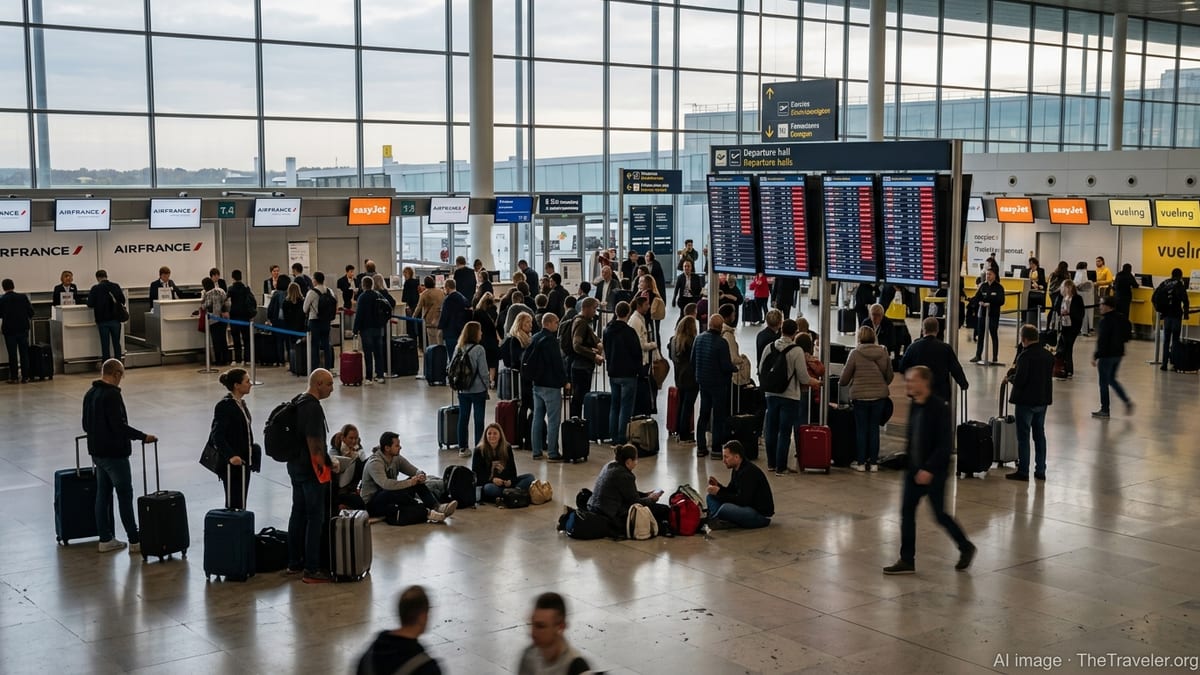
Delays Mount at Paris, Nice and Lyon
Operational data from major tracking platforms on March 28 2026 indicate that Paris Charles de Gaulle and Paris Orly together accounted for the largest share of disruptions, with additional knock-on delays reported at Nice Côte d’Azur and Lyon Saint-Exupéry airports. Across the four facilities, more than 340 arrivals and departures ran late while at least 10 services were cancelled outright, forcing thousands of passengers to rebook or wait out extended ground holds.
Reports show Air France bore a significant portion of the schedule strain at its Paris bases, while low cost operators including Vueling Airlines, easyJet and Transavia France faced clusters of delayed departures during the busiest morning and late afternoon waves. Regional and leisure links between France, North Africa and southern Europe were notably affected, with Air Algérie and Tunisair among the airlines experiencing timetable slippage.
The disruption occurred against a backdrop of already high traffic volumes at the end of March, a period when European network reports have highlighted rising congestion and tighter margins for delay recovery across the continent. For passengers booked on connecting itineraries through Paris, short minimum connection times left limited room to absorb longer ground or air traffic management holds.
While most flights eventually operated, the concentration of delays at a handful of major hubs created visible bottlenecks in terminal departure areas, where crowds formed around information screens and service desks as rolling estimated departure times were updated.
Airlines and Routes Most Affected
According to live timetable snapshots, Air France experienced widespread schedule stretching on short and medium haul services within Europe and to North Africa, particularly on routes linking Paris with Nice, Lyon, Marseille and Toulouse, as well as flights to Algiers, Tunis and Casablanca. Several rotations departed more than an hour behind schedule, compressing aircraft turnaround times for subsequent sectors.
Vueling Airlines and easyJet, both with sizable operations at Paris Orly and Nice, also recorded waves of late departures across popular city pairings such as Paris to Barcelona, Rome and Madrid and Nice to London and Geneva. For these carriers, a delay on an early sector often propagated through the day as aircraft cycled between bases around the network.
Transavia France, which focuses heavily on leisure destinations from Paris Orly and regional French airports, saw disruption on services to the Mediterranean basin and the Canary Islands. Publicly available flight boards showed multiple departures pushed back by 30 minutes or more, with some northbound returns arriving in France late into the evening.
Air Algérie and Tunisair, linking French cities with Algiers, Oran, Tunis and other points in the Maghreb, were affected both by congestion at French airports and by the wider pressures on southbound and northbound traffic flows. Passengers on these services faced extended gate holds, occasional aircraft changes and, in a small number of cases, cancellations requiring rebooking on later flights.
Operational and Network Pressures Behind the Disruption
Network operations documents for recent months have highlighted how French airspace and airport capacity constraints can quickly amplify local issues into broader regional delays. European air traffic management reports point to France as a recurring hotspot for en route and airport flow restrictions on busy days, which in turn drive average arrival delays sharply higher when compared with normal operations.
Even in the absence of a headline industrial action or major weather event, a combination of high traffic demand, sector capacity limits and minor technical or staffing constraints can trigger a cascade of small slot restrictions and ground holds. When these take effect at multiple airports simultaneously, as observed today at Paris, Nice and Lyon, punctuality deteriorates and airlines have limited room to recover their schedules.
Carriers operating dense short haul networks are particularly exposed because their aircraft often complete several sectors per day. A delay of 40 minutes on a morning departure from Paris can echo through three or four subsequent flights, affecting passengers far from the original point of disruption. With many European fleets tightly scheduled at the end of the winter season, spare aircraft and crew to absorb these shocks are in short supply.
Industry analyses have also noted that the ongoing implementation of new air traffic management systems and airspace reconfigurations in parts of France can temporarily reduce capacity as controllers adapt to updated procedures. While intended to improve long term efficiency, these transitions can coincide with days of heavier than expected demand, leaving little slack in the system.
Impact on Travellers and Passenger Rights
For travellers caught up in today’s disruption, the most immediate impacts were missed connections, extended waits at gates and the need to rearrange ground transport or accommodation plans. At Paris Charles de Gaulle, some connecting passengers arriving from long haul services reported very tight margins to reach onward European flights, with late inbound aircraft compressing already short transfer windows.
Those facing cancellations or severe delays on flights departing from French airports or operated by European Union carriers may be protected under Regulation EC 261/2004, the EU regime that defines compensation and assistance rules when services are cancelled, heavily delayed or overbooked. Public guidance on the regulation notes that passengers can, under certain conditions, be entitled to meals, refreshments, hotel accommodation and financial compensation depending on the length of delay, distance flown and cause of the disruption.
Consumer advocates regularly advise affected passengers to retain boarding passes, booking confirmations and any written disruption notices, as these documents can support later claims. When delays stretch past several hours, travellers are encouraged to document expenses such as meals and local transport in case reimbursement is available under airline policies or applicable regulations.
Travel forums and passenger rights groups often highlight that compensation rights may differ if a delay is attributed to extraordinary circumstances such as severe weather, airspace closures or certain air traffic control restrictions. In more routine operational cases linked to airline scheduling or resourcing, however, the threshold for potential compensation is typically lower.
What Travellers Can Do if Flying Through France
With French hubs handling a large share of Europe’s connecting traffic, today’s disruptions offer a reminder that travellers transiting Paris, Nice or Lyon benefit from building additional time into tight itineraries. Travel advisers frequently recommend allowing longer connection windows when routing through busier hubs or during periods of known operational strain, such as late March and the early summer build up.
Passengers due to fly later in the day or evening are encouraged to monitor airline apps and airport departure boards closely, as same day schedule changes can propagate through the network. Rebooking options are often more flexible when travellers act early, while more seats tend to be available before disruption peaks and multiple flights begin to run late.
Experts in passenger rights suggest that anyone whose plans were disrupted should review both the operating carrier’s conditions of carriage and relevant regulations such as EC 261/2004 to understand what assistance they might claim. In many cases airlines provide online forms for post travel claims covering delays, cancellations and incidental expenses.
For now, published operational data indicate that flights at French airports continue to operate under strain, with residual delays expected into the evening. Travellers with imminent departures from Paris, Nice or Lyon are advised to arrive early, stay informed through official airline communication channels and prepare for the possibility of extended waits before takeoff.