

More news on this day
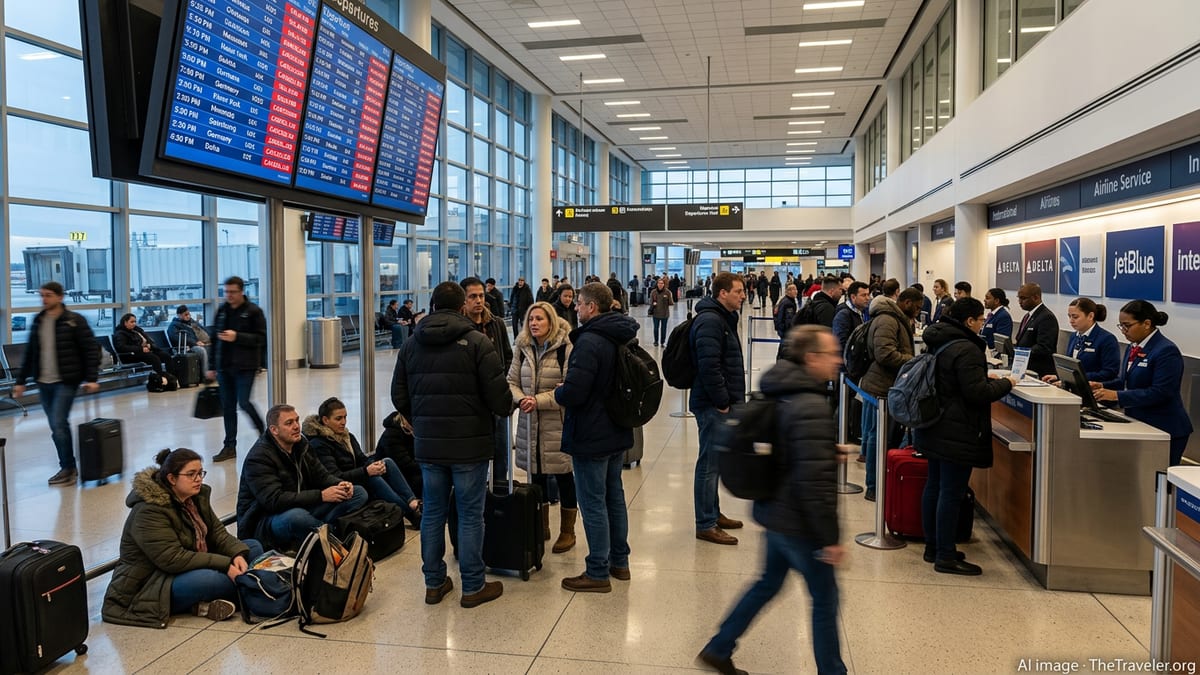
Travelers at New York’s John F. Kennedy International Airport faced a chaotic day of air travel as 22 flight cancellations and 323 delays rippled across Delta, JetBlue, Lufthansa, American Airlines, Aer Lingus and other major carriers, disrupting journeys to and from key hubs in the United States, Germany, Qatar and other international destinations.
Get the latest news straight to your inbox!
Major Disruptions Across Domestic and International Routes
The latest wave of disruptions at JFK affected a broad mix of domestic and long-haul international services, according to live flight-tracking data and airport operations reports. Departures and arrivals to major U.S. cities, including Atlanta, Chicago, Los Angeles and Boston, were among those hit, creating knock-on effects throughout airline networks and leaving aircraft and crews out of position for subsequent flights.
Transatlantic and transcontinental services were particularly strained. Flights to Germany, including key Lufthansa services to Frankfurt and Munich, saw extended delays as weather and congestion along the U.S. East Coast forced ground stops and flow restrictions. Connections onward to European and Middle Eastern destinations, including Qatar’s Doha hub, were jeopardized for many passengers who suddenly faced missed onward flights and unplanned overnight stays.
At the terminal level, departure boards at JFK cycled through a near-constant churn of revised times for much of the day. Some flights posted multiple successive delay increments before ultimately departing, while others were cancelled outright with only a few hours’ notice, leaving passengers scrambling to rebook as seats on remaining services quickly filled.
Delta, JetBlue, American and Partners Under Pressure
Delta Air Lines, a major JFK operator with extensive domestic and transatlantic schedules, experienced a series of rolling delays as aircraft arriving late from other parts of the country cascaded into later departures from New York. Travelers bound for key hubs such as Atlanta and Detroit reported holding at the gate while ground crews waited for connecting passengers and final maintenance checks on aircraft operating beyond their originally scheduled turn times.
JetBlue, which maintains a significant presence at JFK, also faced operational headwinds. The carrier’s high-frequency shuttle-style routes to Florida and the West Coast left little slack to absorb lengthy delays, and passengers transiting through New York on multi-leg itineraries found themselves particularly vulnerable when earlier flights in the chain encountered weather or congestion.
American Airlines and its alliance and codeshare partners, including oneworld and transatlantic joint venture carriers, were similarly affected. As departure banks backed up, agents worked to prioritize rebooking for passengers facing international connections, especially those continuing on to European gateways and beyond. Limited remaining seat availability on peak-time flights meant many travelers were re-accommodated on overnight or next-day departures.
Aer Lingus, which connects JFK with Ireland and onward European destinations, joined the list of carriers grappling with squeezed schedules. Its customers faced especially complex rebooking scenarios when tight connections in Dublin or other European hubs could not be maintained once their New York departures slipped beyond critical cutoff times.
Ripple Effects Felt in Germany, Qatar and Major U.S. Cities
The cancellations and delays at JFK did not remain a local problem for long. Flights touching the New York hub feed into global networks, and disruptions quickly spread along those routes. Lufthansa customers connecting through Frankfurt and Munich, for example, reported concerns about missing onward flights into smaller German and European cities when their inbound JFK legs departed late.
Passengers booked on itineraries involving Qatar Airways’ Doha hub also faced uncertainty. Long-haul flights operate on tightly coordinated schedules designed to synchronize with banked connections to Asia, Africa and the Middle East. Missed connections in Doha can mean long layovers and significant itinerary changes, and some travelers chose to seek rerouting options through alternative European or U.S. gateways rather than risk incomplete journeys.
Within the United States, the effect was most visible at large domestic hubs and popular leisure destinations. Airports such as Atlanta, Chicago, Orlando and Los Angeles received delayed arrivals from New York that then departed late on subsequent legs. For travelers originating far from New York but relying on aircraft arriving from JFK, the disruption could come as an unwelcome surprise with little obvious connection to conditions at their home airports.
The cumulative impact of 22 cancellations and more than 300 delays meant that even airports not directly linked to JFK by nonstop service could feel secondary effects as airlines shuffled aircraft, crews and spare capacity across their networks to restore some measure of stability.
Passenger Frustration Mounts Amid Long Waits and Missed Plans
For travelers caught in the disruption, frustration grew as the day wore on. Lines at airline service counters and customer assistance kiosks stretched down concourses, with many passengers simultaneously trying to rebook at the desk and on carrier apps that at times struggled to keep pace with rapidly changing seat availability.
Business travelers cited missed meetings and conferences in major cities from Frankfurt to Chicago, while leisure passengers described lost vacation days, missed cruise departures and last-minute changes to hotel and rental car bookings. Families with young children and elderly travelers faced some of the greatest challenges, particularly when rebooked itineraries involved overnight connections or early-morning departures requiring quick turnarounds.
Customer service agents reported fielding repeated questions about compensation, meal vouchers and hotel arrangements. Policies varied between carriers and depended on whether delays were attributed to weather, air-traffic control constraints or airline-controlled operational issues. While some travelers received hotel and meal support, others were left to make their own arrangements, leading to uneven experiences among passengers affected by similar disruptions.
At the gates, announcements encouraged travelers to keep contact details updated and to monitor mobile notifications closely, as last-minute seat openings and rebooking opportunities sometimes appeared only briefly before being reassigned. For some passengers, persistence in refreshing airline apps or circling back to different service points at the airport made the difference between same-day and next-day departures.
Advice for Travelers Facing Future Irregular Operations
The latest round of cancellations and delays at JFK underscores how quickly irregular operations can spread across airline networks, particularly at large coastal hubs that handle a mix of domestic and long-haul flying. Travel experts recommend building additional buffer time into itineraries that rely on tight international connections, especially during seasons when weather or congestion are more likely.
Passengers are also encouraged to check flight status frequently on the day of departure, beginning several hours before leaving for the airport. When disruptions appear likely, contacting the airline through multiple channels, including apps, phone support and social media, can sometimes yield faster rebooking than waiting in line at a single service desk at the terminal.
Where itineraries involve critical events, such as cruise departures or important business commitments, many advisors suggest arriving at the departure city at least a day early when possible. Although this adds to the cost and time of travel, it can provide a valuable cushion if the initial flight segment experiences significant delay or cancellation.
For the hundreds of passengers affected at JFK, the immediate priority remains getting to their destinations, even if a day or more behind schedule. As airlines gradually work through the backlog created by the 22 cancelled flights and more than 300 delays, operations are expected to normalize, but travelers across the United States, Germany, Qatar and other linked markets will continue to feel the aftershocks in the days ahead.