

More news on this day
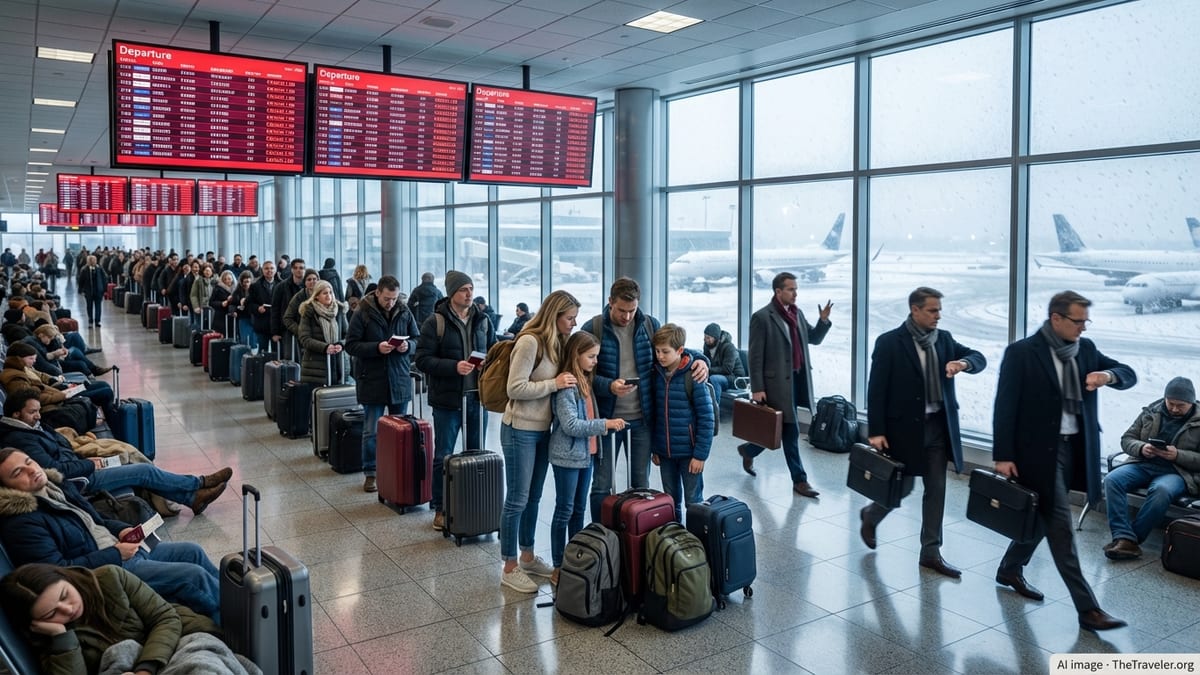
Hundreds of airline passengers were left stranded at Chicago O’Hare International Airport over the busy early April travel period as 447 flights were delayed and 11 canceled, disrupting major domestic and international routes operated by United Airlines, American Airlines, Delta Air Lines and other carriers to cities including New York and Los Angeles.
Get the latest news straight to your inbox!
Stormy Skies and a Saturated System Converge at O’Hare
The latest disruption at Chicago O’Hare unfolded against a backdrop of intense spring weather that has battered large swaths of the United States in recent days. Publicly available flight-tracking data for the Easter travel window show that squall lines, thunderstorms and low clouds repeatedly triggered ground-delay programs across the Midwest, slowing traffic into one of the country’s busiest hubs.
At O’Hare, that translated into 447 delayed flights and 11 outright cancellations within a single reporting window, according to aggregated figures from flight-status portals monitored on April 5 and April 6. Although those numbers represent only a slice of the wider Easter-period chaos seen nationwide, they were enough to bring departure boards in several O’Hare terminals close to saturation with yellow “delayed” markers.
Travel-industry analyses compiled over the weekend indicate that the operational strain did not originate with any one airline. United Airlines and American Airlines, which both use O’Hare as a major hub, were heavily affected, but flights operated by Delta and several low-cost and regional carriers also recorded knock-on delays as weather systems moved east and aircraft arrived late from previous trips.
The pressure on the system has been magnified by near-record passenger volumes this spring. Trade-group projections for the March to April period point to tens of millions more travelers than in recent years, leaving less slack in schedules and aircraft rotations when storms or congestion hit a large hub such as Chicago.
Domestic and Transcontinental Routes to New York and Los Angeles Hit Hard
The disruption at O’Hare quickly rippled along some of the country’s most heavily traveled corridors. Flight-status snapshots taken during the height of the delays show dozens of affected departures and arrivals on routes linking Chicago with New York area airports and Los Angeles, two markets that already operate at tight utilization under normal conditions.
Multiple O’Hare services to New York’s LaGuardia and John F. Kennedy airports, as well as Newark Liberty, recorded extended hold times at the gate or on the tarmac. Similar patterns appeared on transcontinental flights to Los Angeles International Airport, where late-arriving aircraft from Chicago forced subsequent rotations to depart behind schedule and, in a small number of cases, to be canceled entirely.
Because many of these flights act as feeders for onward international connections, the disruption did not stop on the coasts. Publicly available information from airline schedules and tracking platforms indicates that long-haul services to Europe and Asia left with large numbers of misconnected passengers, or in some cases waited on the ground while airlines rebooked travelers arriving late from Chicago.
This web of dependencies is a hallmark of the hub-and-spoke model that dominates U.S. air travel. When a central node such as O’Hare experiences a few hundred delays in rapid succession, aircraft and crews that should be moving in a tight sequence across the network instead begin to bunch up, creating rolling problems for hours after the initial weather trigger has passed.
Passenger Impact: Crowded Gates, Long Lines and Missed Connections
For travelers inside the terminals, the statistics translated into scenes of crowded gate areas, lengthening customer-service lines and improvised overnight plans. Reports from passengers on social media platforms throughout the weekend showed families trying to find space on the floor near charging outlets, business travelers rebooking meetings from the concourse, and long queues forming at airline rebooking counters as flights slipped later into the night.
At one point during the disruption, publicly viewable departure boards in O’Hare’s domestic terminals showed more flights marked delayed than on time across several consecutive hours. With only 11 cancellations recorded in the cited reporting window, most travelers did eventually depart, but often after waits that stretched far beyond their original schedules and caused them to miss connections in New York, Los Angeles and other onward hubs.
Travel forums and consumer advocates tracking the situation noted that passengers faced a patchwork of remedies, depending on whether the delay was categorized as weather related or tied to airline-controlled operational issues. In many cases, the initial trigger was adverse weather in the Chicago area or along arrival routes, limiting eligibility for hotel or meal vouchers even as travelers found themselves stuck overnight or pushed to next-day flights.
For international passengers transiting through O’Hare, the timing of delays proved particularly disruptive. Evening departures to Europe and late-night red-eye flights to the West Coast typically have few viable same-day alternatives, leaving those who missed them reliant on space opening up on already crowded services the following day.
Major Carriers Face Renewed Scrutiny of Resilience
The events at O’Hare have added to a growing body of recent data pointing to the vulnerability of the U.S. aviation system when weather collides with constrained capacity. Over the broader Easter period, industry tallies show thousands of delays and hundreds of cancellations nationwide, with Chicago consistently appearing among the most affected hubs.
United Airlines and American Airlines, which route large portions of their domestic and international networks through Chicago, have repeatedly featured in disruption statistics in recent weeks as spring storms have cycled across the central United States. Delta, while less reliant on O’Hare itself, has also seen elevated delays at its own hubs when incoming aircraft from Chicago and other storm-affected cities arrive behind schedule.
Analysts who study airline operations note that carriers now operate with tighter aircraft utilization and leaner staffing than in earlier eras, in part to keep costs down in a competitive market. While efficient under clear skies, this approach can leave airlines with limited flexibility to recover quickly when multiple waves of weather hit key hubs in close succession.
Recent government and academic reviews of aviation performance have highlighted similar patterns, pointing to ground-delay programs, air-traffic-control staffing challenges and congested terminal operations as recurring bottlenecks. The latest O’Hare episode provides another real-time case study of how quickly localized storms can cascade into a nationwide network event when those structural pressures are already present.
What the Disruption Signals for the Months Ahead
The timing of the O’Hare disruption has raised concerns about how the system will cope with even heavier traffic in the upcoming summer peak. Travel organizations are already forecasting record passenger volumes for the June through August period, with leisure and international demand both expected to exceed pre-pandemic levels on many routes.
For airlines, this latest cluster of delays and limited cancellations underscores the importance of building more slack into schedules, expanding the availability of reserve crews and aircraft, and strengthening coordination with air-traffic-control authorities during forecast storm windows. Some carriers have already trimmed marginal flights or adjusted schedule banks at congested hubs in anticipation of continuing volatility.
For passengers, the scenes at Chicago O’Hare serve as another reminder that travel planning in a period of frequent weather disruptions and high demand requires extra buffers. Industry guidance that has emerged from recent events suggests booking longer connection times at major hubs, traveling early in the day when possible, and monitoring flight status closely via airline and airport channels in the 24 hours before departure.
While the 447 delays and 11 cancellations recorded in this latest episode represent only a fraction of U.S. air traffic over the same period, the resulting ripple effects across routes to New York, Los Angeles and beyond illustrate how even a relatively contained disruption at a key hub can upend travel plans for hundreds of passengers in a matter of hours.