

More news on this day
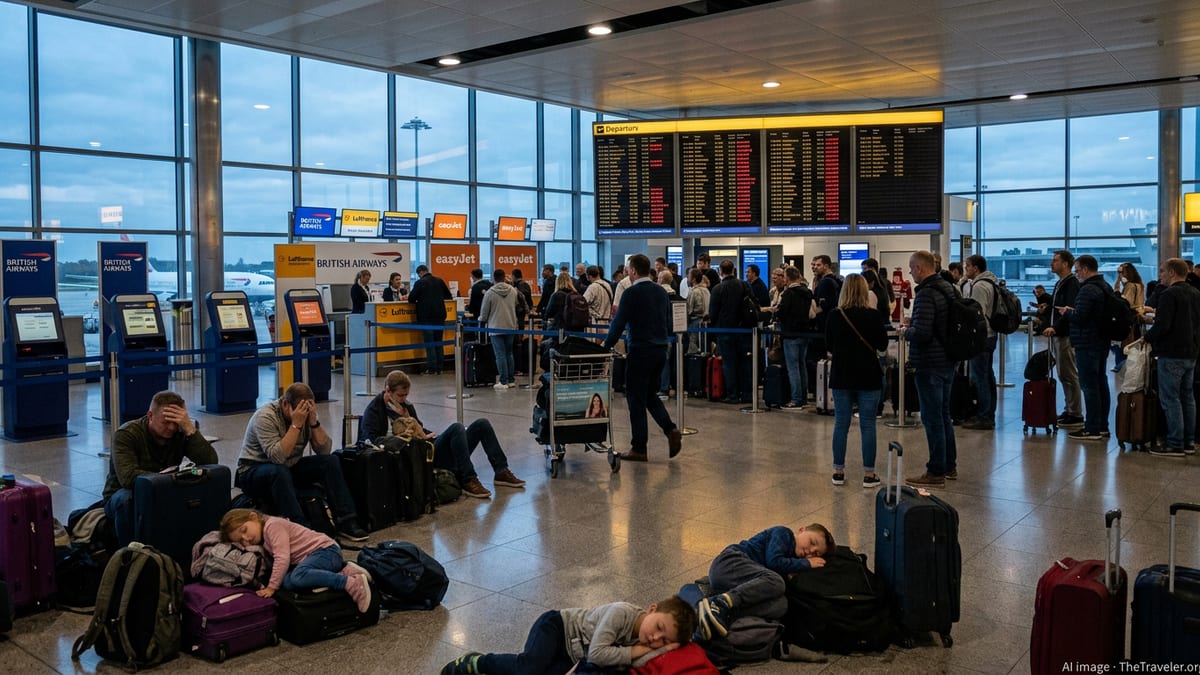
Hundreds of travelers were left sleeping on terminal floors and in departure lounges across Europe on March 11 as a fresh wave of operational disruption saw more than 380 flights delayed and at least 86 cancelled, snarling traffic through major hubs in France, the Netherlands, Belgium, the United Kingdom and beyond.
Get the latest news straight to your inbox!
Major Hubs in France, Netherlands and Belgium Buckle Under Strain
Data from multiple flight-tracking and passenger-rights services on Tuesday pointed to widespread disruption centered on Paris Charles de Gaulle, Amsterdam Schiphol and Brussels, with knock-on effects felt at London Heathrow and other key hubs. In total, airlines across France, the Netherlands, Belgium and neighboring states delayed around 380 flights and cancelled at least 86, leaving aircraft and crews out of position and passengers stuck far from home.
Paris Charles de Gaulle, already grappling with earlier weather and staffing pressures, reported scores of late-running departures and a cluster of cancellations, particularly on medium- and long-haul services. Travelers bound for destinations in the Middle East and Asia were among the hardest hit as airlines reworked schedules to avoid sensitive airspace and accommodate longer detours.
In the Netherlands, Amsterdam Schiphol once again emerged as a flashpoint. The hub has periodically struggled this winter with the twin challenges of adverse weather and tight staffing, producing a fragile operating environment in which even modest disruptions can cascade quickly into large-scale delays. Belgian operations were further complicated by industrial tensions and a national strike call that prompted Brussels Airport to warn of mass cancellations and advise passengers to avoid nonessential travel.
At London Heathrow, one of Europe’s most important long-haul gateways, delays on continental feeder routes compounded the chaos. Late-arriving aircraft from Paris, Amsterdam and Brussels compressed turnaround windows and led to rolling knock-on delays for onward services to North America, the Middle East and Asia.
Finnair, KLM, Eurowings and Others Forced to Trim Schedules
The disruption cut across traditional alliance lines, affecting network carriers and low-cost airlines alike. KLM, Finnair and Eurowings were among the European operators reporting multiple delayed or cancelled departures as they adjusted to a complex mix of weather, staffing and geopolitical constraints.
KLM, the Dutch arm of the Air France–KLM group, has been particularly exposed. The airline has already cancelled all flights to Dubai until late March as a result of heightened geopolitical risk and airspace restrictions along key corridors, and it has rerouted many remaining long-haul services to avoid overflying parts of the Middle East. Those detours add flight time, consume extra fuel and compress crew duty windows, leaving less flexibility elsewhere in the network when problems arise.
Finnair, whose Helsinki hub depends heavily on east–west traffic flows to and from Asia, has also been forced to pare back schedules and reconfigure routings. Longer flight paths and tighter crew rosters mean that any delay on morning departures can ripple throughout the day, contributing to late-evening cancellations that strand passengers overnight in European capitals.
Within the Lufthansa Group, Eurowings has faced its own set of challenges, particularly on intra-European routes feeding into congested hubs in Germany, France and the Benelux region. Operational data indicated clusters of delays on routes linking Düsseldorf and Cologne to Paris, Amsterdam and London, adding to the pool of disrupted travelers and further straining airport resources.
Geopolitical Tensions and Weather Create a Perfect Storm
Industry analysts say the latest wave of disruption is the result of an unfortunate convergence of factors rather than a single failure point. Unsettled weather systems sweeping across Western Europe have periodically forced ground stops, runway capacity reductions and de-icing delays, particularly at coastal hubs such as Paris and Amsterdam. Even when conditions improve, the backlog of aircraft waiting for slots can take hours to unwind.
At the same time, ongoing instability in the Middle East has redrawn the map of available airspace for many long-haul flights linking Europe with the Gulf region, South Asia and parts of East Asia. Airlines including KLM, Lufthansa Group carriers and Gulf-based operators have had to suspend certain routes and replan others along more northerly or southerly tracks, increasing block times and adding complexity to crew scheduling.
These reroutes are also feeding into congestion at already-busy European hubs, as flights arrive off-slot and compete for limited stands and gates. Airport operators in Paris, London and Amsterdam report that late-evening peaks have become especially difficult to manage, with ground handling teams and immigration queues stretched by waves of delayed arrivals landing in quick succession.
Compounding the issue is a lingering shortage of skilled staff in key operational roles, from air traffic controllers to ground handlers. While airlines and airports ramped up hiring in 2025, many remain short of pre-pandemic headcount, reducing the system’s resilience when bad weather or airspace closures strike.
Passengers Face Long Queues, Thin Information and Scramble for Beds
For passengers, the statistics translate into very tangible frustration. At Paris Charles de Gaulle and Amsterdam Schiphol, travelers reported overnight queues at airline service desks, long waits to retrieve checked baggage from cancelled flights and a rush on the limited supply of airport hotel rooms. Social media posts from London, Brussels and regional airports in France and the Netherlands showed families stretched out on terminal floors using coats and carry-on bags as makeshift bedding.
Many stranded travelers complained of sparse or conflicting information, with airport display boards showing flights as delayed long after airlines had already scrubbed them from the schedule. Others reported that call centers were overwhelmed, leaving customers on hold for hours while available rebooking options dwindled.
Faced with uncertainty, some passengers turned to overland alternatives, booking last-minute train tickets between Paris, Brussels, Amsterdam and London in hopes of salvaging their journeys. However, peak-season rail services also filled quickly, especially on cross-Channel and high-speed routes, limiting options for those attempting to piece together complex rerouting on their own.
Travelers caught overnight in unfamiliar cities encountered a familiar secondary problem: limited and increasingly expensive hotel inventory near major airports. As the evening disruption wore on, room rates climbed sharply and availability around major hubs disappeared, forcing some passengers to stay in remote suburbs or remain in the terminal.
EU261 Rights and Practical Advice for Impacted Travelers
With delays and cancellations mounting, passenger-rights experts are urging affected travelers to document their situation carefully and to assert their entitlements under European Union rules. Under Regulation EC 261/2004, many passengers departing from or arriving in the EU, or flying on EU-based airlines such as KLM, Finnair and Eurowings, may be eligible for compensation if their flight arrives more than three hours late or is cancelled at short notice, provided the airline is deemed responsible for the disruption.
The picture is complex, however. Airlines can avoid paying compensation if they can show that extraordinary circumstances outside their control, such as severe weather or sudden airspace closures, were the primary cause of the disruption. Even in those cases, carriers must still provide what EU law calls a duty of care, which includes meals, refreshments, hotel accommodation when necessary and transport between the airport and place of lodging.
Specialists recommend that stranded passengers keep boarding passes, booking confirmations, meal and hotel receipts, as well as screenshots of airline communications and departure boards. These can help substantiate later claims or complaints. Submitting a claim directly to the airline is usually the first step, though some travelers may choose to use third-party claims firms or seek advice from national consumer protection agencies if they encounter difficulties.
For those yet to travel, consumer advocates suggest building extra buffer time into itineraries, especially when connecting through Paris, Amsterdam, Brussels or London, and considering flexible tickets where possible. With underlying pressures on Europe’s air transport network showing little sign of immediate relief, passengers may continue to face periodic bouts of disruption in the weeks ahead.