


Hurghada offers the bigger tourism machine, easier airport access and the widest range of excursions on Egypt’s Red Sea coast, while Marsa Alam tends to attract travelers who prefer quieter resorts built directly on substantial house reefs. For snorkelers, though, the real choice is less about city name and more about the exact bay, reef plateau and hotel you pick. Within both regions you will find superb coral, average coral and places where the reef has clearly suffered, often just a few kilometres apart.
Get the latest updates straight to your inbox!
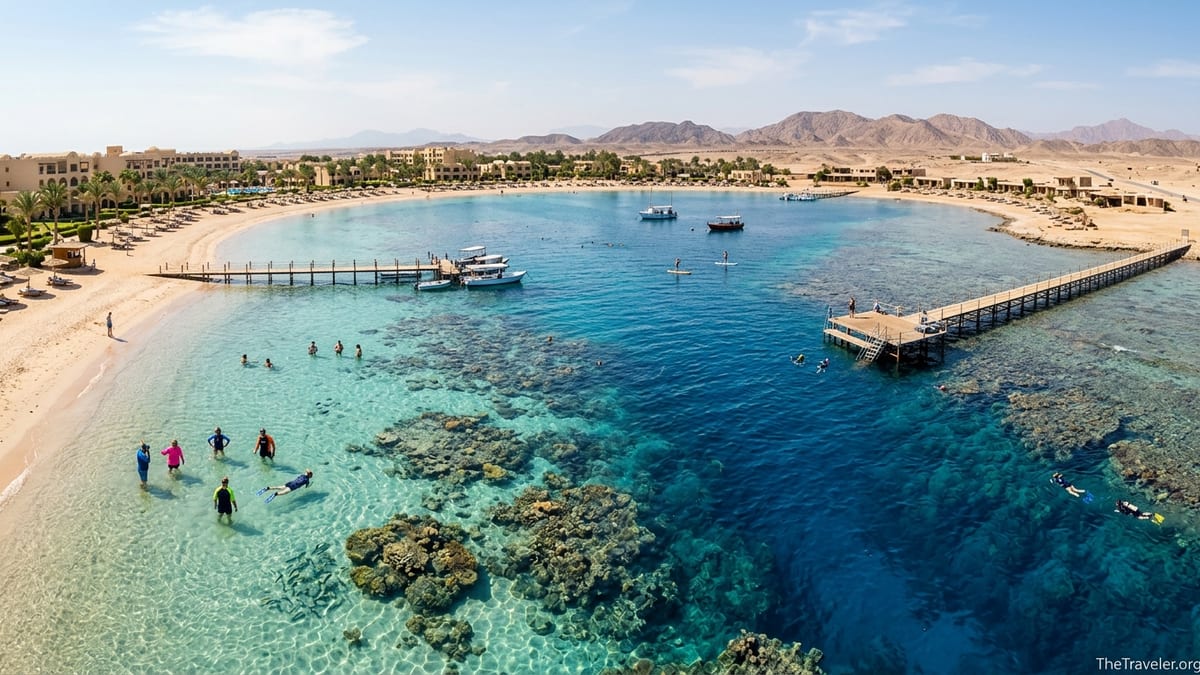
Why the Resort and Bay Matter More Than the Postcode
The online debate about Hurghada versus Marsa Alam often sounds like every reef near Marsa Alam is pristine while everything around Hurghada is crowded or damaged. In reality, both coasts are long, varied and heavily dependent on local geography. A family staying at a sheltered bay in Makadi or Sahl Hasheesh can enjoy calm, clear lagoons with healthy coral gardens that look nothing like the busier public beaches in central Hurghada. Likewise, not every hotel marketed as “Marsa Alam” sits on a perfect drop-off. Some properties there front shallow seagrass or rock ledges with only modest coral, and rely on daily buses or boat trips to reach the area’s headline bays and offshore reefs.
Choosing a snorkeling base on either coast therefore starts with bay shape and reef layout. You are looking for a gently curving, semi-enclosed bay if you want protection from wind and waves, or an outer-reef setting with a long jetty if you are a confident swimmer who wants immediate access to deeper coral walls. Hotel marketing often conflates the two. A “private beach” might be a sandy lagoon with excellent conditions for children but little coral, or it might be a narrow ribbon of sand in front of a fringing reef that requires strong swimming to reach the drop-off. Studying satellite imagery and recent traveler photos can be more revealing than a resort’s own description.
There is also a difference between a true house reef and a resort that simply lies near good boat sites. In Marsa Alam, specialist dive resorts such as Marsa Shagra and Marsa Nakari are built around 24-hour access to named bays that can be entered directly from shore, with coral starting only a few metres out. In the wider Hurghada area, many large hotels instead focus on pools and entertainment, leaving the very best reefs to boat excursions around the Giftun Islands or offshore pinnacles. Neither model is inherently better, but they shape how much time you will spend in the water versus on buses or boats.
Reef Access Around Hurghada, Makadi, Sahl Hasheesh, Giftun and Safaga
Central Hurghada itself has a developed seafront where many hotels sit behind marinas and sea walls. Direct beach snorkeling here is limited: large sections have been dredged or sheltered with artificial breakwaters, and the nearest quality reefs usually require a boat, such as the coral gardens and drop-offs around the Giftun Islands. Full-day snorkel boats to Giftun or Orange Bay typically include two or three reef stops plus time on a sandy island beach, with equipment, lunch and hotel transfers bundled into the price. Published 2026 rates from Hurghada operators often range from the equivalent of about 25 to 45 euros per adult, with some tours adding a small cash national-park fee on board.
South of the city, Sahl Hasheesh and Makadi Bay change the picture. Sahl Hasheesh is a planned bay resort area about 18 kilometres south of Hurghada International Airport, with several hotels fronting shallow reef plateaus and sandy entries. Here, access is usually from the beach across sand patches or via short jetties over coral heads. Conditions are often suitable for beginners inside the bay, especially on calm mornings, while more confident snorkelers can follow the outer edge of the fringing reef where depth quickly drops and visibility is good. In Makadi Bay, mid-range and upscale family resorts line a protected bay known for clear water and a combination of sand and coral. Guests at properties such as large all inclusive complexes on the north side of the bay often report being able to wade in from sandy sections and then fin over healthy coral gardens only a few minutes from shore, without needing a boat.
Further south again, around Safaga, resorts are more spread out along the coastline. Some sit on broad, sandy beaches with patch reefs a short swim out, while others are adjacent to deeper channels and rely on on-site dive centers and small boats to reach nearby reefs. In this stretch of coast the presence of a jetty usually signals that coral heads come close to shore or that there is a shallow reef flat followed by an abrupt drop-off. For snorkelers this is often ideal, because the jetty provides safe water entry and exit without standing on coral. However, when wind and waves pick up, hotels sometimes close exposed jetties for safety, especially in winter and spring when northerly winds are stronger. In that case, sheltered swim-only areas inside the bay may remain open but will offer less interesting snorkeling.
Marsa Alam’s Bays: Abu Dabbab, Marsa Mubarak, Marsa Shagra and Marsa Nakari
The stretch of Red Sea coast marketed as Marsa Alam runs for well over 100 kilometres, with hotels scattered in clusters rather than concentrated in a single town. Some of the most famous snorkeling places sit to the north of Marsa Alam town, in a series of sandy bays such as Abu Dabbab and Marsa Mubarak. Abu Dabbab is a broad, naturally protected bay where snorkelers enter directly from a long sandy beach and follow seagrass meadows that attract green sea turtles. Coral reefs flank the bay’s northern and southern sides, creating shallow gardens for less confident swimmers while leaving a central channel of sand for families who simply want to paddle and float.
Marsa Mubarak, another bay in the same northern zone, has a similar combination of seagrass and fringing reefs but is generally reported as quieter than Abu Dabbab. Some resorts and excursion operators use small boats or zodiacs to ferry guests from anchored vessels near the bay entrance to the prime snorkeling spots. Once in the water, snorkelers can drift over seagrass in 3 to 10 metres of water with a realistic chance of seeing turtles grazing. Both bays are also known as occasional feeding grounds for dugong. Encounters are genuinely possible but cannot be counted on; local dive centers repeatedly stress that dugong and turtle sightings vary by day and season and that chasing or surrounding the animals is forbidden.
Further south, Marsa Shagra Village and Marsa Nakari operate as dedicated dive and snorkel camps with true house reefs. Guests can walk from shore into named bays where coral starts close in and the reef slopes gently from shallow platforms suitable for less experienced snorkelers to deeper walls beyond 20 metres for divers. Entry is normally from a sandy pocket or a short jetty, and both centers emphasize independent, repeat access to the water rather than relying solely on day boats. Conditions here tend to be quieter than around Hurghada, with fewer boats anchored on any one site, which many underwater photographers and experienced snorkelers value as much as the coral itself.
Coral Condition, Marine Life and Wildlife Encounters
Coral health varies by micro-site along both coasts. Around Hurghada and the Giftun Islands, years of heavy boat traffic and casual visitor behavior have left some shallow plateaus with broken or abraded coral, especially closer to popular sandy island beaches. At the same time, offshore pinnacles and less visited reefs north and south of the main channels can still show vibrant hard corals, clouds of anthias and a wide variety of reef fish. Snorkelers on well-chosen Hurghada trips routinely report seeing clownfish, butterflyfish, goatfish, parrotfish and occasional blue-spotted rays in clear water, with visibility often 20 metres or more when wind is low. Turtles appear regularly but not predictably, and dolphins are more often an opportunistic bonus than a planned encounter.
Marsa Alam’s better-known bays and offshore reefs generally benefit from lower overall visitor density. In Abu Dabbab and Marsa Mubarak the focus is less on large coral structures and more on seagrass meadows frequented by turtles, rays and sometimes dugong, while the bay edges and adjacent offshore reefs offer healthier hard and soft corals. Offshore sites such as the so-called Dolphin House reefs off Marsa Alam are managed as protected areas. Access is controlled through licensed operators, and there are zones where boats and snorkelers must keep out so resting spinner dolphins have undisturbed space. Even in these managed parks, dolphins sometimes keep their distance or are simply not present when boats arrive, so reputable operators frame sightings as a possibility, not a promise.
It is essential to underline that no wildlife encounter can be guaranteed in either destination. Even in spots heavily promoted for a particular species, such as dugong grazing in Marsa Mubarak or turtles near Abu Dabbab, changing currents, food availability and human presence all affect what you will actually see on a given morning. Ethical snorkel briefings now stress staying at least several body lengths from large animals, keeping to the side rather than blocking their paths, and never diving down to touch or ride them. For coral itself, the single most impactful rule is never to stand or rest on the reef: even brief contact can crush delicate structures that took years to grow.
Sea Conditions, Seasons and Safety for Different Skill Levels
The northern Red Sea around Hurghada tends to be a few degrees cooler in winter than the Marsa Alam area, but the difference is modest. Water temperatures around both destinations often hover around 22 to 24 degrees Celsius in mid-winter and climb to the high twenties in summer. Many snorkelers are comfortable in standard swimwear from late spring to early autumn, while a thin wetsuit or shorty is advisable for longer winter sessions. Visibility is usually excellent, although strong wind can stir up surface chop and reduce comfort at exposed sites.
Wind is a key factor along the entire Egyptian Red Sea coast. From roughly November through March, persistent northerly winds are common. In exposed locations this can lead to waves on the reef edge, minor currents running along the drop-off and occasional closure of hotel jetties for safety. When a jetty is closed, resorts typically keep only the most sheltered swim areas open, often inside small lagoons created by breakwaters. These zones are useful for children or nervous swimmers but rarely cover the best coral. Marsa Alam’s semi-enclosed bays like Abu Dabbab are known for offering relatively calm water even on breezier days, making them popular with beginners and families.
For inexperienced snorkelers and young children, sheltered bays with wide sandy entries are the safer and more enjoyable choice in both regions. Places such as Makadi Bay, parts of Sahl Hasheesh and the central sandy sections of Abu Dabbab and Marsa Mubarak allow you to walk into the water, adjust masks in waist-deep sand and then gradually move toward the reef edge. Exposed reefs accessed purely via long jetties, or those on outer headlands with no inner lagoon, are better suited to confident swimmers who are comfortable finning in deeper water and dealing with mild chop. Regardless of destination, basic safety practices apply: using a brightly coloured flotation vest or snorkel jacket if you are not a strong swimmer, avoiding solo snorkeling, and staying alert to current direction relative to your exit point.
Airports, Transfers and the Geography of the Hotel Strips
Hurghada International Airport sits right beside the resort city, and many hotels in the main Hurghada strip are 10 to 25 minutes away by road. Transfers to Makadi Bay and Sahl Hasheesh typically take around 30 to 45 minutes under normal traffic. Safaga hotels are further again, often 60 to 75 minutes from the airport. This compact geography helps keep transfer costs low; shared shuttle transfers are widely included in package deals, and private taxis or prebooked cars inside the Hurghada area are often quoted in the range of the equivalent of 20 to 35 euros per car each way for popular resort clusters, depending on distance and vehicle type.
Marsa Alam International Airport sits in a more sparsely developed stretch of coast, and resorts are dispersed over a long distance north and south. Some hotels lie 10 to 20 minutes from the terminal, while others nearer popular bays such as Abu Dabbab or further north towards Port Ghalib may involve 40 to 60 minutes on the coastal highway. Properties on the southern stretches near Wadi el-Gemal or the dive villages of Marsa Shagra and Marsa Nakari can require transfers closer to 90 minutes. Package holidays often bundle group transfers, but independent travelers arranging private cars from the airport typically face higher point-to-point prices than around Hurghada because there are fewer flights and less local traffic to amortize costs.
An important practical detail is that many Marsa Alam resorts marketed in international brochures can also be reached from Hurghada Airport, usually by a road journey of three hours or more. Some travelers choose this routing because flights to Hurghada are more frequent from European hubs. In that scenario, transfer costs can become a significant part of the holiday budget unless they are included in a package. For a family of four, a one-way private transfer between Hurghada and the Marsa Alam hotel strip can easily exceed the cost of several local snorkel boat trips, so it is worth comparing package offers carefully.
Resort Types, Sample Prices and the Cost of Boat Trips
Both destinations now offer a mix of large family-friendly all inclusive properties, adults-only resorts and smaller dive-focused accommodations. Around Hurghada, many of the big beach hotels near Makadi Bay and Sahl Hasheesh cater to families with multiple pools, slides and kids’ clubs, while also providing access to patch reefs or short jetties for casual snorkeling. As of late 2026, published sample rates for mid-range all inclusive resorts in these areas in shoulder seasons such as April or October commonly fall somewhere in the equivalent of 120 to 200 euros per night for a double room, with higher prices in school holidays. Central Hurghada hotels without strong house reefs can be cheaper, especially those a street or two back from the water.
In Marsa Alam, there is a clearer separation between family-oriented all inclusives and dive villages built around house reefs. Northern-bay properties near Abu Dabbab and Marsa Mubarak offer classic resort amenities combined with shore-accessible snorkeling, sometimes at slightly higher nightly rates than comparable inland-facing hotels. Dive-focused operations such as Marsa Shagra Village and Marsa Nakari typically sell package stays that include meals and an allowance of guided or unguided reef access. Recent price lists show wide ranges depending on room type and included diving or snorkeling services, but per-night effective costs for a snorkel-focused guest in a standard room often end up comparable to a good all inclusive resort once the value of unlimited house-reef access is factored in.
For those staying in hotels without a strong house reef, boat trips become a key cost. In Hurghada, full-day shared snorkel excursions to island and reef combinations like Giftun, Orange Bay or similar sites are widely advertised in the 25 to 45 euro bracket per adult including gear, food and soft drinks, with children discounted. Some budget offers undercut this headline price but then add on equipment rental and marine fees at the marina. In Marsa Alam, published prices for full-day snorkeling by boat to bays or offshore reefs around Abu Dabbab, Marsa Mubarak or Dolphin House often sit slightly higher, commonly somewhere from the equivalent of about 40 to 70 euros per adult once transfers from outlying hotels are included. Half-day shore-based trips from Marsa Alam to a single bay can be cheaper in cash terms but still add up over several days.
Equipment rental is another line item. Many day boats in both areas include mask, snorkel and basic fins in the excursion price, while better-quality gear or prescription masks may incur small rental fees. Dive centers that publish public rental lists in the wider region commonly charge around 10 US dollars or the equivalent per day for a full snorkeling set and about half that for mask and fins only. Buying a well-fitting mask and snorkel before you travel is therefore cost-effective for frequent snorkelers, leaving only fin rental or the optional hire of a short wetsuit in cooler months.
Three-Day Snorkeling Itineraries for Hurghada and Marsa Alam
A realistic three-day snorkeling plan near Hurghada might start with a full-day boat trip to the Giftun Islands on day one, including two reef stops and time on a sandy island beach. This gives you a feel for offshore visibility and fish life while a guide helps new snorkelers with equipment and basic techniques. Day two could focus on house-reef time from a hotel in Makadi Bay or Sahl Hasheesh, entering from a sheltered sandy section in the morning and exploring the nearby coral gardens when wind is light. Day three can remain flexible: if the sea is calm, another half-day snorkel boat to a different reef can add variety, while if wind picks up you can stay inside the bay, using the calmer inner water for relaxed floating and fish-watching near the shallows.
In Marsa Alam, a three-day plan built around shore access might base you at or near one of the northern bays. On day one you could join an organized snorkel trip to Abu Dabbab, using the calm, sandy entry to get comfortable and then following a guide along the seagrass and reef edges in search of turtles. Day two could be spent snorkeling the house reef of your own resort or, if staying at a dive village like Marsa Shagra, making repeated short sessions on its north and south reefs as light and tides change. Day three can be left open to either relax or join a boat trip to Marsa Mubarak or a sheltered outer reef if wind and visibility are favorable. Building this margin into the schedule is wise on both coasts, because occasional strong wind days are part of Red Sea travel.
For families and mixed-ability groups, including shore-based days is as important as booking headline boat excursions. Children often tire after 45 minutes in the water, so having a room, restaurant and shaded rest areas a short walk from the entry point makes a big difference compared with being committed to an all-day boat. On the other hand, confident snorkelers may find that at least one day on an offshore reef delivers clearer water and more varied coral than any house reef or bay can offer. Structuring a long weekend to balance both types of experience usually works better than relying solely on one.
Conservation Rules, Safety and Accessibility
Both Hurghada and Marsa Alam fall under Egyptian Red Sea environmental regulations that restrict how operators and visitors may use reefs. Marine parks such as the offshore Dolphin House reefs and remote oceanic sites near Daedalus have controlled mooring zones and designated no-go areas intended to protect both animals and coral. Local guides are required to brief guests on key rules, including not feeding fish, not taking any marine life or shells, and keeping hands, fins and equipment away from the reef surface. Enforcement levels vary, but awareness has grown and reputable operators promote these guidelines as part of the experience.
For individual snorkelers, responsible behavior starts with buoyancy control. Using a snorkel vest or lightweight flotation aid not only improves comfort for less confident swimmers but also reduces the temptation to push off the reef or stand on coral to rest. Staying horizontal in the water, maintaining a safe distance from both wildlife and other snorkelers, and avoiding crowded clusters where people are jostling for the same turtle or ray sighting all help reduce accidental contact. Underwater photographers in particular should remember that getting closer is not always better; zooming in from a respectful distance protects both subject and coral.
Accessibility varies widely between resorts and sites. Some hotels have gently sloping sandy beaches with only small steps or ramps down from the promenade, which suit visitors with limited mobility, while others require negotiating long, sometimes steep jetties and ladders to reach deeper water. Rocky shorelines with sharp coral rubble can make unguided entry hazardous without proper footwear and good balance. Travelers who rely on walking aids or who have limited stamina should check in advance whether their chosen hotel offers beach wheelchairs, handrails on jetties or alternative shallow-water access. Across both destinations, the combination of strong sun and reflective water also makes high-factor reef-safe sunscreen, rash guards or long-sleeved swim tops, and wide-brimmed hats crucial, especially for children.
Comparison Table: Hurghada vs Marsa Alam for Snorkeling
Reef access in the wider Hurghada area is strongest on well-chosen house reefs in Makadi Bay, Sahl Hasheesh and some Safaga resorts, plus on boat trips to the Giftun Islands and offshore pinnacles. Marsa Alam stands out for shore-accessible bays like Abu Dabbab and Marsa Mubarak and for dedicated house-reef resorts such as Marsa Shagra and Marsa Nakari. For snorkeling quality, Marsa Alam generally has the edge in terms of quieter reefs and a higher chance of seeing turtles in shallow seagrass, while Hurghada’s best offshore sites still deliver excellent coral and fish life when reached by small-boat excursions.
Beginners and families tend to find Hurghada’s infrastructure and short transfers convenient, with many hotels offering pools, kids’ clubs and partial snorkeling right from the beach. Sheltered bays in both destinations, including Makadi, parts of Sahl Hasheesh, Abu Dabbab and Marsa Mubarak, provide good conditions for first-time snorkelers. Confident swimmers and underwater photographers may lean toward Marsa Alam, where the combination of house reefs and lower crowding can mean more relaxed time in the water, especially outside peak holiday weeks. In terms of transfers, Hurghada clearly wins for short, inexpensive journeys from airport to hotel, whereas Marsa Alam involves more varied and sometimes longer road legs.
Weather exposure is comparable at a broad level, but Hurghada’s more built-up coastline can leave some central hotels shielded from waves while others on headlands feel the full effect of northerly winds. Marsa Alam’s specific bays are either very sheltered, like Abu Dabbab, or more exposed on outer reefs and headlands; choosing a bay known for protection improves winter comfort. Relative costs are nuanced: nightly hotel prices in both regions overlap heavily, but Marsa Alam guests who rely on boat trips rather than house reefs may pay slightly more per excursion, while Hurghada visitors in hotels without good reef access may need to budget for multiple day boats to reach the best snorkeling. In both cases, staying at a resort with a genuinely accessible and interesting house reef can significantly reduce total excursion spending over a week-long holiday.
Final Recommendations by Traveler Type
For families and beginners, Hurghada’s Makadi Bay and Sahl Hasheesh, along with Marsa Alam’s Abu Dabbab and Marsa Mubarak areas, all provide the mix of sheltered water, sandy entry and nearby facilities that makes first-time snorkeling less stressful. Shorter transfers and a surplus of family-oriented resorts give Hurghada a slight convenience advantage, especially for long weekends, but families who value quiet over nightlife may find Marsa Alam’s bays more restful once they arrive.
Confident snorkelers and underwater photographers often find Marsa Alam more rewarding, particularly when staying at resorts built around true house reefs where you can enter the water at dawn, midday and late afternoon without organizing a boat each time. The quieter reef environment and higher chance of relaxed turtle encounters in seagrass bays are strong draws. Hurghada remains an excellent choice for those who want to combine solid snorkeling with a wide range of other activities, from desert trips to city nightlife, and who are happy to use boats to reach the best reefs.
Travelers who care most about quiet beaches, long, uncrowded swims and evenings spent at the hotel rather than in town will typically prefer Marsa Alam or the less developed sections of coast south of Safaga. Those who prioritise easy flights, short transfers, flexible last-minute excursion options and a dense choice of restaurants and bars will be better served basing themselves around Hurghada. In either case, looking beyond the destination name to examine the specific bay, reef access, jetty situation and recent guest photos of the house reef will do more for your snorkeling holiday than assuming that every reef in one region is automatically better than every reef in the other.